Install and Replace Rain Gutters Like a Pro: The Ultimate Homeowner’s Guide
Why Proper Rain Gutter Installation Protects Your Home From Costly Water Damage
Rain gutter installation is one of the most important home improvement projects you can do to protect your foundation, siding, and landscaping from water damage.
Here’s a quick overview of the process:
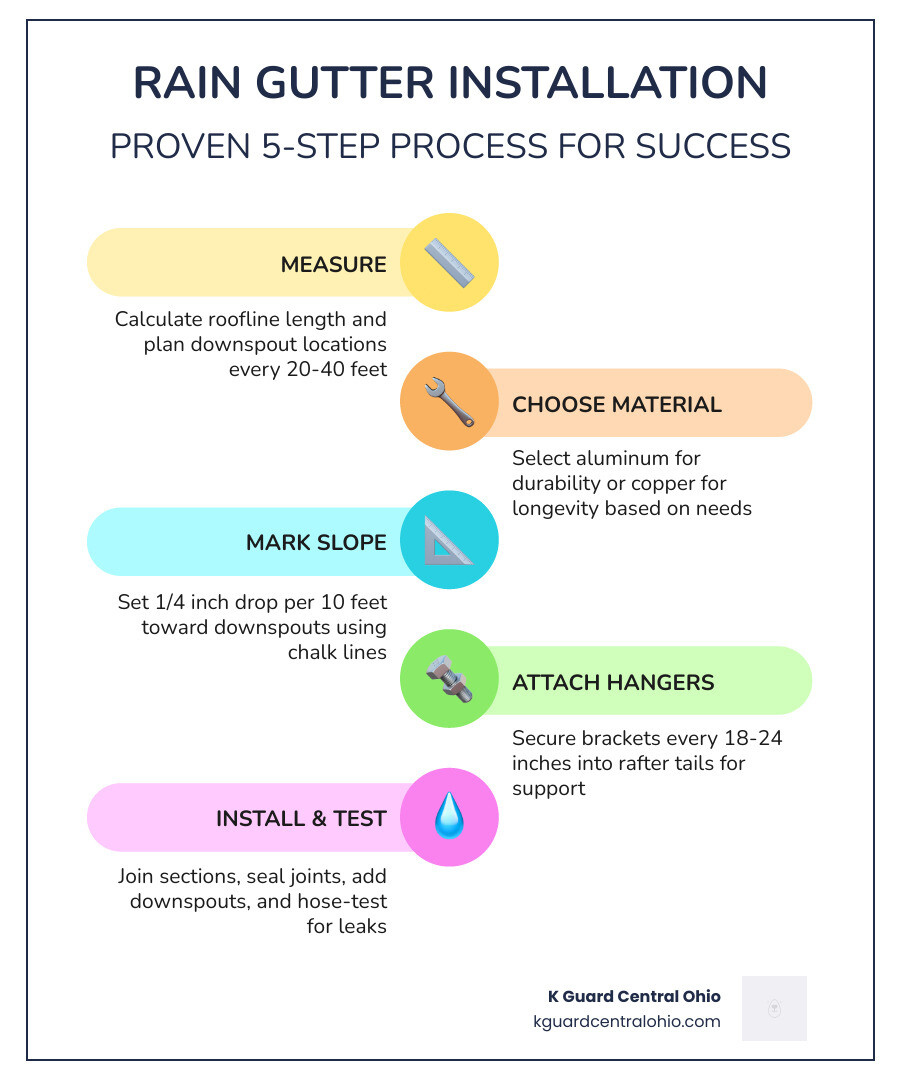
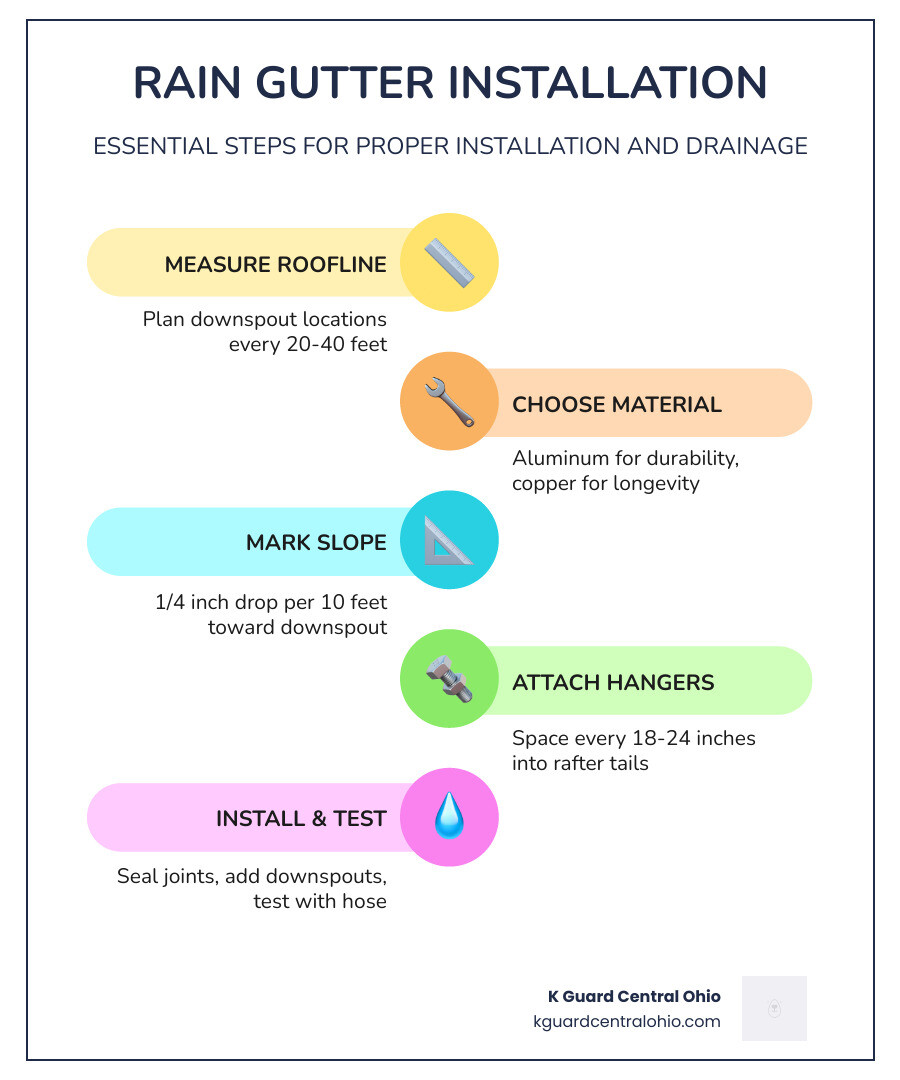
- Measure your roofline and plan downspout locations (one every 20-40 feet)
- Choose your material — aluminum is the most common; copper lasts longest
- Mark a slope on the fascia — 1/4 inch drop for every 10 feet toward the downspout
- Attach hangers every 18-24 inches into rafter tails
- Cut and join gutter sections, sealing all joints and end caps
- Install downspouts and direct water at least 4 feet from the foundation
- Test the system with a garden hose and check for leaks or standing water
Without gutters, rainwater runs straight off your roof and pools near your foundation — causing soil erosion, basement flooding, and structural cracks that can cost thousands to fix.
This guide walks you through the full process, from planning and measuring to installation and long-term maintenance.
I’m Rich Mannino, General Manager of K-Guard Leaf Free Gutters, and I’ve spent nearly two decades working in rain gutter installation and gutter protection systems for homeowners across Central Ohio and beyond. I’ll share the professional standards and hard-won insights that separate a gutter system that lasts from one that fails after the first hard rain.
Planning and Measuring Your System
Before you ever climb a ladder, you need a solid plan. A successful rain gutter installation begins on the ground with a tape measure and a sketch of your home’s perimeter. We often see homeowners underestimate the complexity of their rooflines, especially with the intricate architectural details found in modern Central Ohio homes.

The primary goal of your system is foundation protection. When water falls off the roof without a gutter, it creates a “drip line” that erodes the soil, eventually leading to basement leaks and foundation settling. To prevent this, you must measure every eave where water sheds. Remember to add about 10% to your total linear footage to account for waste, overlaps at the joints, and those “oops” moments that happen during cutting.
Your system components include more than just the troughs. You’ll need end caps, miters (for corners), downspouts, elbows, and hangers. These parts are all mounted to your fascia boards—the long horizontal boards that run along the edge of your roof. If these boards are rotted, your new gutters won’t have a prayer of staying attached. Always inspect the wood first!
Determining the Right Size for Your rain gutter installation
Not all gutters are created equal. The size you need depends heavily on two factors: your roof pitch (how steep it is) and the average rainfall intensity in Central Ohio.
Standard residential gutters are 5 inches wide, which works for most average-sized homes. However, if you have a very steep roof or a large surface area, water moves much faster and in higher volumes. In these cases, 6-inch gutters are the professional choice. They can handle significantly more water without overflowing. If you are curious about how these choices affect your budget, you can find more info about gutter pricing to help you decide.
Why Material Quality Matters
When it comes to rain gutter installation, the material you choose dictates how long you’ll be worry-free.
- Vinyl: Affordable and easy for DIYers, but it can become brittle in our cold Ohio winters and may crack over time.
- Aluminum: The industry standard. It’s lightweight, rust-proof, and can be painted to match your trim. We recommend heavy-duty aluminum for its long-term durability.
- Copper: The “forever” material. It can last up to 50 years and develops a beautiful patina, but it costs over $20 per linear foot.
For most homeowners, the real debate is between sectional gutters (sold in 10-foot pieces at big-box stores) and seamless gutters. Sectional gutters have seams every 10 feet, which are notorious for leaking over time. For a deeper dive into the pros and cons of these materials, check out this guide on How to Install and Replace Rain Gutters.
Understanding the Professional rain gutter installation Process
If you’ve decided to tackle this yourself, you’ll need to follow the same standards we use in the field. Professional rain gutter installation isn’t just about screwing metal to wood; it’s about managing the physics of moving water.

First and foremost: ladder safety. Always have a partner hold the base of the ladder. Once you’re up there, the first step is marking your “high point.” This is usually at the end of a run furthest from the downspout. From there, you’ll snap a chalk line with a 1/4-inch slope for every 10 feet of run. This slight angle ensures that gravity does its job and water flows toward the exit rather than sitting and stagnating.
Professional Standards for a Successful rain gutter installation
To achieve a “precision pitch,” we use levels and string lines to ensure there are no “rainbows” (high spots in the middle) or sagging sections. Another critical standard is hanger spacing. In Central Ohio, we deal with heavy snow and ice. Because of this, we recommend spacing your internal hangers every 18-24 inches. This provides the structural integrity needed to support the weight of wet snow without the gutters pulling away from the fascia.
Joint sealing is where most DIY projects fail. You must use a high-grade, waterproof silicone sealant on all end caps and seams. A pro tip: always overlap your joints in the direction of the water flow—think of it like shingles on a roof—so water passes over the seam rather than into it. For a look at the technical mechanics behind this, see How It Works. You can also find a great breakdown of the mechanical steps in this guide on How to Install Rain Gutters in 8 Steps – This Old House.
Optimizing Downspouts and Extensions
Downspouts are the “exhaust system” of your gutters. As a rule of thumb, you need one downspout for every 20-30 feet of gutter. If you have a particularly large roof section, you might need more to prevent the trough from overflowing during a May downpour.
When installing downspouts, use wall straps every 5-6 feet to secure them against the house. Perhaps the most important part of the entire rain gutter installation is the extension at the bottom. You want to direct water at least 4 feet away from your foundation. If you don’t, all that hard work collecting the water is wasted as it just soaks right back into your basement walls. For more on this, check out our guide on How to Install Downspouts in 5 Simple Steps.
Common Pitfalls: Repairing vs. Replacing Traditional Systems
Sometimes, an old system can be saved, but often, repairs are just a band-aid on a bigger problem.
If you notice sagging sections, it usually means the hangers have pulled out of the wood, likely because the fascia board is rotted. Leaking joints can sometimes be cleaned and re-sealed, but if the metal is corroded or rusted through (common in old galvanized steel), replacement is the only real answer.
| Issue | Repair Cost (Est.) | Replacement Indicator |
|---|---|---|
| Minor Leak | $50 – $150 | Widespread rust or corrosion |
| Sagging | $75 – $200 | Rotted fascia boards |
| Clogging | $100 – $250 | Frequent overflows despite cleaning |
When you reach the point where the cost of repairs starts to rival the cost of a new system, it’s time to look at Solving Your Gutter Woes with a permanent fix.
The Hidden Costs of Traditional Gutter Maintenance
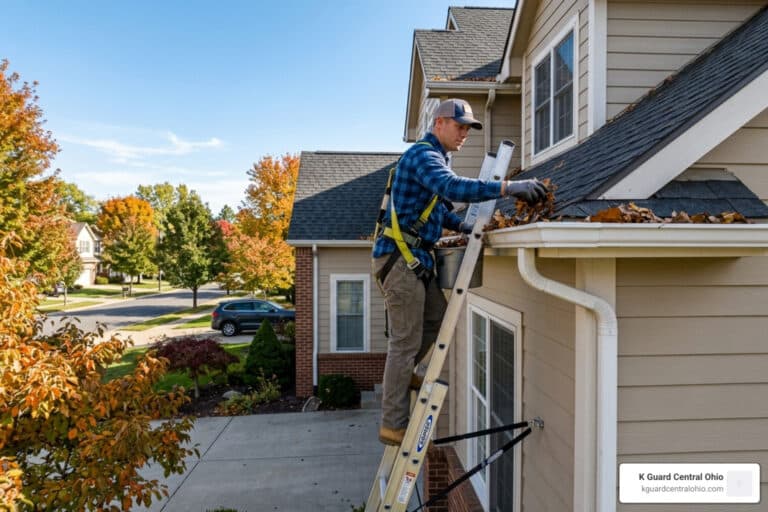
Traditional gutters are high-maintenance. To keep them working, you’re looking at biannual cleaning—once in the spring to clear out maple seeds and once in the fall for the leaves. If you have a lot of trees, you might be up on that ladder four times a year.
The “hidden cost” isn’t just the $150-$300 you pay a pro to clean them; it’s the risk of a fall or the damage caused when you forget to clean them. Clogged gutters lead to ice dams in the winter and mosquito breeding grounds in the summer. When you calculate the time and money spent over 10 years, traditional gutters are much more expensive than they seem. Learn more about Unpacking the True Cost of New Gutters and Downspouts to see the full financial picture.
The K Guard Advantage: Seamless Solutions and Integrated Guards
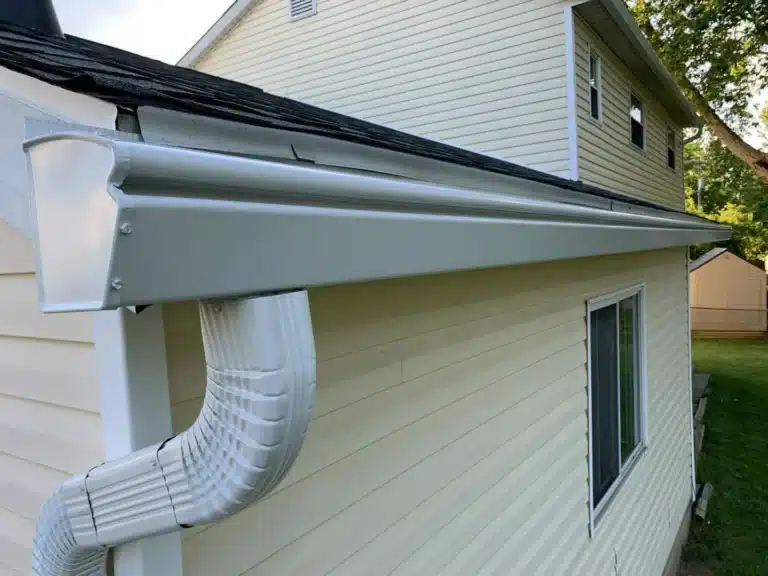
This is where we do things differently. While a DIY rain gutter installation uses 10-foot sections that are prone to leaks, our professional team uses a K Guard seamless gutter machine. We roll-form the gutters right in your driveway to the exact length of your roofline. No seams means no leaks.
Professional installation also solves the safety issue. Multi-story homes or steep roofs are dangerous for the average homeowner. Our team is trained in specialized fabrication and high-altitude safety, ensuring the job is done right without any trips to the emergency room. If you’re considering hiring help, read our tips on Hiring a Gutter Contractor: What You Need to Know Before You Install.
Why K Guard Changes the Game
If you’re tired of the “ladder life,” K Guard is the ultimate solution. Our system isn’t just a gutter; it’s a fully integrated, high-capacity hooded system.
- Lifetime Guarantee: We stand by our product with a lifetime guarantee for as long as you own your home.
- Elimination of Annual Gutter Cleaning: The patented hood uses liquid adhesion to pull water into the gutter while leaves and debris simply slide off the edge, ensuring the total elimination of annual gutter cleaning.
- Investment: With a $5,000 average installation cost, the system pays for itself by ensuring the elimination of annual gutter cleaning and protecting your home’s value.
- Strength: Our system is mounted with high-strength polymer hangers that won’t ever corrode.
For homeowners in Central Ohio, this is the gold standard for Gutter Guards Columbus.
Frequently Asked Questions about Gutter Systems
What is the correct slope for gutters to ensure proper drainage?
The standard professional rule is a 1/4-inch drop for every 10 feet of gutter run. This ensures water moves fast enough to carry away small debris but not so fast that it overshoots the downspout. Proper sloping is the number one way to prevent standing water, which attracts pests and causes rust. You can see more on this in Bob Vila’s guide to gutter installation.
How far apart should gutter hangers or brackets be placed?
In Central Ohio, we recommend spacing hangers every 18-24 inches. While some regions can get away with 36 inches, our snow loads are too heavy for that. By anchoring hangers into the rafter tails—the structural ends of your roof trusses—you ensure the system can support hundreds of pounds of ice. You can see our Installation standards for more detail.
When is it better to choose a professional K Guard installation?
If your home is two stories or higher, has a steep roof pitch, or if you simply want a “one-and-done” solution that requires zero maintenance, it’s time to call in the pros. DIY gutters will always require cleaning and will eventually leak at the seams. K Guard offers maintenance-free living with a lifetime guarantee. When you’re ready to choose, our guide on How to Pick a Gutter Replacement Company can help you vet your options.
Conclusion
Whether you choose to tackle your rain gutter installation as a weekend DIY project or invest in a professional system, the goal remains the same: protecting your home from the elements. As we move through May 2026, the weather patterns in Central Ohio continue to bring heavy, unpredictable rains that demand a high-performing drainage system.
Traditional gutters can work, but they require your constant attention and labor. If you’re ready to hang up the ladder for good and enjoy the peace of mind that comes with a lifetime guarantee and a maintenance-free home, we’re here to help.
At K Guard Central Ohio, we’ve built our reputation on providing the most durable, efficient, and attractive gutter solutions in the region. Don’t wait for the next big storm to find out your gutters aren’t up to the task. Contact Us today for a free estimate and join the thousands of Ohio homeowners who have upgraded to a K Guard system.