Gutter Sanity Check: The Average Price for Guttering and Fascias
What You’ll Actually Pay for Guttering and Fascias
If you’re trying to nail down the price for guttering and fascias before calling a contractor, here’s a fast answer:
| Component | Typical Cost (US) |
|---|---|
| Guttering only (uPVC/aluminium) | $40–$95 per linear foot installed |
| Fascia replacement | $1–$20 per linear foot (material-dependent) |
| Full roofline (gutters + fascias + soffits) | $2,000–$5,500 for most homes |
| Average house installation | ~$5,000 |
| Scaffolding (two-storey) | $250–$600 added cost |
Costs vary by property size, material choice, access requirements, and your location.
Getting a quote for new guttering and fascias can feel overwhelming — especially when two contractors give you wildly different numbers for the same job. That sticker shock is real, and it’s common. Labour, scaffold hire, waste disposal, and the condition of your existing roofline all quietly pile onto what looks like a straightforward material cost. Most homeowners are surprised to learn that the guttering materials themselves are often the smallest part of the bill.
The average full installation sits around $5,000 — but knowing why it costs that much is what helps you spot a fair quote versus a risky one.
I’m Rich Mannino, General Manager of K-Guard Leaf Free Gutters, and after nearly two decades helping homeowners navigate the price for guttering and fascias, I’ve seen every kind of quote — the honest ones, the lowball ones, and the ones that hide the real costs until the job is already underway. In the sections ahead, I’ll walk you through exactly what drives roofline costs so you can budget with confidence.
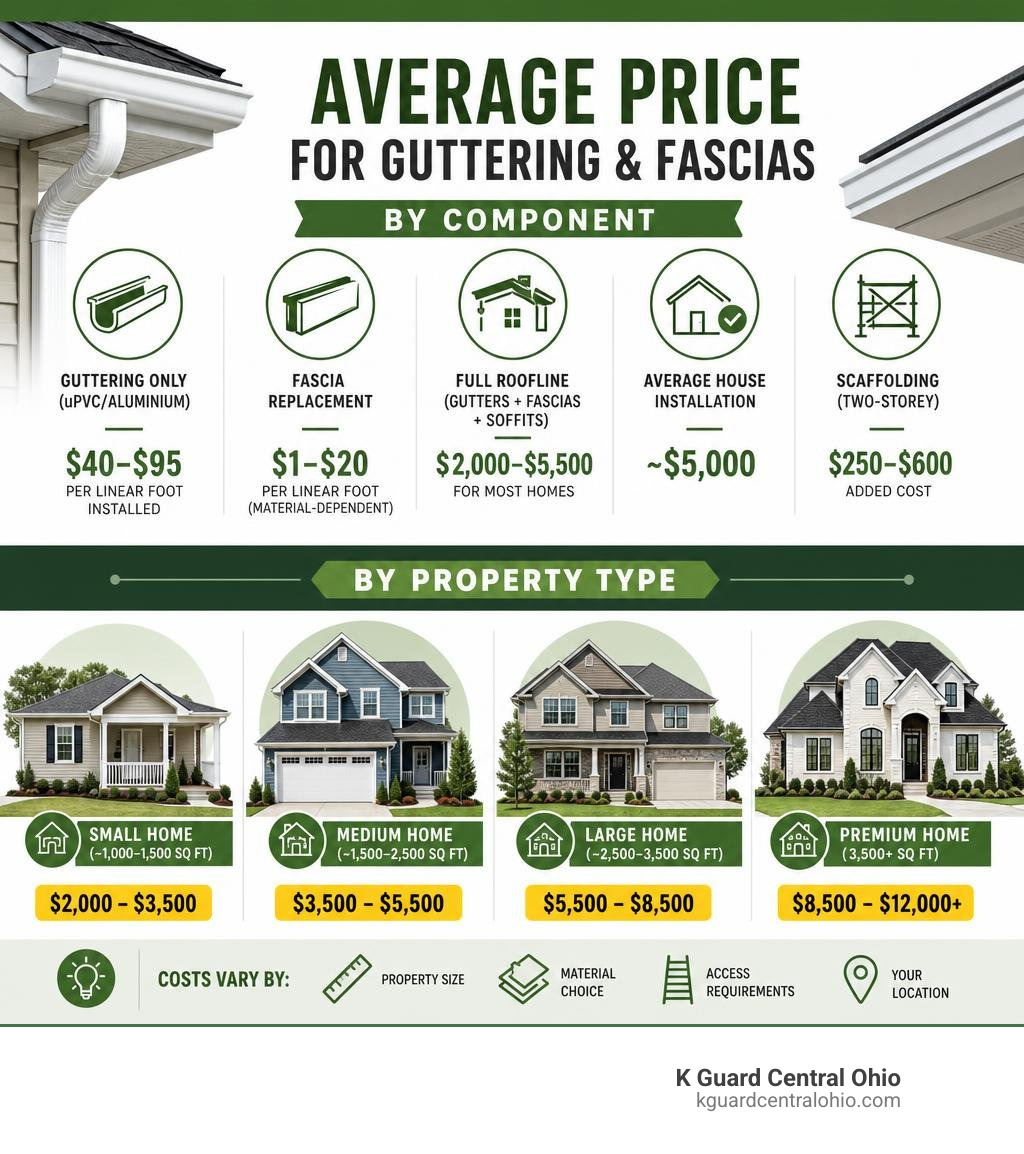
Simple guide to price for guttering and fascias terms:
Understanding the Average Price for Guttering and Fascias in 2026
When we talk about the overall price for guttering and fascias, we are looking at a highly interconnected system. Your gutters don’t just float in the air; they are mounted directly onto your fascia boards. If your fascia boards are rotting, soft, or pulling away from the rafters, they cannot support the weight of heavy, water-filled gutters. Conversely, if your gutters clog and overflow, water spills directly backward over the fascia, rotting the wood and ruining your soffits.
This is why we almost always recommend assessing both components at the same time. Doing so prevents you from paying for labour and access equipment twice.
The total length of your roofline (measured in linear feet) is the primary baseline for your estimate. However, your property’s architectural layout plays an equally massive role. To give you a clear picture of how these costs distribute, we have put together a breakdown of what you can expect to pay for a full roofline overhaul based on typical home layouts in Central Ohio as of June 2026.
| Property Type | Estimated Linear Feet | Average Price Range (Full Replacement) |
|---|---|---|
| Single-Story Ranch | 120 – 150 ft | $2,000 – $3,500 |
| Standard Two-Story | 150 – 200 ft | $3,500 – $5,000 |
| Large Colonial / Custom Home | 200 – 300 ft | $5,000 – $8,500+ |
| Split-Level | 160 – 220 ft | $3,800 – $5,800 |
To dive deeper into how these estimates are built from the ground up, you can read our detailed breakdown on the real cost of gutter and downspout replacement in 2026.
Average Price for Guttering and Fascias by Property Type
Every home has its own personality, and unfortunately, some personalities are more expensive to outfit than others. The structural design of your home dictates how much material is required and how complex the installation process will be.
- Ranch Homes: These single-story properties are the most straightforward. Because they sit low to the ground, they rarely require complex scaffolding setups. The roofline is usually a continuous, straight run, which keeps both material waste and labour hours to a minimum.
- Two-Story Homes: Once you move to a second level, the complexity increases. Installers must navigate greater heights, requiring specialized safety equipment, taller ladders, or scaffolding. The physical effort of hauling heavy fascia boards and seamless gutters up to the second storey naturally increases the labour cost.
- Colonial Homes: Known for their symmetrical, stately designs, Colonials often feature extensive rooflines that wrap around the entire footprint of the house. They typically require multiple downspouts and precision-engineered miters (corners) to direct water away from the foundation safely.
- Split-Level Homes: These multi-level structures present unique challenges because the roofline is broken up into staggered, offset sections. This means more individual runs of guttering, extra end caps, more downspouts, and a higher count of custom-cut fascias and soffits.
For a closer look at budgeting for these specific layouts, check out Don’t Get Soaked: A Homeowner’s Guide to New Gutter Costs.
Cost Per Linear Foot for Roofline Materials
When analyzing your estimate, you will notice that materials are priced per linear foot. The material you choose acts as a sliding scale for your overall project cost, directly impacting how long your roofline will last.
- Traditional Wood Fascia: Wood is the classic choice, but it is highly susceptible to the elements. Moisture, pest infestations, and dry rot can quickly compromise its integrity. It requires painting every three to five years to stay weatherproof, meaning the low upfront cost ($1 to $3 per linear foot for materials) often hides high long-term maintenance expenses.
- Cheap Retail Vinyl: Vinyl gutters and fascias are lightweight and inexpensive upfront. However, they are prone to cracking under the intense freeze-thaw cycles we experience in Central Ohio. Over time, UV exposure makes vinyl brittle, leading to saggy runs and leaks at the seams.
- K-Guard Heavy-Duty Seamless Aluminum: This is the gold standard for long-term protection. Engineered from heavy-duty, high-grade aluminum, our seamless system is built to withstand heavy snow, ice, and torrential summer downpours. Because it is seamless, it eliminates the joints where traditional gutters fail. While the initial investment is higher, it completely eliminates the need for future replacements.
For a comprehensive breakdown of material pros, cons, and raw costs, explore our Cost of New Gutters 101 guide.
Key Cost Factors: What Drives Your Roofline Estimate?
If you have ever gathered multiple home improvement quotes, you know they can vary wildly. This isn’t necessarily because one contractor is trying to overcharge you; rather, it’s because a true professional accounts for every variable of your specific property to ensure a safe, long-lasting installation.
Beyond the raw material costs, several logistical factors dictate the final price for guttering and fascias.
- Property Height and Accessibility: The taller the home, the more challenging the work. If your home has landscaping, tight property lines, or steep slopes around the foundation, getting a stable footing for ladders or scaffolding becomes a time-consuming process.
- Waste Removal and Disposal: Tearing down old, heavy wooden fascias and rusted or bent gutters generates a significant amount of debris. A reputable contractor will include the cost of cleanup, hauling, and eco-friendly disposal fees directly in their initial quote.
- Existing Structural Damage: You never truly know what lies behind your old gutters until they are pulled away. If moisture has bypassed your shingles, the rafter tails (the wood ends that your fascia boards nail into) may be rotted. Repairing these structural rafter feet is essential before installing new fascias, which can add unexpected labour and material costs to the project.
Scaffolding and Access Requirements
Safety isn’t just a buzzword; it is a major operational cost. For many two-story and multi-level homes, working solely from ladders is neither safe nor efficient.
Scaffolding provides a stable, secure platform that allows our installers to handle long, heavy sections of seamless gutters and fascia boards with absolute precision. Setting up and tearing down scaffolding takes time and specialized equipment, which typically adds between $250 and $600 to the total project cost. While some budget contractors might offer to do the job entirely from ladders to cut corners, this often results in rushed workmanship and increased safety risks on your property.
To understand how access and safety gear factor into your bottom line, take a look at Don’t Get Soaked: A Homeowner’s Guide to New Gutter Costs.
Material Choices and Longevity
Investing in your roofline is a classic case of “buy nice or buy twice.” Let’s look at how different materials hold up over a 20-year span:
- Softwood Timber: Needs regular painting, sealing, and rot remediation. It typically lasts 10 to 15 years only if you are diligent with maintenance.
- uPVC / Vinyl: Requires minimal cleaning but is highly vulnerable to temperature swings. It often begins to warp, fade, or crack within 10 to 15 years.
- Standard Seamless Aluminum: Lasts 20 to 30 years. However, if left unprotected by gutter guards, it still requires annual cleaning and can suffer structural damage from heavy ice dams.
- K-Guard Leaf-Free Gutter System: Made from heavy-duty aluminum that will never rust or warp. Because our system features a fully integrated hood that prevents leaves and debris from ever entering the gutter, it completely eliminates clog-induced water damage. Backed by a lifetime warranty, it is designed to last for the entire lifespan of your home.
For more insights on material durability in our regional climate, read the How Much Does Gutter Replacement Cost in Ohio? 2026 Guide.
Full Replacement vs. Capping Over: Which is Best?
When exploring ways to lower the price for guttering and fascias, you will likely run across a process called “capping over” (sometimes called overcladding). This is the practice of leaving your old wooden fascia boards in place and simply covering them with a thin sheet of plastic or aluminum capping.
While capping over is cheaper upfront, it is a temporary cosmetic fix that can lead to severe structural consequences down the road.
We always advise a full replacement. Tearing away the old materials completely is the only way to inspect the underlying rafter tails for hidden rot, pest infestations, or mold. Installing new, solid materials ensures your roofline remains structurally sound for decades.
Learn more about identifying hidden damage and managing repair costs in our guide on rain gutter repair cost.
When to Choose Full Replacement
There are certain scenarios where capping over isn’t just a bad idea — it is structurally impossible. You must insist on a full, down-to-the-rafters replacement if you notice any of the following:
- Dry Rot: If the wood of your existing fascia is soft, spongy, or crumbling, it has lost its structural integrity. It cannot securely hold the heavy screws used to mount your gutter system.
- Pest Infestations: Squirrels, birds, wasps, and mice love to exploit soft, rotting wood to build nests in your attic. A full replacement seals these entry points permanently.
- Inadequate Ventilation: Your soffits play a critical role in venting your attic space. If you simply cover up old, unvented soffits, you trap heat and moisture inside your attic, leading to mold growth and premature shingle failure.
To understand the long-term financial benefits of doing the job right the first time, check out Don’t Get Drained: Unpacking the True Cost of New Gutters and Downspouts.
The Dangers of Cheap Fascia Capping
Capping over rotten wood is like painting over rust — it might look clean for a few months, but the underlying destruction continues unabated.
When you trap moisture behind a non-breathable vinyl or aluminum cap, you create a perfect, dark greenhouse environment for wood-decaying fungi. The rot will spread rapidly from the old fascia board directly into your roof’s rafter tails. What started as a cheap cosmetic upgrade can easily turn into an incredibly expensive structural roof repair.
Furthermore, because capped fascias are structurally weak, the weight of winter ice or heavy rains can cause the gutters to rip completely off the house, taking the capping and the rotten wood along with them. Our fully integrated system avoids this entirely by mounting securely to solid, freshly replaced wood, providing a permanent, worry-free solution.
To explore how proper sizing and professional installation protect your home’s structural integrity, read 5-Inch Seamless Gutters: What You Need to Know About Pricing.
The Ultimate Upgrade: Specialized Gutter Guard Systems
If you are already planning to replace your gutters and fascias, this is the absolute best time to consider upgrading to a specialized gutter guard system. Adding leaf protection after the fact often means retrofitting plastic screens that clip onto your existing gutters — screens that still require regular cleaning and can easily collapse under heavy snow.
A fully integrated, seamless system like K-Guard built during your initial installation offers a sleek, high-capacity, and incredibly durable solution. It protects your brand-new fascias from water exposure while keeping you safely off the ladder forever.
To see if this upgrade makes sense for your budget, read our article on Gutter Guard Costs and Whether They Are Actually Worth It.
Eliminating Annual Gutter Cleaning
Let’s be honest: nobody actually enjoys cleaning gutters. It is a dirty, smelly, and highly dangerous chore. Every year, thousands of homeowners suffer serious injuries from ladder falls.
Standard open gutters act as giant catch-alls for leaves, twigs, pine needles, and maple seeds. When these materials clog your system, water backs up, spills over your new fascias, and pools around your foundation.
The K-Guard system utilizes the physics of liquid adhesion. Rainwater flows over our specially curved hood and directly into the gutter, while leaves, debris, and pests are naturally shed over the edge. We are so confident in this design that we back it with a lifetime, 100% no-clog guarantee. If your gutters ever clog, we will come out and clean them for free.
For more information on how we design our systems to handle heavy Central Ohio storms, view our Gutter Installation Cost Columbus Ohio Survival Guide.
Lifetime Guarantees and Long-Term Value
When evaluating the price for guttering and fascias, it is crucial to look at the total cost of ownership.
A standard open gutter system might seem cheaper upfront, but when you factor in the cost of professional gutter cleaning twice a year (typically $150 to $300 per visit) or the cost of replacing warped vinyl gutters every decade, the expenses quickly add up. Over 15 to 20 years, you will easily spend thousands of dollars just maintaining a basic system.
With an average installation cost of approximately $5,000, the K-Guard system is a one-and-done home improvement. It protects your home’s foundation, preserves your beautiful new fascias, increases your property’s resale value, and gives you back your weekends.
Learn more about the engineering behind our system by visiting Why KGuard.
Frequently Asked Questions about Gutter and Fascia Costs
How long does it take to replace gutters, fascias, and soffits?
For a standard single-story or two-story home, a professional crew can typically complete a full replacement in one to two days. Larger homes with complex rooflines or extensive rot repairs may take three days. While weather delays (such as active rain or high winds) can occasionally shift the schedule, our team works efficiently to minimize any disruption to your daily routine.
Can you replace soffits and fascias without removing the gutters?
Technically, it is possible in very rare cases, but it is highly inefficient and rarely recommended. Because your gutters are mounted directly to the fascia boards, trying to replace the wood behind them without taking the gutters down is incredibly difficult. It often results in damaged gutters and poor sealing. Removing the old gutters first is the only way to ensure the new fascia is installed flat, level, and structurally secure.
What are the warning signs that my roofline needs immediate replacement?
You should look closely at your roofline at least twice a year. The most common warning signs include:
- Peeling, flaking, or cracking paint on your wooden fascias.
- Visible sagging in your gutter runs or spaces where the gutter is pulling away from the wood.
- Damp patches, water stains, or active mold growth on your interior ceilings or inside your attic.
- Pest activity, such as birds or squirrels constantly nesting near your eaves.
- Water spilling over the sides of your gutters during a normal rainstorm.
Conclusion
Your roofline is your home’s first line of defense against water damage, erosion, and structural rot. While keeping an eye on the price for guttering and fascias is an important part of home maintenance, choosing the cheapest option often leads to expensive repairs down the road.
At K Guard Central Ohio, we believe in providing permanent, worry-free solutions. Our fully integrated, leaf-free gutter system completely eliminates the need for annual gutter cleaning and is backed by a lifetime guarantee. With an average installation cost of approximately $5,000, it is an investment that pays for itself in safety, home protection, and peace of mind.
Ready to protect your home for a lifetime? Learn more about our flexible Financing options or take a closer look at our system by visiting Explore K-Guard Products.