Detailed Guide to Gutter Lifespan
How Long Do Gutters Really Last? (The Quick Answer)
Gutter lifespan varies widely depending on the material, installation quality, and how well they’re maintained. Here’s a fast breakdown:
| Gutter Material | Average Lifespan |
|---|---|
| Vinyl | 10-20 years |
| Aluminum | 20-30 years |
| Galvanized Steel | 20-30 years |
| Copper | 50-100 years |
| Zinc | 80-100 years |
Most homeowners have aluminum gutters, which means a typical gutter system needs replacement roughly once every 20 to 30 years — though poor maintenance or harsh weather can cut that timeline nearly in half.
Gutters don’t get much attention until something goes wrong. But they’re quietly doing one of the most important jobs on your home: keeping water away from your foundation, siding, and roof structure. When they fail early, the damage they leave behind is almost always more expensive than the gutters themselves.
In Central Ohio, where freeze-thaw cycles, heavy rainfall, and falling debris put constant stress on gutter systems, knowing your material’s expected lifespan — and the warning signs of failure — can save you thousands in preventable repairs.
This guide covers everything you need to make a smart decision: which materials last longest, what shortens gutter life, when to repair versus replace, and how the right system can protect your home for decades.
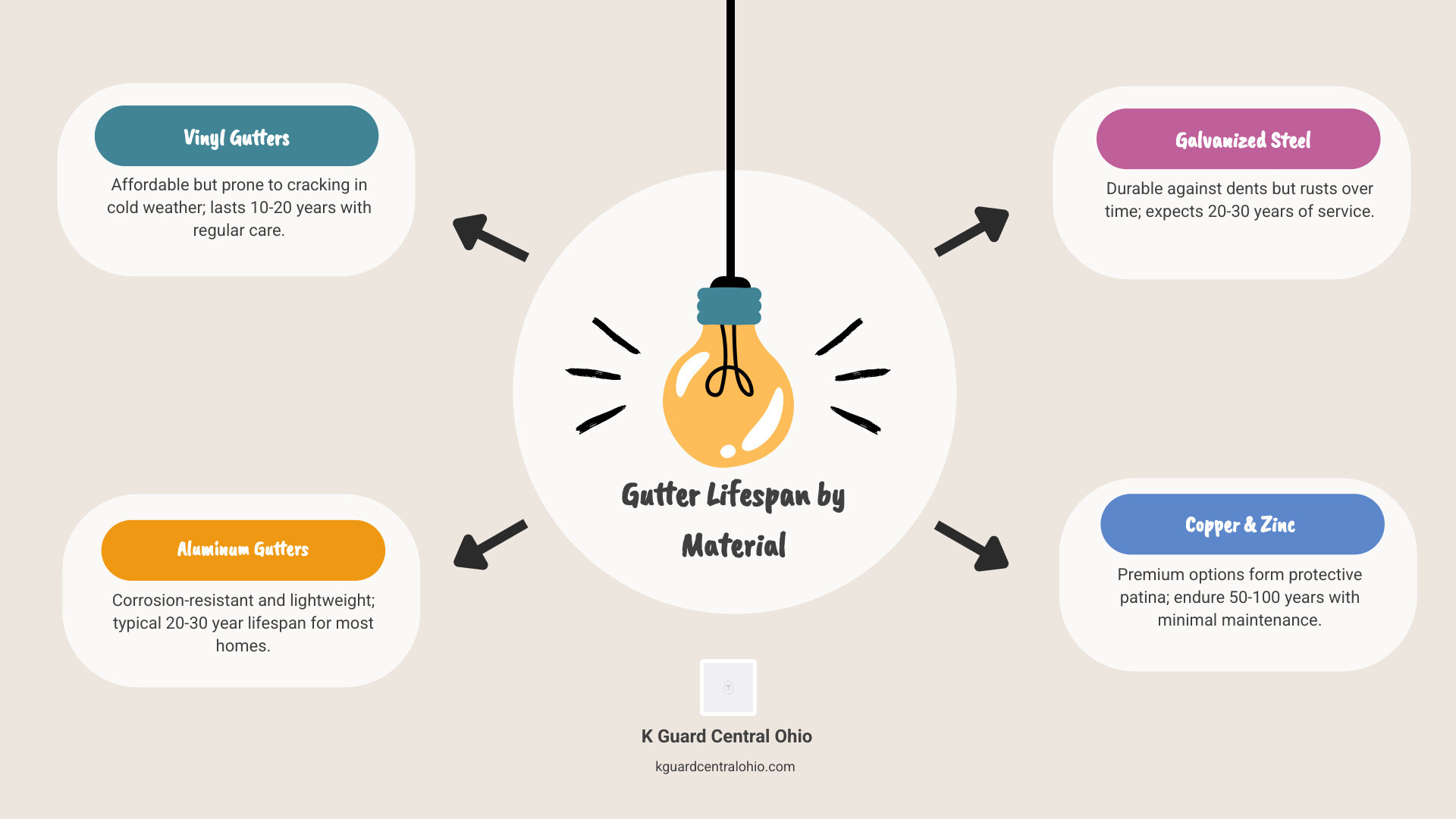
Average Gutter Lifespan by Material
When we talk about gutter lifespan, the material is the single most significant predictor of how many birthdays your gutters will celebrate. While a budget-friendly option might seem appealing today, it could end up costing you more in labor and replacement costs just a decade down the road.
As of April 2026, the industry has seen a massive shift toward more durable materials. Gone are the days when flimsy plastic was the standard. Today, homeowners are looking for longevity. Here is how the most common materials stack up:
| Material | Expected Years | Best For |
|---|---|---|
| Aluminum (.032) | 20-30+ Years | Most residential homes; great balance of cost/durability. |
| Vinyl (PVC) | 10-20 Years | Budget-conscious projects in very mild climates. |
| Galvanized Steel | 20-25 Years | High-strength needs, though prone to eventual rust. |
| Copper | 50-100 Years | Historic homes and luxury builds; “forever” gutters. |
| Zinc | 80-100 Years | High-end custom homes; self-healing properties. |
Vinyl gutters are often the “short-term” choice. While they don’t rust, they are notorious for becoming brittle. In our Central Ohio climate, the constant swing between summer heat and winter freezes causes vinyl to crack and warp. You can learn more about these differences in this article on How Long Do Gutters Last on a House? Gutter Lifespan For Aluminum, Vinyl & More.
If you are looking for a system designed to go the distance, you can explore Our Products to see how high-quality engineering changes the math on durability.
Aluminum Gutter Lifespan and Performance
Aluminum is the undisputed heavyweight champion of the gutter world, and for good reason. It doesn’t rust, it’s lightweight, and when installed correctly, it offers an impressive gutter lifespan.
However, not all aluminum is created equal. Many “big box” stores sell .027-gauge aluminum, which is thin and prone to denting from a stray ladder or a heavy snow load. At K Guard, we advocate for heavy-duty .032 aluminum coil. This thicker gauge provides the structural integrity needed to survive 20 to 30 years or more.
One thing to watch for with aluminum is color fading. Typically, the factory finish on quality aluminum will look great for about 15 to 20 years before you notice significant chalking or fading. While the metal itself is still fine, the aesthetic decline often prompts homeowners to consider a refresh. For a deeper dive into aluminum durability, check out Understanding Durability: How Long Do Gutters Last?.
Premium Materials: Copper and Zinc
If you want to buy gutters once and never think about them again, copper and zinc are the gold standards. Copper gutters can easily last 50 to 100 years. Over time, they develop a beautiful green patina that acts as a protective layer against the elements. This “self-healing” patina is why you see copper on 100-year-old historic buildings that still have functioning drainage.
Zinc is similar, often lasting 80 to 100 years. Like copper, it develops a patina that protects the underlying metal. These materials are investments, but they offer unparalleled aesthetics and longevity. If you’re interested in how these premium looks can be replicated or integrated, see our Color Options.
Factors Influencing How Long Gutters Last

Why do some gutters last 30 years while others fail in seven? It’s rarely just bad luck. Several environmental and physical factors play a role in the gutter lifespan of your home.
- Installation Quality: You could buy the most expensive copper gutters in the world, but if they aren’t sloped correctly, they will fail. Proper “pitch” ensures water actually moves toward the downspouts rather than sitting in the bottom of the trough, which leads to corrosion and weight-related sagging.
- Nearby Vegetation: If your home is nestled under a canopy of beautiful Central Ohio oaks or maples, your gutters are under constant assault. Debris traps moisture against the metal and adds immense weight, which can pull the hangers right out of your fascia board.
- Maintenance Habits: This is the big one. Gutters that are cleaned twice a year almost always outlast neglected ones. Stagnant water is the enemy of any metal system.
To see how professional standards can change the trajectory of your system’s life, look into our Installation process. For more on the reality of gutter durability, read How long do residential and commercial gutters really last?.
Maximizing Gutter Lifespan with Seamless Systems
If you look at old-school gutters, you’ll see seams every 10 or 20 feet. These seams are held together with sealant and screws. Over time, the sealant dries out, the metal expands and contracts at different rates, and—you guessed it—leaks form.
Seamless gutters are custom-extruded on-site to the exact length of your roofline. Because there are no breaks in the straight runs, there are far fewer places for leaks to start. This significantly boosts the gutter lifespan because you don’t have water dripping onto your fascia board, causing rot. Seamless aluminum gutters can easily last 25 to 35 years when maintained, compared to the 10 to 15 years often seen with sectional “DIY” kits. Discover more in The Life Expectancy of Seamless Gutters: What You Need to Know.
Impact of Local Climate and Weather
In Central Ohio, our gutters have to be tough. We deal with the “Big Three” of gutter destruction:
- Heavy Snow: The weight of snow and ice sitting in a gutter can exceed hundreds of pounds.
- Ice Dams: When heat escapes your roof and melts snow, it refreezes in the gutter, creating a dam that pushes water back under your shingles.
- Freeze-Thaw Cycles: Water expands when it turns to ice. If water is trapped in your gutters or seams, it can literally rip the metal apart as it freezes.
Our local expertise helps us design systems that stand up to these specific Midwestern challenges. You can learn more About Us and our history in the region.
Signs Your Gutters Need Replacement

How do you know if you’re reaching the end of your gutter lifespan? Sometimes the signs are subtle, and sometimes they’re as obvious as a waterfall in your front yard.
- Loose Gutter Spikes: If you see large nails (spikes) pulling out of the gutter, it’s a sign of age. Most modern installers haven’t used spikes in over 20 years—we use hidden hangers now. If you have spikes, your gutters are likely at least two decades old and ready for retirement.
- Foundation Cracks: If you notice cracks in your home’s foundation or water in the basement, your gutters are failing to move water far enough away.
- Peeling Paint: Water overflowing from clogged or sagging gutters will run down your siding and fascia, causing paint to bubble and peel.
- Sagging: If the gutters look like they are “dipping” or pulling away from the house, the internal fasteners have likely failed, or the fascia board behind them is rotting.
You can see examples of what “failing” versus “healthy” gutters look like in our Photos gallery. For a checklist of warning signs, check out How Long Do Gutters Last?.
Identifying the End of Your Gutter Lifespan
Beyond the obvious breaks, look for rust spots (orange or red dust) and “tiger striping”—black streaks on the front of the gutters that indicate constant overflowing. If you find yourself up on a ladder every month to fix a new leak or re-attach a bracket, you have reached the end of the road.
Our system is designed to eliminate these common points of failure. Learn How It Works to see the difference.
Repair vs. Replacement Decisions
We often get asked: “Can’t you just patch it?”
If you have a single leak at a corner or one loose bracket, a repair is a great, cost-effective choice. However, if the metal is corroded, the gutters are sagging in multiple spots, or you have widespread “pinhole” leaks, patching is like putting a band-aid on a sinking ship.
When you factor in the cost of labor for multiple repairs over three years, a full replacement often becomes the more financially sound decision. We even offer Financing to help make that transition easier on the family budget.
Maintenance Strategies to Extend Gutter Longevity
If you want to stretch your gutter lifespan to the max, you have to be proactive. Maintenance isn’t just about cleaning; it’s about inspection.
- Clean Twice Annually: Once in the late fall after the last leaves have dropped, and once in the spring to clear out “helicopters” (maple seeds) and oak tassels.
- Flush the Downspouts: A gutter is only as good as its exit strategy. Use a garden hose to ensure water flows freely through the downspouts and away from the foundation.
- Check the Pitch: During a rainstorm, grab an umbrella and walk around your house. If you see water pooling in the middle of a gutter run, the pitch needs to be adjusted.
For more maintenance tips and local advice, visit our Blog. You can also see how climate impacts maintenance in this guide on How Long Will New Gutters Last in Dayton, OH.
Professional Inspections and Cleaning
Sometimes it’s best to leave it to the pros. A professional inspection can catch small issues—like a loose hidden hanger or a failing sealant joint—before they turn into a basement flood. Our team has the experience to spot these red flags from a mile away. Get to know the people behind the service and Meet the Team.
The Role of Gutter Guards in Protection
The single best thing you can do for your gutter lifespan is to keep debris out of them entirely. Gutter guards reduce the weight of the system, prevent clogs that lead to rust, and stop pests (like mosquitoes and birds) from making a home in your eaves.
However, not all guards are effective. Some “add-on” screens still allow small debris to enter, which then becomes trapped and even harder to clean. The K Guard Leaf Free Gutter System is a completely integrated, seamless solution that is built to never clog. When you eliminate the debris, you eliminate the primary cause of gutter failure. Discover Why KGuard is the permanent solution for your home.
Frequently Asked Questions about Gutter Lifespan
How often should I clean my gutters to maximize their life?
For most homes in Central Ohio, twice a year is the minimum. If you have heavy pine tree coverage (which sheds needles year-round), you may need to clean them three or four times a year. Of course, with a leaf-free system, that number drops to zero!
Does a new roof require new gutters?
Not necessarily. If your gutters are less than 10-15 years old and in great structural shape, they can stay. However, if they use an old “strap” hanger system (which goes under the shingles), they usually need to be replaced when the roof is done. It’s often cheaper to do both at once because the contractors are already on-site.
Are seamless gutters worth the extra investment?
Absolutely. The reduction in leak points and the custom fit to your home’s slope mean they generally last 10 to 15 years longer than sectional gutters. When you look at the cost-per-year of the gutter lifespan, seamless is almost always the winner.
Conclusion
Your gutters are the unsung heroes of your home’s exterior. While a 20-to-30-year gutter lifespan is the average for aluminum, your actual results depend on the choices you make today. By choosing high-quality materials, ensuring a professional seamless installation, and protecting the system from debris, you aren’t just buying gutters—you’re buying peace of mind.
At K Guard Central Ohio, we believe in doing the job once and doing it right. Our integrated systems are designed to withstand the toughest Ohio winters and the heaviest spring downpours, all while keeping you off the ladder for good.
Ready to upgrade your home’s protection? Explore our high-performance gutter systems and see how we can help you extend your home’s longevity.