Don’t Get Sidetracked: Attaching Downspouts to Vinyl Siding
Why Knowing How to Install Downspout Straps to Vinyl Siding Protects Your Home
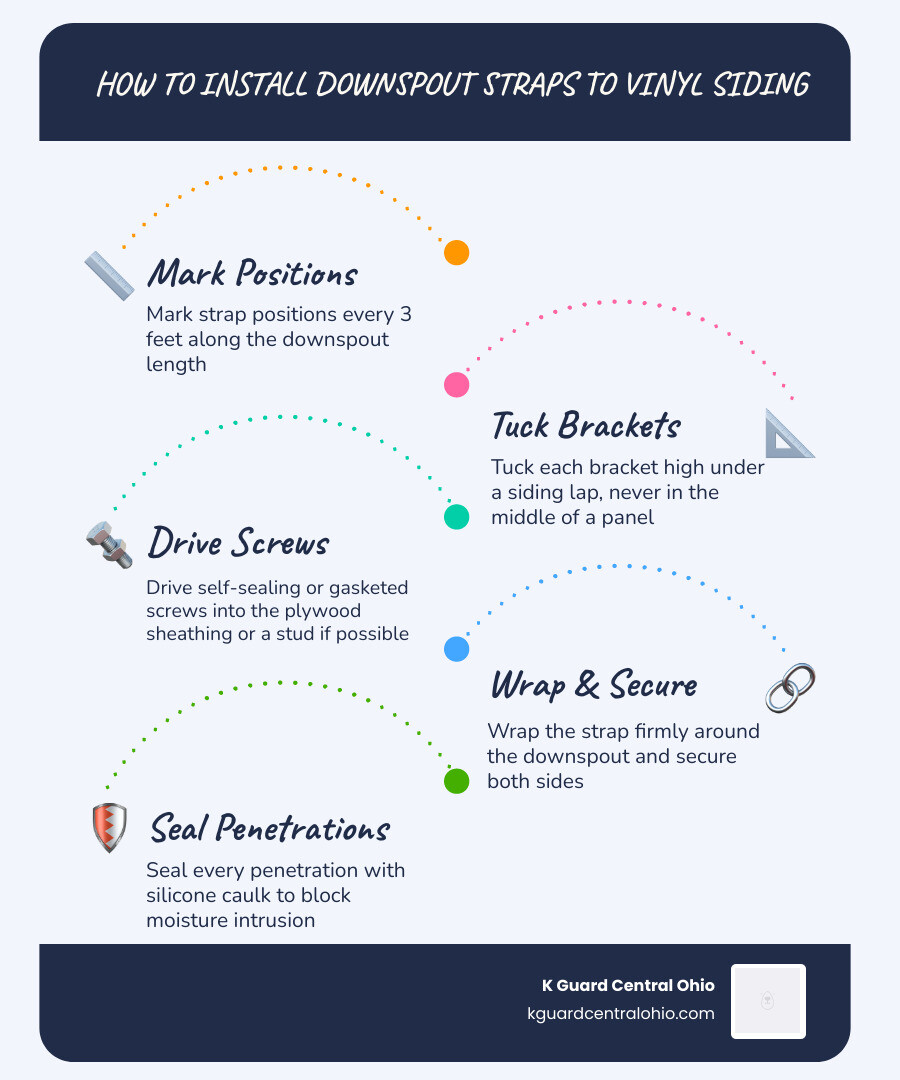
How to install downspout straps to vinyl siding the right way takes just a few steps:
- Mark strap positions every 3 feet along the downspout length
- Tuck each bracket high under a siding lap — never in the middle of a panel
- Drive self-sealing or gasketed screws into the plywood sheathing (or a stud if possible)
- Wrap the strap firmly around the downspout and secure both sides
- Seal every penetration with silicone caulk to block moisture intrusion
Vinyl siding looks simple to work with — but it buckles easily, expands in heat, and hides a weather barrier underneath that you really don’t want to compromise. A loose downspout isn’t just an eyesore. It can direct hundreds of gallons of water straight toward your foundation, and foundation crack repairs alone can run anywhere from $2,300 to $6,800.
Getting the attachment right matters more than most homeowners realize.
I’m Rich Mannino, General Manager of K-Guard Central Ohio, and with nearly two decades overseeing professional gutter and downspout systems, I’ve seen what happens when how to install downspout straps to vinyl siding is done wrong — and how simple it is to do it right. In this guide, I’ll walk you through everything you need to know to get a secure, leak-free installation.
Essential Tools and Materials for Vinyl Siding Installation
Before you climb the ladder, you need the right gear. Using the wrong fasteners or outdated tools can lead to cracked siding or a downspout that rattles every time the wind kicks up in Central Ohio.
To do this like a pro, gather the following:
- Impact Driver: While a standard drill works, an impact driver provides better screw grip and control, reducing the risk of the bit slipping and scratching your vinyl.
- Zip Screws: These are self-tapping screws specifically designed for gutter work. For vinyl siding, you want 1.5-inch zinc zip screws to ensure they reach through the siding and into the wood sheathing.
- Galvanized or Stainless Steel Straps: Never settle for plastic. Metal straps (also called leader straps or brackets) offer superior longevity.
- Silicone Sealant: A high-quality, exterior-grade silicone caulk is non-negotiable for waterproofing the screw holes.
- Measuring Tape and Level: Accuracy ensures your downspout looks straight and professional.
- Tin Snips or Hacksaw: Necessary if you need to trim the downspout sections to fit.
Using How to Install Downspout Straps: A Step-by-Step Guide as a reference, quality materials prevent “callback” repairs. At K-Guard, we emphasize that How It Works isn’t just about the gutter—it’s about the entire drainage ecosystem working in harmony.
How to Install Downspout Straps to Vinyl Siding Without Damage
Vinyl siding is a “floating” system. It is designed to move as temperatures change. If you pin it too tightly to the house, it will warp or buckle as it tries to expand in the summer sun. This is the biggest mistake DIYers make when learning how to install downspout straps to vinyl siding.
The Secret of the Siding Lap
The best way to attach a strap is to place the fastener high up, tucked just under a siding lap (the bottom edge of the panel above). This hides the penetration and allows the panel below some room to move.
Reaching the Sheathing
Your screws should never just “hang” in the vinyl. Vinyl is too thin to hold the weight of a downspout filled with rushing rainwater. You must ensure the screw penetrates the plywood sheathing or, ideally, a wall stud.
| Feature | Mounting Under a Lap | Middle-Panel Attachment |
|---|---|---|
| Risk of Buckling | Low (allows for expansion) | High (pins the panel) |
| Moisture Protection | Better (partially shielded) | Lower (fully exposed) |
| Aesthetics | Clean, hidden fasteners | Visible screw heads |
| Structural Integrity | Excellent | Variable |
If you are worried about direct penetrations, some homeowners use mounting blocks. These are plastic plates that provide a flat surface for the strap, though they require more intensive siding modification. For most standard Central Ohio homes, the “under the lap” method we use during Installation is the most efficient and safest for the siding. Following guides like How to Fasten a Downspout to Vinyl Siding | ehow can provide additional visual context for this process.
Proper Spacing and Placement for Maximum Support
A single 10-foot downspout can become incredibly heavy during a May thunderstorm. Without enough straps, the weight of the water—combined with high winds—can rip the entire assembly off the wall.
Recommended spacing for how to install downspout straps to vinyl siding
The “3-foot rule” is the industry standard. This means you should place a strap every 3 linear feet.
- One-Story Home (approx. 10 ft downspout): Use 3–4 straps.
- Two-Story Home (approx. 20 ft downspout): Use 6–7 straps.
- Three-Story Home (approx. 30 ft downspout): Use 9–10 straps.
In high-wind areas or for taller homes, we recommend increasing frequency to every 2 feet. This extra support prevents the “vibration” that often leads to screws backing out over time. You can find more details on general assembly in our guide on How to Install Downspouts in 5 Simple Steps.
Strategic placement of how to install downspout straps to vinyl siding
Don’t just place straps randomly. For maximum strength, place straps:
- Near the top: 2–8 inches from the top elbow.
- Over the seams: Placing a strap over the joint where two downspout sections meet provides “double duty” by securing the sections together while anchoring them to the house.
- Near the bottom: About 18 inches from the ground or the final elbow.
When wrapping the strap, ensure the “decorative” or finished side is facing outward. It should be snug, but don’t crank the screws so hard that you crush the downspout or dent the vinyl siding.
Proper placement also makes future maintenance easier. If you ever need to perform Unclogging Your Gutters: A Step-by-Step Guide from the Ground Up, having a securely fastened downspout allows you to work without fear of the pipe shifting.
Preventing Leaks and Moisture Intrusion
Every time you put a hole in your siding, you are creating a potential path for water to reach your home’s wood frame. Moisture intrusion can lead to mold, wood rot, and expensive structural repairs.
To prevent this, use self-sealing or gasketed screws. These screws come with a small rubber washer that compresses against the siding, creating a watertight seal. Even with these screws, we highly recommend applying a bead of silicone caulk to the back of the strap or directly over the screw head once installed.
As noted in How to Attach a Downspout to Your House: Expert Q&A, there is no “magic” trick, but the combination of reaching the underlying structure and sealing the hole is what separates a DIY job from a professional one.
Frequently Asked Questions about Downspout Straps
Should I use straps or clips for vinyl siding?
We always recommend metal straps over plastic clips. Clips (often called “C-clips”) only partially wrap around the downspout and rely on tension to hold it. In the fluctuating temperatures of Central Ohio, plastic clips become brittle and can snap during a freeze-thaw cycle. Metal straps wrap entirely around the pipe and are screwed in on both sides, offering far superior wind resistance and durability.
How do I prevent vinyl siding from buckling?
Buckling happens when the siding is “pinned” to the wall and cannot move. To avoid this:
- Don’t over-tighten the screws. Stop as soon as the head is flush with the strap.
- Use the “under the lap” method mentioned earlier.
- Ensure your pilot holes (if pre-drilling) are slightly larger than the screw shank to allow for a tiny bit of movement.
Can I attach downspouts to a rain barrel?
Yes, but you must account for the change in weight and positioning. When rerouting a downspout to a rain barrel using elbows or diverters, the “offset” creates new leverage points. You should add an extra strap near the diverter to ensure the weight of the water doesn’t pull the downspout away from the wall.
Conclusion: Long-Term Protection for Your Home
Learning how to install downspout straps to vinyl siding is a valuable skill for any homeowner, but it’s only one piece of the puzzle. A perfectly strapped downspout won’t help if the gutters themselves are clogged with debris or sagging from age.
At K-Guard Central Ohio, we provide a complete solution. Our specialized gutter guard system is designed to handle the heaviest Midwestern rainfalls while completely eliminating the need for annual cleaning. We offer a lifetime guarantee on our systems, ensuring that your home remains protected from foundation damage and moisture intrusion forever.
While the average professional installation is approximately $5,000, it is an investment that pays for itself by preventing the $15,000+ repairs associated with foundation failure and basement flooding.
Ready to stop worrying about your gutters? Discover Why K-Guard is the top choice for homeowners in Central Ohio, or contact us today for more information on our Professional Gutter Installation Services. We’ll make sure your downspouts—and your peace of mind—are securely fastened.