
How to Fix Gutter Problems Fast by Using Expert Tips
When You Need Fast Gutter Repair: What to Do Right Now
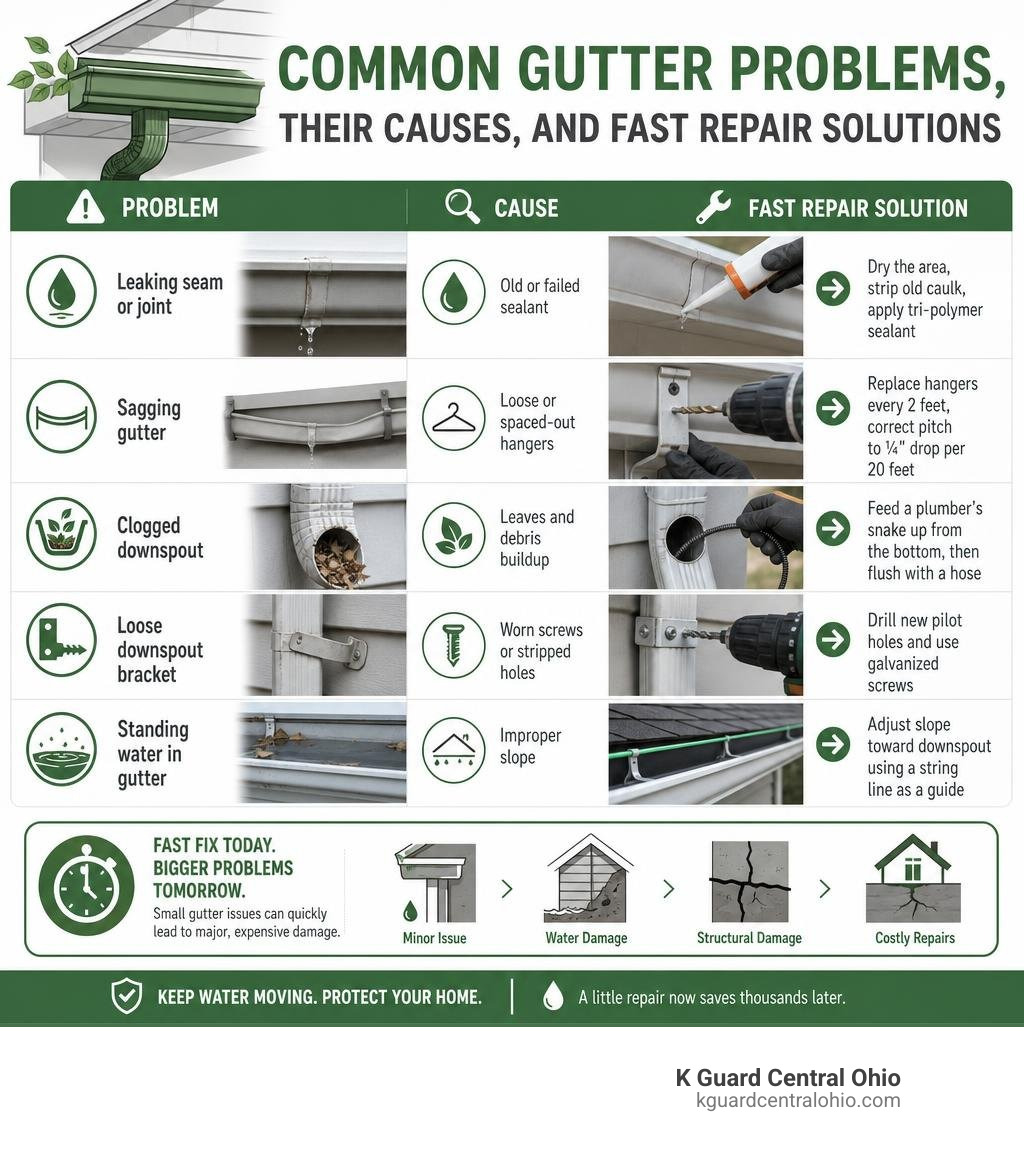
Gutter repair is urgent — here are the most common fixes homeowners need fast:
| Problem | Quick Fix |
|---|---|
| Leaking seam or joint | Dry the area, strip old caulk, apply tri-polymer sealant |
| Sagging gutter | Replace hangers every 2 feet, correct pitch to ¼” drop per 20 feet |
| Clogged downspout | Feed a plumber’s snake up from the bottom, then flush with a hose |
| Loose downspout bracket | Drill new pilot holes and use galvanized screws |
| Standing water in gutter | Adjust slope toward downspout using a string line as a guide |
Most single-issue repairs cost between $125 and $650. Left unchecked, a simple $300 fix can quietly grow into a $30,000+ foundation problem within just a few years.
Gutters do one job: move water away from your home. When they fail — whether from a clogged joint, a sagging run, or a loose downspout — that water hits your siding, soaks into the soil at your foundation, and starts doing serious damage. The longer you wait, the more expensive the problem gets.
This guide walks you through the exact steps to clean, diagnose, and fix the most common gutter problems yourself — and helps you know when it’s time to call a pro or consider a permanent upgrade.
I’m Rich Mannino, General Manager of K-Guard Leaf Free Gutters, and after nearly two decades managing gutter systems and overseeing installations across Central Ohio, I’ve seen how fast gutter repair problems escalate when they’re ignored. In this guide, I’ll share what actually works — based on real experience, not guesswork.
Why Urgent Gutter Maintenance and Repair Cannot Wait
Here in Central Ohio, our weather does not play nice with weak drainage systems. From sudden summer downpours to heavy winter snow loads and rapid freeze-thaw cycles, our home exteriors face constant stress. When your gutters are clogged or damaged, water doesn’t simply disappear. It pools, backs up, and overflows, attacking the most vulnerable parts of your home.
One of the biggest local threats is our soil. Much of Central Ohio features heavy clay soil, which acts like a sponge. When failing gutters dump hundreds of gallons of rainwater directly next to your home’s foundation, this clay soil expands rapidly. As it dries, it shrinks. This constant swelling and shrinking puts immense hydrostatic pressure on your basement walls. Ignoring a minor $300 gutter repair today can easily escalate into a catastrophic $30,000+ foundation crack or basement collapse in 5 to 7 years.
Winter brings its own set of expensive headaches. When debris traps water in your gutters during a freezing Central Ohio winter, that water freezes solid. The ice forces its way back under your shingles, creating devastating ice dams. Repairing the resulting damage to your ceilings, walls, and insulation can easily cost over $10,000.
To understand the financial breakdown of addressing these issues early, check out A Comprehensive Guide to Gutter Repair Cost.
The True Cost of Neglected Drainage Systems
When we inspect gutter systems across Columbus and the surrounding areas, we discover rotted fascia board wood on approximately 30% of our visits. This happens because overflowing water constantly splashes back onto the wooden boards behind your gutters. Once fascia wood rots, it loses its structural integrity, meaning it can no longer support the weight of your gutters.

Furthermore, water pooling near the foundation inevitably finds its way into your crawlspace or basement. It takes only a tiny hairline crack for hydrostatic pressure to force gallons of muddy water into your finished basement, destroying drywall, carpet, and personal belongings while inviting toxic mold growth.
To learn more about what to expect when your system starts to fail, read Rain Gutter Repair Cost: What to Expect When Your Gutters Go Down the Drain.
Navigating Storm Damage and Insurance Claims
Severe Midwest storms can bring high winds, massive hail, and falling tree limbs that twist gutter runs and tear downspouts completely free from the siding. If your home experiences sudden storm damage, it is crucial to act quickly.
First, perform emergency temporary weatherproofing if it is safe to do so, or call a professional to prevent immediate water intrusion. Second, document everything. Take clear, close-up photos of the twisted metal, missing brackets, and any dented sections.
Most homeowners’ insurance policies cover sudden storm damage, but they will quickly deny a claim if they see evidence of long-term neglect (like old rust or years of packed-in leaf debris). Having a documented professional inspection and clear photos will provide the proof you need to support your insurance claim and get your repairs covered.
Step-by-Step Guide to Cleaning and Clearing Clogs
Before you can perform any gutter repair, you must start with a clean system. Trying to seal a leak or adjust a slope when your gutters are filled with wet leaves and muck is a recipe for failure.
First, let’s talk safety. Ladder safety is the most critical part of this job:
- Set your ladder on solid, stable, and level ground.
- Never stand on the top three rungs of an A-frame ladder.
- Use a ladder standoff stabilizer to avoid resting the weight of the ladder directly against your aluminum gutters, which can easily dent them.
- Always wear heavy-duty work gloves to protect your hands from sharp metal edges, and wear nitrile gloves underneath if you are handling wet, decaying debris.
Manual Cleaning and Downspout Flushing
Manual cleaning is highly effective, especially when the debris is damp.
- Start Near the Downspout: Use a plastic gutter scoop or a garden trowel to scoop out the heavy debris, working away from the downspout so you don’t accidentally push more clogs into it. Dump the muck into a bucket hung from your ladder.
- Clear the Downspout: If water isn’t draining, you have a downspout clog. Feed a hand auger (plumber’s snake) up through the bottom elbow of the downspout, lock the collar, and spin the line to break up packed leaves and roof grit.
- Flush Out the Gutters: Use a garden hose with a spray nozzle to flush the remaining dirt toward the downspout. Pro tip: If your downspout connects to an underground tiling system, cover the open underground pipe with a bucket before flushing. This prevents the flushed debris from causing a secondary, highly expensive underground clog!
- Flush Again: Verify that water is flowing rapidly and completely through the system without pooling.
Clearing Gutters Safely with a Leaf Blower
If the debris in your gutters is completely dry, you can save yourself a lot of ladder climbing by using a leaf blower.
You can purchase a specialized gutter-cleaning attachment for your leaf blower. These kits typically include several rigid extension tubes and a U-shaped nozzle attachment that can extend your reach by 11 to 12 feet.
This allows you to stand safely on the ground while blowing dry leaves and pine needles out of your single-story gutters. Simply assemble the extension tubes, wear safety goggles to protect your eyes from falling debris, and walk slowly along the perimeter of your home, directing the air blast down into the gutter channels. Once finished, disassemble the extensions and sweep up the debris from your lawn or landscaping.
How to Perform Common Gutter Repair Tasks Yourself
If your gutters are clean but still dripping, sagging, or pulling away, it’s time to roll up your sleeves for some basic DIY repairs.
Sealing Joints for Cracked Gutter Repair
Sectional gutters rely on joints and seams that are held together by brackets and sealed with caulk. Because metal expands in the hot summer sun and contracts during freezing winter nights, this sealant naturally degrades and fails every 5 to 8 years.
To fix a leaking joint, you cannot simply smear new sealant over the old, leaking caulk. You must perform a proper repair:
- Wait for a dry spell; your gutters must be completely dry before applying any sealant.
- Use a putty knife or wire brush to completely scrape away the old, degraded sealant.
- Clean the area thoroughly with rubbing alcohol to remove any remaining residue or grease.
- Apply a generous bead of high-quality, weather-rated tri-polymer gutter sealant along the inside of the seam. Smooth it out with a gloved finger to ensure an airtight, waterproof seal.
For a detailed look at fixing structural cracks and splits, read Cracked Gutter Got You Down? Easy Fixes Revealed.
Correcting Gutter Pitch and Sagging Runs
If you notice standing water in a clean gutter, your system has a slope issue. Gutters must be pitched downward toward the downspouts to allow water to drain. The ideal slope is a 1/4-inch to 1/2-inch decline for every 20 feet of gutter run.
Sagging is often caused by outdated gutter spikes pulling out of rotted wood, or by builders spacing hangers too far apart (often 36 inches on builder-grade homes). To correct the pitch:
- Run a tight string line from the high end of the gutter run to the downspout, measuring to ensure a perfect 1/4-inch drop per 10 to 20 feet.
- Work on small sections at a time so the entire gutter run doesn’t collapse.
- Remove the old, loose hangers or spikes.
- Adjust the gutter section to align with your sloped string line.
- Install new heavy-duty hidden screw-in hangers. Space these support hangers every 2 feet along the gutter to ensure they can handle heavy ice and snow loads.
Securing Loose Downspouts and Hardware Upgrades
Downspouts frequently work themselves loose from the home due to wind or accidental bumps. If a downspout bracket has pulled out of your siding, do not try to screw it back into the same hole — the original hole is stripped and will not hold.
Instead, slide the bracket slightly higher or lower, drill new pilot holes, and secure the bracket using high-quality stainless steel fasteners or galvanized screws. Stainless steel and galvanized hardware provide superior corrosion resistance against wet weather, ensuring your downspouts stay anchored for years to come.
Gutter Repair vs. Full Replacement: Making the Right Choice
While basic repairs can extend the life of your system, gutters are not designed to last forever. Standard sectional gutters typically have a functional lifespan of up to 20 years if they are properly maintained. If your system is approaching or past this age, you may find yourself throwing good money after bad.
| Indicator | Choose Gutter Repair | Choose Full Replacement |
|---|---|---|
| Scope of Damage | Isolated to one or two sections, single leak, or loose bracket | Widespread warping, multiple sagging runs, seams leaking everywhere |
| System Age | Under 15 years old | Over 20 years old |
| Fascia Wood Condition | Solid and dry | Extensive rotting or soft spots behind the gutters |
| Structural Integrity | Metal is structurally sound; no rust-through holes | Severe rust spots, cracks, or split metal throughout |
| Cost Efficiency | Repair cost is under 50% of replacement | Total repair costs exceed 50% of a full replacement |
When to Choose Gutter Repair Over Replacement
If the damage to your gutters is isolated — such as a single crushed downspout elbow from a lawnmower, or a single leaking end cap — a targeted repair is highly cost-effective. A single-issue repair will typically cost you between $125 and $650, which is a drop in the bucket compared to the cost of a brand-new system.
However, if you notice structural warping along entire runs, or if water is constantly bypassing your gutters because the metal has twisted, a patch job won’t solve your problems. To explore professional solutions to these complex issues, check out Solving Your Gutter Woes: An Expert’s Take on Rain Gutter Solutions.
The Permanent Solution: K-Guard Leaf-Free Gutter System
If you are tired of climbing ladders, dealing with messy sealants, and worrying about the next heavy storm damaging your Central Ohio home, there is a permanent solution. At K Guard Central Ohio, we offer a completely integrated, leaf-free gutter system that changes everything.
Unlike standard sectional gutters or flimsy add-on gutter guards, the K-Guard system is a fully integrated, seamless system crafted from heavy-duty aluminum.
- Lifetime Guarantee: Our system is built to last a lifetime. It will never sag, pull away, or lose its pitch.
- Total Elimination of Annual Gutter Cleaning: Thanks to our patented hood design, leaves, pine needles, and roof grit are diverted completely away from your gutters, while rainwater is drawn smoothly into the channel. You will never have to clean your gutters again.
- Cost-Effective Investment: The average house installation for a high-quality K-Guard system is approximately $5,000. When you calculate the recurring costs of professional cleanings, wood rot repairs, and foundation maintenance over 10 to 20 years, K-Guard easily pays for itself.
Frequently Asked Questions About Gutter Maintenance
How often should I clean my gutters?
For standard gutter systems, we recommend cleaning them at least twice a year — once in the spring to clear out seed pods and blossoms, and once in the late fall after all the leaves have dropped. If your home is surrounded by a dense tree canopy, particularly oak or maple trees, you may need to clean them three or four times a year to prevent severe clogs.
What is the correct slope for proper gutter drainage?
Your gutters should have a downward pitch of 1/4-inch to 1/2-inch for every 20 feet of gutter run toward the downspout. If the slope is too flat, water will stand in the gutters, attracting mosquitoes and accelerating rust. If the slope is too steep, the water will rush too fast, overflowing the downspout opening during heavy downpours.
Do gutter guards completely eliminate the need for cleaning?
The short answer is: standard DIY gutter guards do not. Cheap plastic screens, mesh covers, and foam inserts still allow fine debris, pine needles, and roof grit to enter the gutter. Over time, this debris builds up inside, requiring you to unscrew and remove the guards just to clean out the system.
The only way to completely eliminate gutter cleaning is with a fully integrated, patented system like the K-Guard leaf-free gutter system, which uses liquid adhesion to guide water into the gutter while shedding all debris onto the ground.
Conclusion
Your gutters are your home’s first line of defense against water damage. While basic DIY gutter repair tasks like sealing minor leaks and tightening loose brackets can buy you some time, they are temporary fixes for an ongoing battle against the elements.
Taking care of your home shouldn’t involve risking your safety on a high ladder multiple times a year. If you are ready to protect your foundation, preserve your fascia boards, and eliminate the chore of gutter cleaning forever, it’s time to upgrade.
Ready to make the switch? Upgrade to a Leaf-Free Gutter System today and request your free estimate from our expert team at K Guard Central Ohio!