
Choosing the Best Gutter Cleaning Methods for Your Home
When deciding on the best gutter cleaning approach, you have to weigh budget, roof height, and physical effort. The right method depends heavily on what is actually sitting inside your gutter troughs. Broadleaf tree foliage acts completely differently than pine needles or dense organic silt.
Manual tools are the classic choice for homeowners on a strict budget. Simple plastic scoops, like the Amerimax Gutter Getter Scoop, cost under $10 and allow you to scrape out wet goop directly into a bucket. A helpful trick when scooping manually is to pinch the flexible plastic sides together so sludge doesn’t spill over the edges as you lift it. You can also flip manual gutter tools over to push debris under metal hanger brackets.
However, manual scooping fails if you don’t account for standard 1 to 1.5-inch roof shingle overhangs that block direct hand access into the trough. Furthermore, budget manual tools require you to climb up and down a ladder repeatedly.
For those who want to avoid ladder work altogether, ground-based tools like telescoping hose wands, wet/dry vacuum attachment kits, leaf blower extensions, and pressure washer wands offer viable alternatives.
| Tool / Method | Safety Level | Reach | Avg. Cost | Cleaning Speed | Key Limitation |
|---|---|---|---|---|---|
| Manual Scoop | Low (Ladder required) | Direct reach | $5–$15 | Slow | Roof shingle overhangs block access |
| Telescoping Hose Wand | High (Ground level) | 40–70 inches | $20–$40 | Moderate | Low pressure fails on heavy mud |
| Wet/Dry Vacuum Kit | High (Ground level) | Up to 11 ft | $30–$80 | Fast | Struggles with wet, heavy sludge |
| Leaf Blower Attachment | High (Ground level) | Up to 11 ft | $20–$50 | Very Fast | Blows messy debris all over yard |
| Pressure Washer Wand | Moderate (Kickback force) | Up to 9 ft | $40–$100 | Fast | Mud splatter, backpressure risks |
| K-Guard System | Maximum (No ladders) | Full perimeter | ~$5,000 | Instant (Self-cleaning) | Initial capital investment |
A common mistake with DIY leaf blower and vacuum extension kits is relying on friction-fit joints. Under heavy air movement, friction-fit tubes can blow apart mid-clean, leaving your tool stuck high in the gutter. Always look for attachment kits with threaded or twist-locking connections to keep everything locked securely in place.
Pros and Cons of Blowers, Vacuums, and Pressure Washers
Using powered lawn equipment to clean eavestroughs is popular because it speeds up the chore dramatically. However, each mechanical tool comes with distinct tradeoffs:
- Leaf Blower Attachments:
- Pros: Incredibly fast for clearing loose, dry autumn leaves. Universal flexible boot connectors allow you to attach extension tubes to blowers generating up to 120 MPH wind speeds. Blowers with flexible connecting tubes let you hold the power unit horizontally, reducing arm fatigue.
- Cons: Completely useless on packed, frozen, or wet organic mud. It also hurls wet leaves across your siding, windows, and lawn, creating a second cleanup job on the ground.
- Wet/Dry Vacuum Extension Kits:
- Pros: Running a vacuum on suction mode keeps leaf debris contained inside the canister rather than scattering it across your lawn. Kits like the Craftsman Wet/Dry Vacuum Gutter Cleaning Kit earn high marks for effectiveness because suction cleans out both dry foliage and small sludge pockets.
- Cons: Heavy wet leaves can quickly clog narrow 2.5-inch extension elbows. Commercial-grade gutter vacuums like the SkyVac Atom Sonic solve this issue with immense suction power, but carry a price tag near $4,000, making them more suitable for contractors than casual DIYers.
- Pressure Washer Sky Lances:
- Pros: Curved pressure washer extensions (like the Sun Joe SPX-SRL9 Sky Lance, rated for 1,800 to 4,000 PSI) effortlessly blast out dense dirt, pine needles, and stubborn mud dams.
- Cons: Water pressure can be dangerous if mismanaged. We recommend setting pressure washers to a maximum of 1,700 PSI for gutter work. Higher settings can easily strip paint, loosen gutter seams, or blast water upward under roof shingles, risking attic leaks. High-pressure wands also create a severe “mud shower” effect that covers the operator in dirty water.
Ground-Based Best Gutter Cleaning Options Without a Ladder
Working from ground level is by far the safest way to tackle gutter maintenance. When using ground extensions, you eliminate the single greatest hazard associated with home maintenance: falling from height.
To get the most out of ground-based tools, start by inspecting your roofline visually from a distance to locate major clogs. If you are using a garden hose wand (such as a telescoping wand extending 40 to 70 inches), connect it to a hot-water faucet if available during colder months to help loosen frozen buildup.
When operating high-reach extension tubes, maintain a 45-degree angle from the house foundation. Standing directly underneath the gutter line guarantees that dislodged gunk falls directly on your head. If you want to dive deeper into ground methods, check out our step-by-step guide on unclogging your gutters from the ground up.
Ground methods work exceptionally well for routine clearing, but heavily rooted “gutter gardens”—where weeds have taken root in accumulated silt—often resist ground wands because you lack the vertical leverage to pull stubborn root balls free. In those cases, manual removal or professional help becomes necessary before transitioning to a preventative routine.
Essential Ladder Safety Equipment and Ground-Level Safety Techniques
If you choose ladder-based cleaning, safety must be your top priority. Thousands of emergency room visits each year result from improper ladder setup during home maintenance.
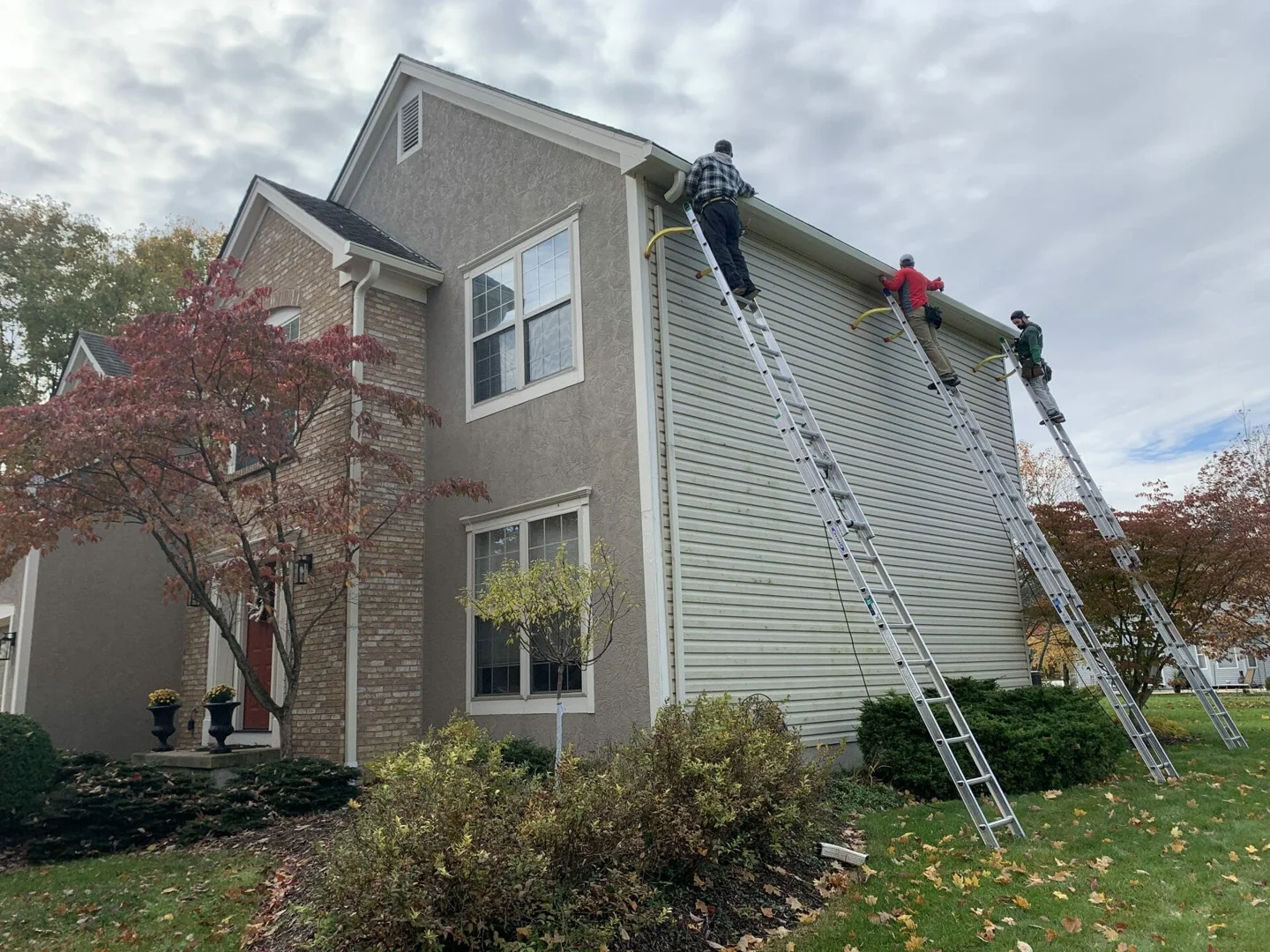
Never rest extension ladder rails directly against vinyl or aluminum gutter troughs. The weight of the ladder plus an adult can crush aluminum gutters, bending the metal channel out of shape and ruining the pitch.
To prevent crushing damage, always install a ladder standoff bracket (also called a ladder stabilizer). Standoff brackets attach to the top ladder rungs and spread the weight against your roof shingles or exterior siding instead of the fragile gutter rim. They also widen the ladder’s contact footprint, providing exceptional lateral stability.
If your property has sloped terrain, pair your setup with adjustable ladder levellers bolted to the base legs. Levellers ensure that both feet sit flat on uneven ground, preventing sideways tip-overs.
Essential Safety Gear for Ladder-Based Best Gutter Cleaning
Working safely from an extension ladder requires specialized protective gear:
- Heavy-Duty Work Gloves: Avoid flimsy cloth gloves or oversized leather riggers. Wear snug, water-resistant work gloves with textured grip palms. Tight-fitting thermal rubber gloves protect your fingers from icy sludge and sharp metal edges inside aluminum troughs while maintaining dexterity.
- Impact-Resistant Safety Glasses: Debris, decaying leaves, and splashing dirty water drop directly downward when you scoop. Eye protection is non-negotiable.
- Non-Slip Footwear: Rubber-soled work boots with defined heel arches keep your feet locked onto ladder rungs, even if shoes get muddy.
- Bucket Hooks & Multi-Faceted Hooks: Never attempt to carry a bucket in your hands while climbing. Use an S-shaped gutter hook to hang a heavy-duty bucket directly from the outer gutter edge or ladder rung, keeping both hands free to grip the side rails.
- Fall Protection Harness: For multi-story homes or steep roof pitches, secure yourself with an OSHA-compliant fall protection harness attached to a certified roof anchor point.
Signs of Clogged Gutters, Maintenance Frequency, and Service Costs
How do you know when your eavestroughs are failing? Watch for these critical warning signs around your exterior:
- Water Overflow: Rain pouring over the front edge of the trough like a waterfall during a moderate storm indicates a dense blockage or blocked downspout.
- Sagging Troughs: Heavy wet leaves, standing water, and accumulated silt add massive weight, pulling gutter hangers loose from the fascia board.
- Black Oxidation Streaks: Known in the industry as “tiger stripes,” dark vertical lines running down the front face of gutters occur when dirty water continuously overflows over the lip.
- Foundation Erosion: Gullies washed into your flowerbeds or small cracks appearing in basement walls signal that downspouts aren’t discharging water far enough from the house.

How often should you clean them? Standard guidelines recommend servicing eavestroughs at least twice a year. Schedule the first cleaning in late spring to remove oak tassels, flower petals, and maple seedpods (“helicopters”). Perform the second cleaning in late fall after deciduous trees drop their leaves and evergreen needles fall, preventing standing water from freezing into heavy ice dams during winter. Homes positioned directly under dense tree canopy may require quarterly attention.
If you prefer to hire out the job, the national average cost for professional gutter cleaning ranges from $100 to $130 for a standard single-story 200 linear-foot home.
However, multi-story layouts, steep roof pitches, and excessive debris accumulation can push service fees higher. If you want to explore ways to reduce recurring maintenance bills, read our guide on surprising ways to cut gutter cleaning costs.
Eliminating Annual Maintenance: The Ultimate Permanent Solution
While scooping leaves, vacuuming silt, and hiring annual cleaning services keep water flowing temporarily, they share one fundamental flaw: they are continuous, endless chores. Every spring and fall, the cycle resets, forcing you back onto a dangerous ladder or handing money over to service contractors year after year.

There is a permanent way out of this cycle: replacing fragile traditional gutters with the K-Guard Leaf-Free Gutter System.
K-Guard is a complete, fully integrated gutter replacement system—not a cheap plastic or mesh topper snapped onto old, damaged troughs. Here is why K-Guard stands completely apart from standard gutter cleaning tools and DIY guards:
- Lifetime Clog-Free Guarantee: The K-Guard system comes backed by a lifetime guarantee against clogs. If your system ever clogs for as long as you own your home, we clear it for free.
- Elimination of Annual Gutter Cleaning: Because leaves, twigs, pine needles, and organic debris are shed off the curved hood while surface tension pulls pure water into the trough, you never clean gutters again.
- Patented High-Capacity Design: Built with heavy-duty aluminum and high-strength internal hangers spaced every 24 inches, K-Guard handles extreme rainfall volumes—easily outperforming narrow standard gutters.
- Full Hood Protection & Curb Appeal: The sleek, built-to-last design hides internal hangers completely and integrates seamlessly into your home’s roofline, enhancing curb appeal while protecting fascia boards from rot.
Investing in a high-performance system pays long-term dividends. With an average installation cost of approximately $5,000, it eliminates thousands of dollars in lifetime professional cleaning costs, saves hundreds of hours of dangerous personal labor, and completely protects your home’s foundation, siding, and roof structure from catastrophic water damage.
Compare this to temporary solutions in our article on stopping climbing ladders with the best gutter guard systems.
Frequently Asked Questions About Gutter Maintenance
What time of year is best for gutter cleaning?
Late fall and early spring are the two essential seasonal windows for gutter maintenance. Cleaning in late fall ensures that autumn foliage and pine needles are cleared out before winter freezing temperatures set in. This stops trapped moisture from forming heavy ice dams that can damage roof shingles and pull eavestroughs away from fascia boards.
A second cleaning in early spring clears out flower petals, seedpods, and storm debris dropped by early spring rains, ensuring your drainage path is wide open for heavy summer downpours.
How can I clean my gutters safely from the ground without a ladder?
You can clean gutters safely from ground level using three primary tool attachments:
- Telescoping Garden Hose Wands: Best for light debris and flushing thin silt.
- Wet/Dry Vacuum Extension Kits: Excellent for sucking out dry leaves and light dirt directly into a vacuum canister without creating a mess on your lawn.
- Curved Leaf Blower Tubes: Ideal for blowing out large volumes of dry foliage rapidly.
For best results, maintain a comfortable 45-degree angle relative to your home to avoid debris falling on you, and select extension attachments featuring threaded twist-locks rather than basic friction fittings.
Is it worth hiring a professional gutter cleaning service?
Hiring a professional gutter cleaning service is generally worth the investment if you have a multi-story home, a steep roof pitch, or physical limitations that make ladder use unsafe.
With national average costs running between $100 and $130, professional crews bring commercial-grade vacuum trucks, safety harnesses, and high-pressure flushing tools. They also handle the proper disposal of wet debris and inspect seams for hidden water damage.
However, paying for bi-annual cleanings indefinitely adds up to thousands of dollars over time—making a permanent leaf-free system far more economical in the long run. Learn more about evaluating service value in our guide asking is gutter cleaning worth it?
Conclusion
Choosing the best gutter cleaning method ultimately comes down to managing risk, cost, and time. Whether you choose manual scoops, ground-level vacuum extensions, or professional contractors, keeping water flowing away from your home is critical to preserving its structural integrity.
However, if you are tired of spending sunny weekends balancing on ladders, dodging mud blasts from pressure washers, or paying annual service bills, it is time to upgrade to a permanent solution.
At K-Guard Central Ohio, we help homeowners across Central Ohio eliminate exterior maintenance forever. Our engineered, leaf-free gutter system delivers absolute peace of mind, high-capacity water control, and a lifetime clog-free guarantee.
Ready to throw away your ladder for good? Explore K-Guard Leaf-Free Gutter Systems today and request your free, no-obligation estimate!