Searching for the Cheapest Gutter Installation? Here’s What Gets Removed From the Bid
Every gutter estimate is a list of decisions, and the lowest bid usually wins by quietly making the cheap version of each one. This guide walks through where those cuts happen on a Central Ohio home, what each one causes later, and the exact questions that force an installer to put the answer in writing.
“Cheapest” Is Usually a Different Product, Not a Better Deal
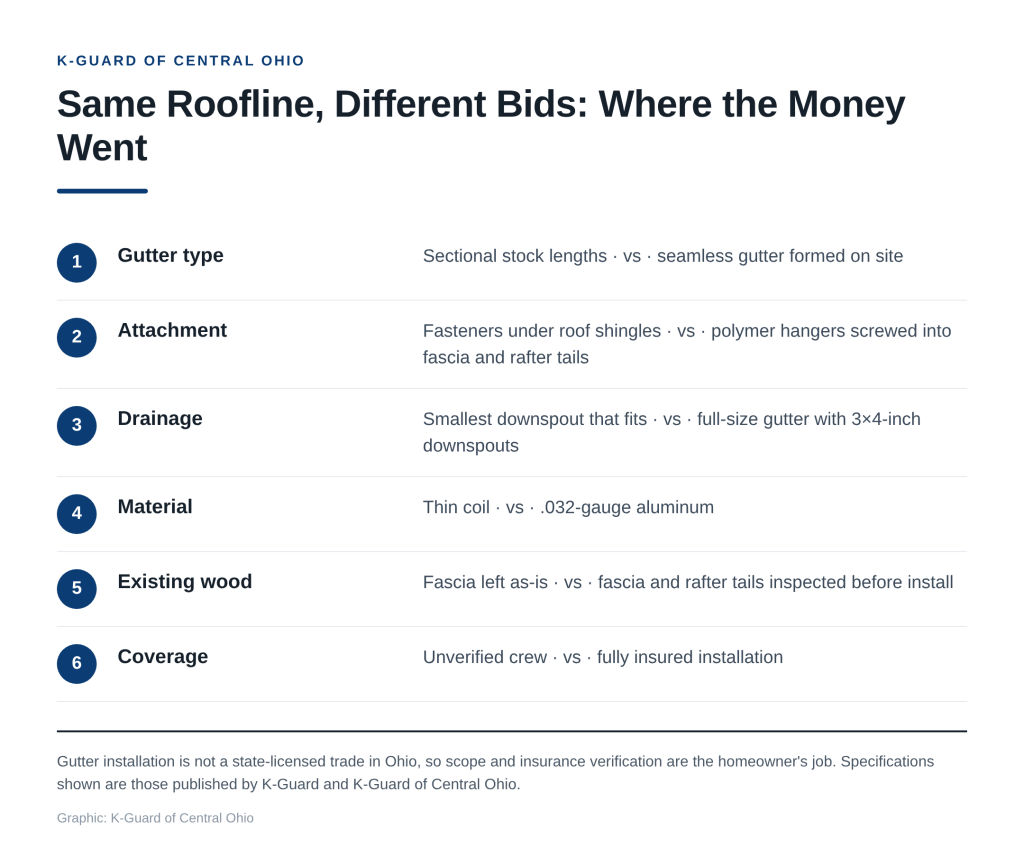
Two estimates for the same roofline can describe genuinely different systems. One may be sectional gutter cut from stock lengths, hung on spike-and-ferrule or widely spaced hangers, with the smallest downspouts that fit. The other may be seamless gutter, formed to the length of your run, hung on brackets fastened into solid wood, with downspouts sized for the roof area feeding them.
Both are “gutters.” Only one of them is priced to survive Ohio’s freeze–thaw cycles and summer downpours. Before comparing numbers, make the two bids describe the same scope, otherwise you are comparing a system to a placeholder.

The Six Cuts That Show Up in Low Bids
1. Sectional instead of seamless
Sectional gutter arrives in pre-cut lengths joined every several feet with sealed connectors. Every joint is a future leak point, because sealant is the only thing keeping water inside the trough. Seamless gutter is formed on site to the length of the run, so joints exist only at corners and outlets. K-Guard of Central Ohio lists seamless gutter installation among its services alongside the K-Guard® system (K-Guard of Central Ohio).
2. Hangers spaced too far apart, or nailed to the wrong thing
Hanger spacing is the cheapest thing on a job to stretch. Fewer hangers means fewer parts and less labor, and the gutter looks fine on install day. It shows up later as sag, standing water, and pitch that no longer drains to the outlet. The K-Guard® system uses patented high-impact, all-weather polymer hangers screwed directly into the fascia board and rafter tails rather than relying on fasteners under roof shingles (K-Guard).
3. Undersized downspouts
Downspouts are the drain for the whole system. Narrow them and the gutter backs up in exactly the storms it was installed for, spilling water at the corners and against the foundation. K-Guard of Central Ohio specifies full-sized gutters with 3×4-inch downspouts to move heavy Central Ohio rainfall away from the home (The K-Guard Difference).
4. No fascia repair
Gutters fasten to fascia. If that board is soft or rotted, new gutter hung on it is temporary regardless of what the gutter itself cost. K-Guard notes that toppers, helmets, and covers installed over leaking or rotting gutters do not stop the leaking and rotting (K-Guard). A bid with no line for inspecting or replacing fascia has either checked it and said so, or skipped it.
5. Thin aluminum
Gauge is invisible on a driveway walk-around and very visible after a ladder leans on it or ice loads the run. Thinner coil is cheaper per foot and dents, oil-cans, and deforms sooner. The K-Guard® system uses .032-gauge aluminum (The K-Guard Difference).
6. Uninsured or unverified crews
Ohio’s state construction licensing under Chapter 4740 of the Revised Code covers HVAC, refrigeration, electrical, plumbing, and hydronics contractors — gutter installation is not one of those state-licensed trades (Ohio Revised Code 4740.01). That means insurance verification is on you, not on a state board. Ask for a current certificate of general liability and workers’ compensation coverage naming the company doing the work, and confirm whether the crew is employed by that company or subcontracted. K-Guard of Central Ohio states its installations are completed by trained professionals as fully insured installations (How It Works).
Corner-Cut → Consequence → What to Ask
| Corner cut in the bid | What it causes later | Ask the installer |
|---|---|---|
| Sectional gutter instead of seamless | Leaks at every sealed joint; staining down siding | “Is this seamless gutter formed on site, and where exactly are the only seams?” |
| Wide hanger spacing / fasteners into soft wood | Sagging runs, standing water, lost pitch | “What is the hanger spacing, what are they screwed into, and is that in writing?” |
| Undersized downspouts | Overflow in heavy storms, water at the foundation | “What downspout size are you installing, and how many outlets per run?” |
| No fascia inspection or repair | New gutter pulling away from rotted wood | “Will you inspect the fascia and rafter tails, and how is repair handled if it’s soft?” |
| Thinner aluminum | Denting, deformation, shorter service life | “What gauge aluminum is the gutter and the hood?” |
| Gutter guard added over old gutters | Existing leaks and rot stay; clunky appearance | “Am I buying a new gutter system, or a cover on the gutters already up there?” |
| No insurance verification | You carry the risk of an on-site injury or damage | “Can I see current liability and workers’ comp certificates for the crew on my roof?” |
Add-On Guard vs. Integrated System
A large share of low gutter-protection bids are a screen, mesh, or cover fastened onto whatever is already on the house. K-Guard of Central Ohio makes the distinction plainly: those add-ons still depend on the size, pitch, age, and condition of the existing gutters (The K-Guard Difference).
The K-Guard® system takes the other approach – a curved hood that uses surface tension to guide water into the gutter while leaves and pine needles slide off the edge, with the hood, gutter, hangers, and downspouts engineered to work as one (How It Works). Because the hood and gutter are the same material and color, the finished profile reads as crown molding rather than a bolted-on accessory (K-Guard).
What Actually Drives Your Estimate
Nothing on this page is an argument that every high bid is better. It is an argument that you should know which factors are moving your number. Those factors are qualitative and specific to your house: total linear footage of gutter, the number of stories and roof height, roof pitch and how many valleys dump into one run, the condition of fascia and rafter tails, the gutter and hood material, and how many downspouts the drainage plan requires.
When an estimate changes, one of those things changed. Ask which one. A company that can explain your number by pointing at your roofline is a company that measured it.
One More Thing Worth Knowing
If you sign a contract at your kitchen table rather than at the company’s place of business, Ohio’s home solicitation sale rules give buyers the right to cancel until midnight of the third business day after signing, with written notice to the seller (Ohio Revised Code 1345.22). Read the exact terms before assuming it applies to your agreement, but know that a same-day “sign now” push is not the only option.
Get a Straight Answer About Your Roofline
K-Guard of Central Ohio offers a free inspection and estimate, including an assessment of your current gutter system and roofline before anything is specified (kguardcentralohio.com). The K-Guard® Leaf-Free Gutter System is backed by a lifetime no-clog warranty offered through individual dealers — ask for the terms that apply to your installation, and see kguard.com for warranty details.
Call (614) 948-6144 or request an estimate at kguardcentralohio.com to have your fascia, pitch, and drainage looked at before you compare bids.