Everything You Need to Know About Gutter Materials
What Are the Best Gutter Materials for Your Home?
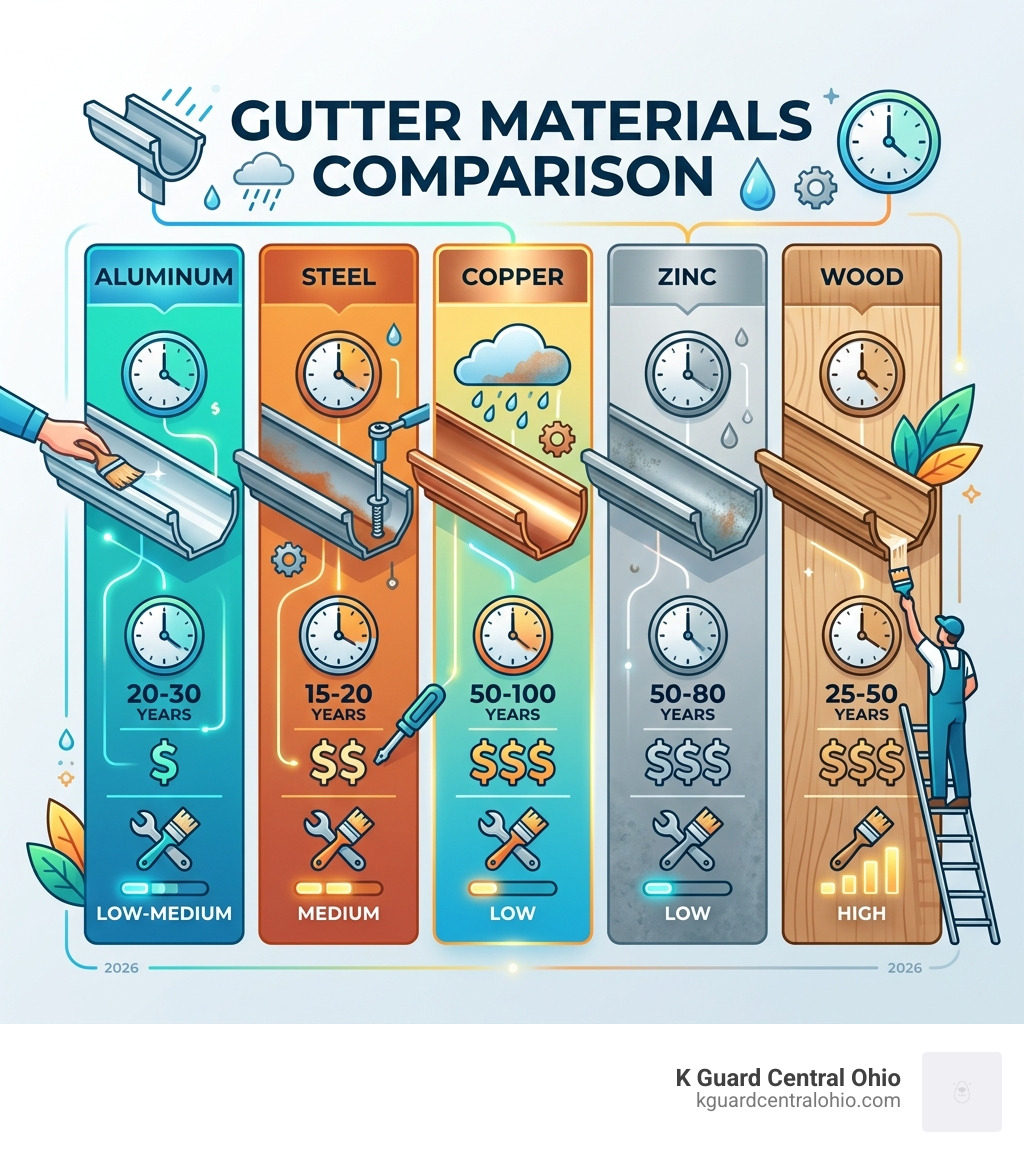
Gutter materials fall into five main categories, each with different costs, lifespans, and maintenance needs:
| Material | Lifespan | Cost | Maintenance |
|---|---|---|---|
| Aluminum | 20-30 years | $ | Low-Medium |
| Steel | 15-20 years | $$ | Medium |
| Copper | 50-100 years | $$$ | Low |
| Zinc | 50-80 years | $$$ | Low |
| Wood | 25-50 years | $$$ | High |
Aluminum is by far the most popular choice for modern homes. It balances cost, durability, and low maintenance better than any other option. K-Guard systems provide a lifetime guarantee and the elimination of annual gutter cleaning, with the $5,000 average installation cost.
Your gutters do more work than most people realize. During a single rainstorm, a roof can absorb close to 1,000 pounds of pressure — and your gutters are what redirect that water safely away from your foundation, siding, and landscaping.
Choose the wrong material, and you’re looking at rust, warping, leaks, and costly repairs within a few years. Choose the right one, and your gutters can protect your home for decades — with little to no effort on your part.
The material your gutters are made from affects everything: how long they last, how often you clean them, whether they crack in Ohio winters, and how much you’ll spend over time. It’s not a decision to make based on upfront price alone.
At K-Guard Central Ohio, we’ve seen what happens when homeowners cut corners on gutter materials — and what’s possible when they don’t.
Why Material Choice Matters for Modern Homes
When you are looking at different gutter materials, it is easy to think they all do the same thing. After all, a trough is a trough, right? Not exactly. In Central Ohio, our homes face a brutal cycle of heavy spring rains, humid summers, and freezing winters. The material you choose acts as the first line of defense for your home’s structural integrity.
Inferior materials—like thin vinyl or low-grade plastics—often fail when you need them most. They might look fine in April 2026, but after one heavy snow load or a few cycles of thermal expansion, they can crack or sag. This leads to water pooling around your foundation, which is a recipe for basement flooding and mold.
The Shift to Seamless Technology
For decades, the industry standard involved “sectional” gutters. These are the 10-foot pieces you find at big-box stores. The problem? Every seam is a potential leak point. Over time, the sealant in those seams dries out and fails. Modern water management has shifted toward seamless technology. By using a single continuous run of material, we eliminate the weak spots.
At K-Guard, we take this a step further by integrating the material into a complete hooded system. This doesn’t just move water; it manages debris, ensuring that the material’s longevity isn’t compromised by standing water or rotting leaves. To learn more about our philosophy on home protection, check out Why KGuard.
High-Grade Aluminum: The K-Guard Standard
If you are researching gutter materials, you will quickly find that aluminum is the king of the industry. It is lightweight, rust-proof, and incredibly versatile. However, not all aluminum is created equal.
The Benefits of .032 Gauge Aluminum
Most standard aluminum gutters are made from .027 gauge coil. While this is “fine” for some, it often lacks the rigidity needed to withstand heavy ice or a ladder leaned against it. At K-Guard, our systems are manufactured from .032 gauge aluminum. This 20% increase in thickness provides significantly more strength, ensuring the gutters won’t warp or bend under pressure.
Superior Corrosion Resistance and Finishes
Unlike steel, which can rust if the coating is scratched, aluminum develops a natural oxide layer that protects it from the elements. We pair this natural durability with high-performance finishes that are baked on. This means you never have to worry about scraping or painting your gutters. They stay looking fresh for decades, matching your home’s aesthetic perfectly. You can explore our variety of Color Options to see how these materials blend with your siding and trim.
The Limitations of Standard Gutter Materials
While we advocate for high-grade aluminum, it’s important to understand why other gutter materials might fall short for the average Central Ohio homeowner.
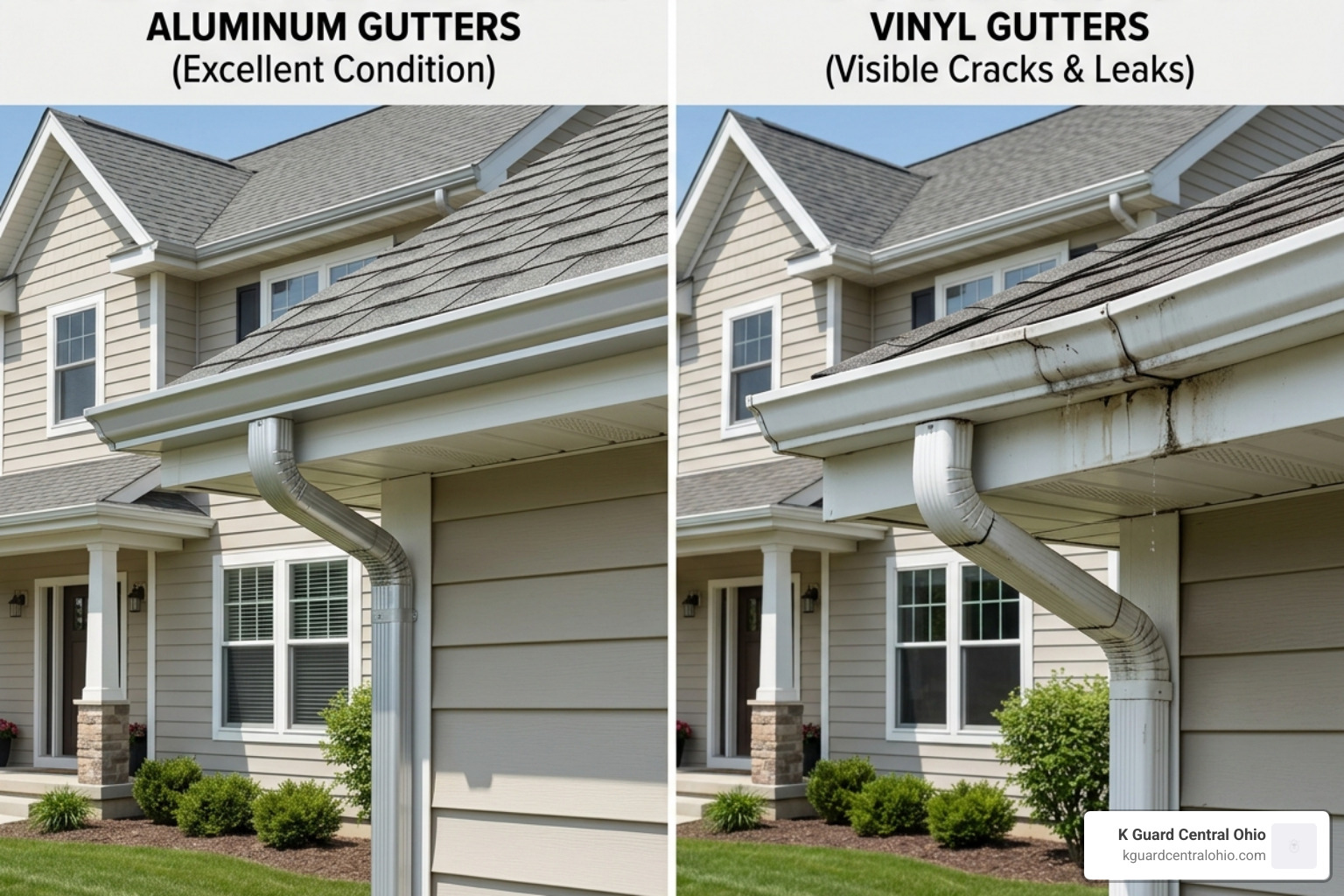
- Vinyl: Often the cheapest upfront, vinyl is prone to becoming brittle. In our cold winters, a stray branch or heavy ice can cause vinyl to shatter. It also has a high rate of thermal expansion, which often leads to “buckling” at the joints.
- Steel: Galvanized steel is incredibly strong, but it has a finite lifespan. Once the zinc coating wears down, the steel begins to rust from the inside out.
- Copper and Zinc: These are beautiful, “lifetime” materials that develop a stunning patina. However, they are extremely expensive and require specialized labor to install. For most, the cost-to-benefit ratio doesn’t align compared to high-grade aluminum.
- Wood: Almost exclusively used for historic restorations, wood gutters (often cedar or fir) require intense maintenance. If you don’t oil them regularly, they rot. At $15-$25 per linear foot installed, they are a labor of love rather than a practical solution for most.
Relying on these temporary or high-maintenance solutions often leads to wood rot on your fascia boards. When gutters fail, water overflows and soaks the wood behind them. To see the difference a permanent system makes, browse our Photos of K-Guard Installations.
Performance Factors: Size, Shape, and Climate
The performance of your gutter materials is heavily influenced by the shape and size of the system.
5-Inch vs. 6-Inch Capacity
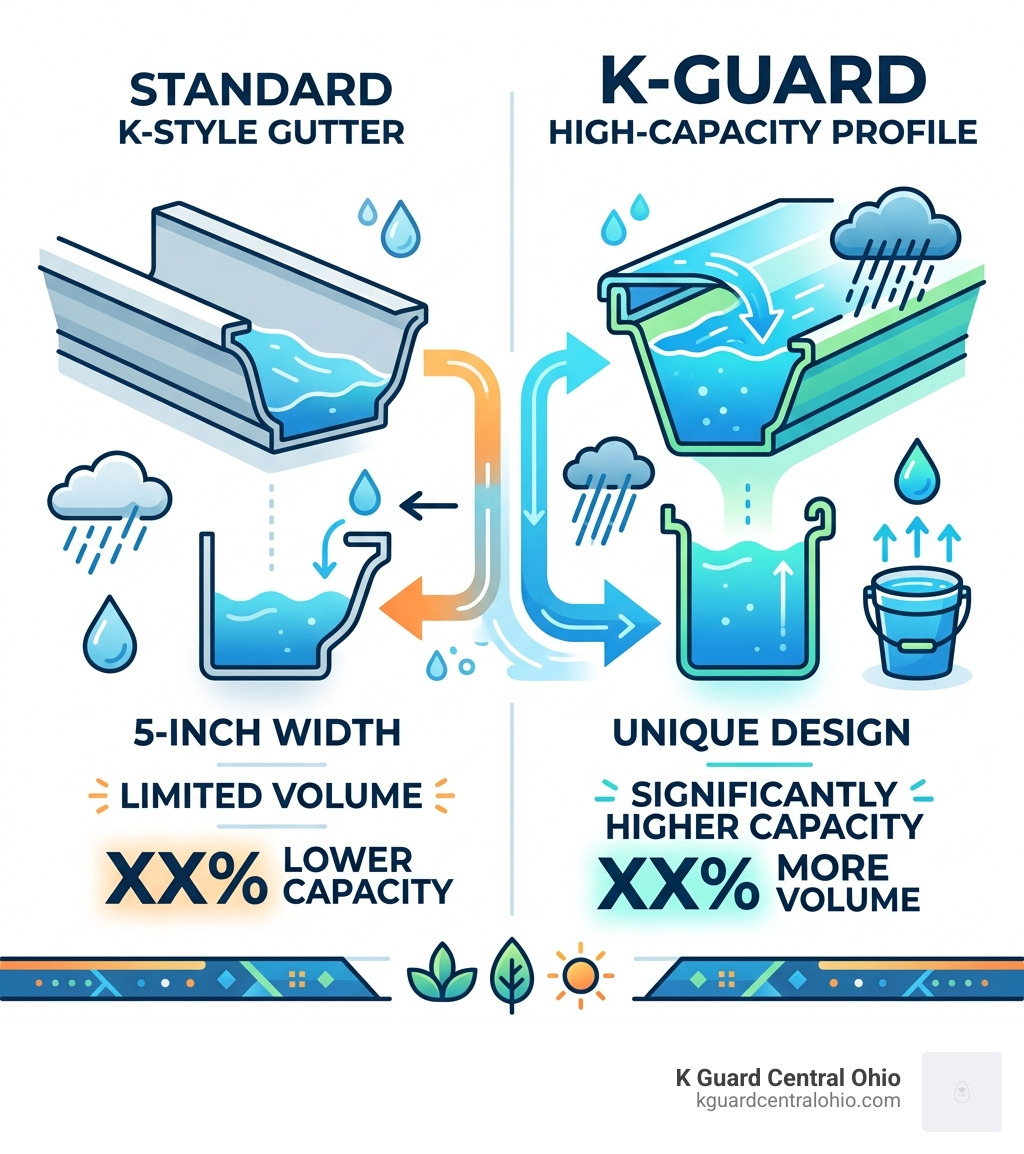
Standard residential gutters are usually 5 inches wide. While this works for many, homes with large or steep roofs often require 6-inch gutters to handle the volume of runoff during a downpour. A 6-inch gutter can hold significantly more water, preventing the “waterfall” effect over the front of the gutter that can erode landscaping.
The K-Guard Profile
Our system features a unique, high-capacity profile that outperforms standard K-style gutters. Because the hood and the gutter work together, the system can handle even the heaviest Ohio rainstorms without overflowing. This design also helps manage snow loads. In the winter, the sturdy construction resists the weight of snow and ice, reducing the risk of the gutters pulling away from the home.
Thermal Expansion
All gutter materials expand and contract as the temperature changes. Aluminum is particularly active in this regard. A seamless system is essential here; because there are no seams to “pop” when the metal shifts, the system remains watertight through every season. You can see the mechanics behind this in our How It Works section.
Technical Considerations for Gutter System Longevity
A gutter system is only as good as the hardware holding it up. Even the best gutter materials will fail if they are attached with flimsy spikes or cheap hangers.
Patented Hangers and Fasteners
Standard gutters are often attached with spikes that go through the gutter and into the fascia. Over time, these pull out, leading to sagging. K-Guard uses heavy-duty, patented hangers made from high-strength polymers. These hangers support the gutter from within and are fastened securely to the fascia board, ensuring the system stays level and functional for a lifetime.
Downspout Sizing
The gutter collects the water, but the downspouts move it. We typically pair our high-capacity gutters with oversized downspouts (3″x4″) to ensure that even large debris—like those pesky “helicopter” seeds—can flush through without causing a backup.
Professional Installation
While DIY gutter kits are available at The Home Depot, they are almost always sectional. For a truly permanent solution, professional installation is required. This allows for the gutters to be “run” on-site to the exact measurements of your home, ensuring a perfect, seamless fit. Learn more about our Installation Process to see how we ensure longevity.
Maintenance and Long-Term Costs of Gutter Materials
When choosing gutter materials, you have to look at the “Total Cost of Ownership.” A cheap vinyl gutter might cost very little today, but if you have to pay someone to clean it twice a year and replace it in seven years, it becomes the most expensive option you could have chosen.
The Hidden Costs of Cleaning
The average homeowner spends hundreds of dollars a year on gutter cleaning services—or worse, they spend their weekends on a dangerous ladder. Over 20 years, those cleaning costs can easily exceed $4,000 to $6,000.
The Financial Benefit of a Permanent Solution
The K-Guard system is designed to be a one-and-done investment. With the $5,000 average installation cost, it pays for itself in just a few years by providing the elimination of annual gutter cleaning and preventing expensive water damage repairs. Plus, because it’s made of high-strength aluminum, you won’t be replacing it in a decade. We even offer Financing Options to make this permanent protection accessible for every budget.
Frequently Asked Questions about Gutter Materials
Which gutter material and system lasts the longest?
For the typical residential home in Central Ohio, a high-strength aluminum system like K-Guard is the longest-lasting practical solution. While copper can last 100 years, its price is prohibitive for most. K-Guard offers the durability of heavy-duty aluminum with the added protection of a hooded design that prevents the internal rot and rust common in open gutters. We stand behind this with a lifetime guarantee. You can learn more About Us and our commitment to quality.
How much does a professional gutter system cost?
While every home is different, the $5,000 average installation cost for a full K-Guard system includes the removal of your old gutters, the custom-formed seamless aluminum gutters, our patented high-strength hangers, and the debris-shedding hood. It is a comprehensive investment in your home’s future. See the full breakdown of Our Products to understand the value.
Why is a leaf-free system better than standard gutters?
Standard gutters—regardless of the gutter materials used—are essentially open troughs that catch everything from the roof. This includes leaves, twigs, and bird nests. When these materials sit in your gutters, they trap moisture against your home and create clogs. A leaf-free system like K-Guard uses the physics of liquid adhesion to pull water into the gutter while whisking debris over the edge. This protects your foundation and fascia and, most importantly, keeps you off the ladder.
Conclusion
Choosing the right gutter materials is one of the most important maintenance decisions you will make for your home. While there are many options on the market—from DIY vinyl to high-end copper—high-grade aluminum remains the gold standard for performance and value.
At K-Guard Central Ohio, we provide the ultimate choice in gutter technology. Our system offers:
- A lifetime guarantee for total peace of mind.
- The elimination of annual gutter cleaning.
- A permanent solution with the $5,000 average installation cost.
Don’t settle for temporary fixes that leave your home vulnerable to the Ohio elements. Invest in a system that works as hard as you do. Contact Us today for a free estimate and take the first step toward a maintenance-free home.