
Gutter Guards for Pine Needles: What Actually Holds Up in Central Ohio
Gutter guards for pine needles get judged on the wrong debris. Most homeowners shop for a cover that stops maple and oak leaves, and almost any product does that. A leaf is wide, flat, and far bigger than the opening it would have to pass through. Needles are the opposite. They’re thin, stiff, and pointed, and they arrive by the thousand in one or two weeks each fall, which is exactly the shape and volume that finds the weak spot in a gutter cover.
If you’ve got white pine, spruce, hemlock, or arborvitae anywhere near your roofline, the needle question is the one that decides whether you’re still on a ladder in November.

Why pine needles beat most gutter covers
A screen or a micro mesh panel works by size exclusion. Debris that’s wider than the opening stays out, and water passes through. That works until debris that’s narrower than the opening in just one dimension, even if much longer in another dimension, falls into the gutter. A pine needle is a fraction of an inch across and several inches long, so it doesn’t sit on top of the mesh the way a leaf does. It drops point-first, slides partway in, and stops when it hits the widest part.
Once a few hundred needles are standing in the mesh openings, they act almost as a filter mat, making every bit of small debris that used to wash straight through stick. Shingle grit, seed pods, and roof dust build on top of the needle layer. On micro mesh the same wedging happens at a smaller scale, so the panel seals over rather than clogging. Water then sheets off the front edge instead of going into the gutter. Both issues result in rainwater running past the gutter and landing next to your foundation.
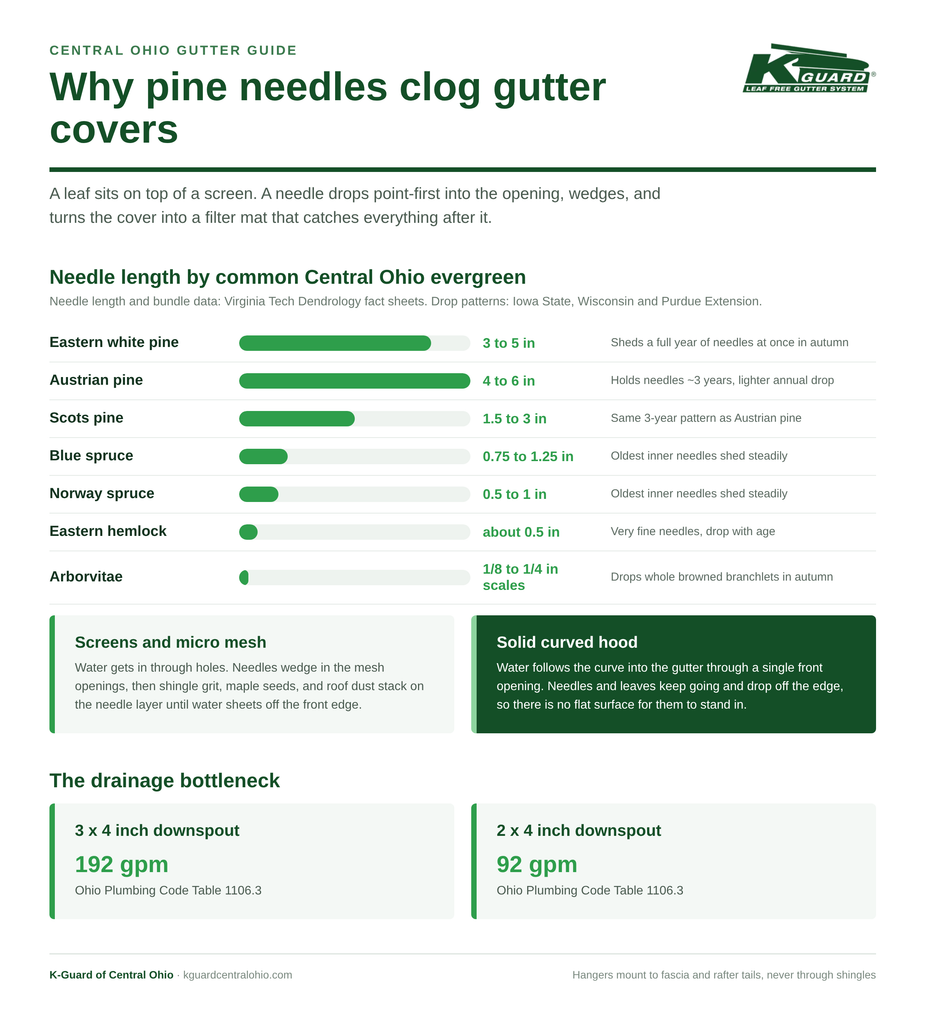
Aluminum gutter systems with a solid curved hood work on a different principle. Instead of straining debris out of the water, the hood uses surface tension to pull water around the curve and into the gutter through a single front opening. Needles and leaves keep going and drop off the edge. K-Guard’s system overview describes exactly that design, with the hood shedding leaves and pine needles rather than catching them. There’s nothing for a needle to stand up in, because there’s no flat perforated surface at all.
Central Ohio needle sizes, tree by tree
Needle size and drop pattern impact how much material lands on your roof and how fine it is. Measurements come from Virginia Tech’s dendrology fact sheets, with drop patterns from university extension programs.
| Tree | Needle length | Needles per bundle | Fall drop pattern |
|---|---|---|---|
| Eastern white pine | 3 to 5 in | 5 | Heavy and sudden, whole years of needles yellow and drop together |
| Austrian pine | 4 to 6 in | 2 | Needles held about three years, so drop is lighter and more gradual |
| Scots pine | 1.5 to 3 in | 2 | Same three-year pattern as Austrian pine |
| Norway spruce | 0.5 to 1 in | Single | Oldest inner needles shed steadily rather than all at once |
| Blue spruce | 0.75 to 1.25 in | Single | Same steady inner shed |
| Eastern hemlock | About 0.5 in | Single | Fine needles, older inner needles discolor and drop with age |
| Northern white cedar / arborvitae | Scale-like, 1/8 to 1/4 in | Scale sprays | Drops whole browned branchlets in autumn |
Iowa State University Extension notes that on white pines and arborvitae, an entire year of needles is lost at once in autumn. Scots and Austrian pines hold theirs about three years, so their annual shed is less noticeable. University of Wisconsin Extension describes the same seasonal needle drop as normal aging of inner needles, triggered by weather and season. That’s why several evergreens on one street tend to shed in the same week. Purdue Extension puts white pine’s big release in autumn and notes arborvitae sheds older branchlets too.
A white pine or a row of arborvitae near the house dumps its load in a short window. Any cover that traps needles goes from clean to blocked in just a few days rather than over a season.
The small debris problem nobody shops for
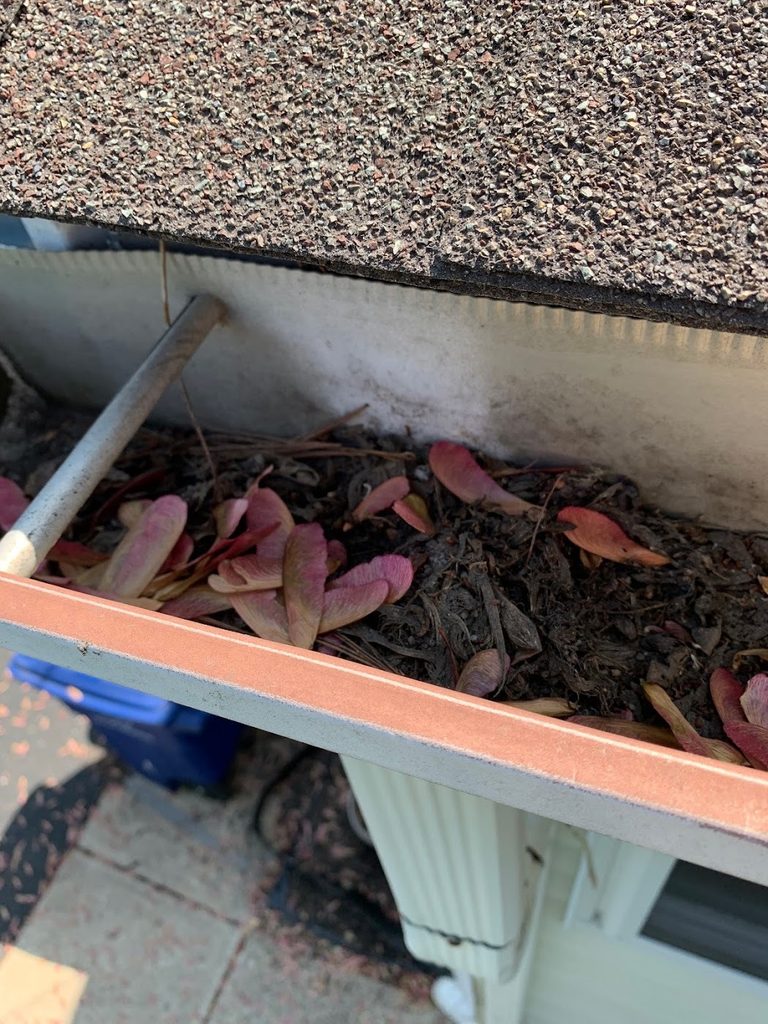
Once a needle mat forms in a mesh opening, it catches small debris that a bare gutter would have flushed to the downspout. Maple seeds, spring catkins, and granules off aging shingles all stack on top, and by the time you notice water spilling over the front of the gutter, the blockage isn’t just needles anymore. It becomes a compacted layer that needs a hose and a brush to be cleared.
That’s why “I clean it once a year” doesn’t cut it on a house with conifers. On a gutter cover with any horizontal filter surface, needles roughly halve the maintenance interval a leafy yard would tolerate. The cleaning takes longer too, because you’re clearing the cover as well as the trough.
What to check before you buy gutter guards for pine needles
There are a few key things that separate a system that handles needles from a cover that only handles leaves.
Look at how water gets in. If the answer is “through holes, slots, or mesh,” ask what happens when something narrower than the hole and longer than the panel lands on it. A hooded design that admits water through a front opening rather than a filter surface doesn’t have that issue.
Ask how the guard attaches. Fasteners driven under or through shingles are a known problem for roof warranties, and Atlas Roofing’s technical bulletin on gutter covers lists installation practices to avoid for that reason. K-Guard’s guards mount on high-impact polymer hangers fastened to the fascia board and rafter tails, which keeps everything off the shingles. You can see the full component list on the products page.
Ask about the drainage side of the system too. Needles that do reach a trough have to leave through the downspout, and a small outlet size will lead to a bottlenecking problem. Ohio Plumbing Code Table 1106.3 rates a 3-inch by 4-inch leader at 192 gallons per minute, against 92 gpm for a 2-inch by 4-inch. An oversized downspout gives water and stray debris a wider path out.
Walk your own property before the quote. Count what’s within about 20 feet of the roofline, note the species, and tell the estimator. A single hemlock at the back corner is a different concern than four white pines along the south side.
Gutters, snow, and needle load together
Central Ohio gives you a big needle drop and freezing temperatures during the same quarter of the year. Debris trapped in a filter surface holds water, that water freezes, and the ice adds weight to a gutter that’s already carrying a load of debris. Hanger spacing determines what the gutter can carry. Manufacturer guidance for hidden hangers runs about 24 inches on center, tightened to roughly 18 inches where ice is heavy. The commercial standard ANSI/SPRI GD-1 uses 24 inches on center for low-slope gutter systems, and that spacing assumes the gutter drains. A trough holding a frozen slug of needles and water carries far more than it was designed to, which is how gutters pull away from fascia over a couple of winters.
The fix for this problem is keeping the debris from collecting in the first place, so there’s nothing to hold water through a freeze.
Frequently Asked Questions
Do micro mesh gutter guards work with pine needles?
They keep needles out of the gutter trough, but needles wedge into the mesh openings and sit there. That layer then catches small debris and can shed water off the front instead of letting it through, so the cover itself needs cleaning even though the gutter underneath looks clean.
Which trees cause the worst gutter clogs in Central Ohio?
Eastern white pine and arborvitae are the hardest on gutter covers because both release a full year of needles or browned branchlets in a short autumn window, according to Iowa State University Extension. Spruce and hemlock shed more gradually but produce very fine needles.
Are my evergreens dying if the inner needles turn yellow in fall?
Usually not. University of Wisconsin Extension describes seasonal needle drop as normal aging of older inner needles, and it shows up on many trees at the same time because weather and season trigger it. Discoloration on the newest outer needles is the pattern worth having checked.
Can I put a gutter cover over my existing gutters instead of replacing them?
You can, though it inherits whatever pitch, hanger spacing, and downspout size the existing gutter already has. If the gutter overflowed before, a cover on top of it tends to move the overflow rather than stop it.
How often do gutters need cleaning if pine trees are close to the house?
An annual cleaning is the usual baseline for a leafy yard, and conifers push that higher because the debris is finer and packs tighter. Homes with white pine or several arborvitae near the roofline often need attention twice a year or more without a system that sheds needles.
Does a bigger downspout help with needle debris?
It helps with anything that reaches the trough. Ohio Plumbing Code Table 1106.3 rates a 3-inch by 4-inch leader at 192 gpm versus 92 gpm for a 2-inch by 4-inch. The larger outlet moves more water and gives fine debris a wider opening to flush through.
If the evergreens around your house are already dropping, look at gutter guards for pine needles that shed debris instead of filtering it and protect your fascia and foundation before the first freeze. Contact K-Guard of Central Ohio to schedule an on-site measurement and see the hood and hanger system on your own roofline.



One Response