Micro Mesh Gutter Guards: What They Catch, What They Miss, and the Upkeep They Need

Micro mesh gutter guards are fine metal screens that sit over your gutter and let water drip through while small debris stays on top. They’re one of the most common upgrades you’ll hear about in late fall, when the leaves are down and the gutters are full again. They do a good job with some debris and a weaker job with others. The difference depends on what trees grow around your house and how much upkeep you’re willing to do. This guide walks through how the mesh works, where it struggles in Central Ohio, and the questions to ask before you buy any type of guard.
How micro mesh gutter guards work
A standard gutter screen is a coarse grid. Oregon State University Extension describes mesh screens as usually 1/4-inch-square wire frames that fit along the length of the gutter (OSU Extension EM 9101). A 1/4-inch opening stops a maple leaf, but pine needles, seed pods and shingle grit can still fall through it.
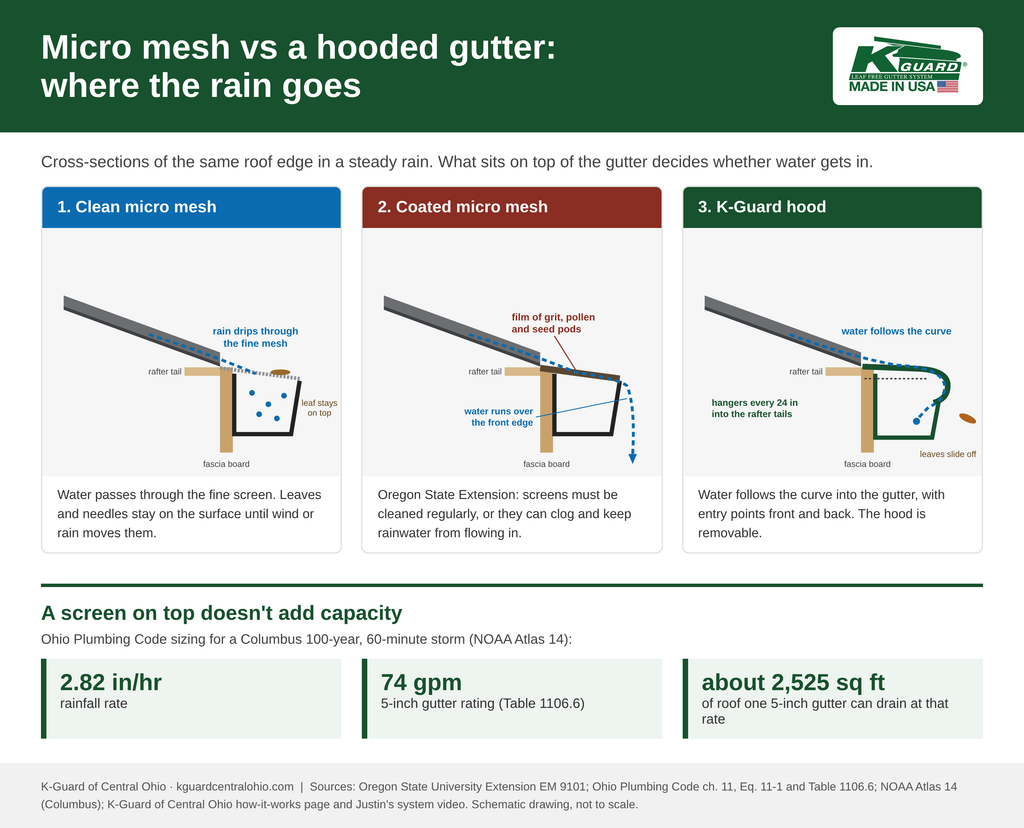
Micro mesh shrinks those openings to a much finer metal weave stretched over a frame. Water hits the mesh, passes through the tiny holes and drops into the trough below. Anything larger than the holes stays on the surface until wind or rain moves it off. Most mesh products go on top of the gutters you already have, so the trough, hangers and downspouts underneath stay the same.
K-Guard of Central Ohio’s comparison page notes that a screen, mesh, or cover can help with debris, but it still relies on the size, pitch, age, and condition of the existing gutter system (The K-Guard Difference). Gutters that sag or leak today will keep doing it under a new screen, and that’s when gutter replacement is the better fix.
What fine mesh stops, and what it lets build up
Fine mesh does its best work on small debris that slips through a basic screen. Pine needles, small leaves and maple seeds have a harder time getting into the trough when the openings are tiny. For homes under white pines or arborvitae, that’s a real improvement over an open gutter or a coarse screen, and our pine needle guide covers which trees shed the most.
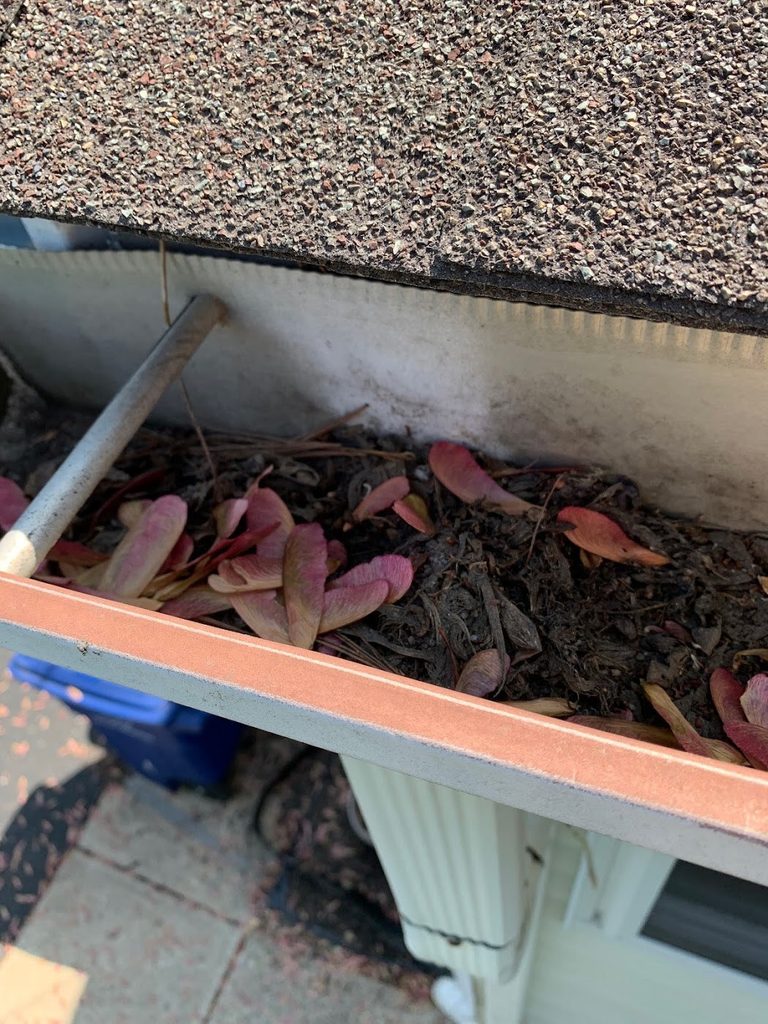
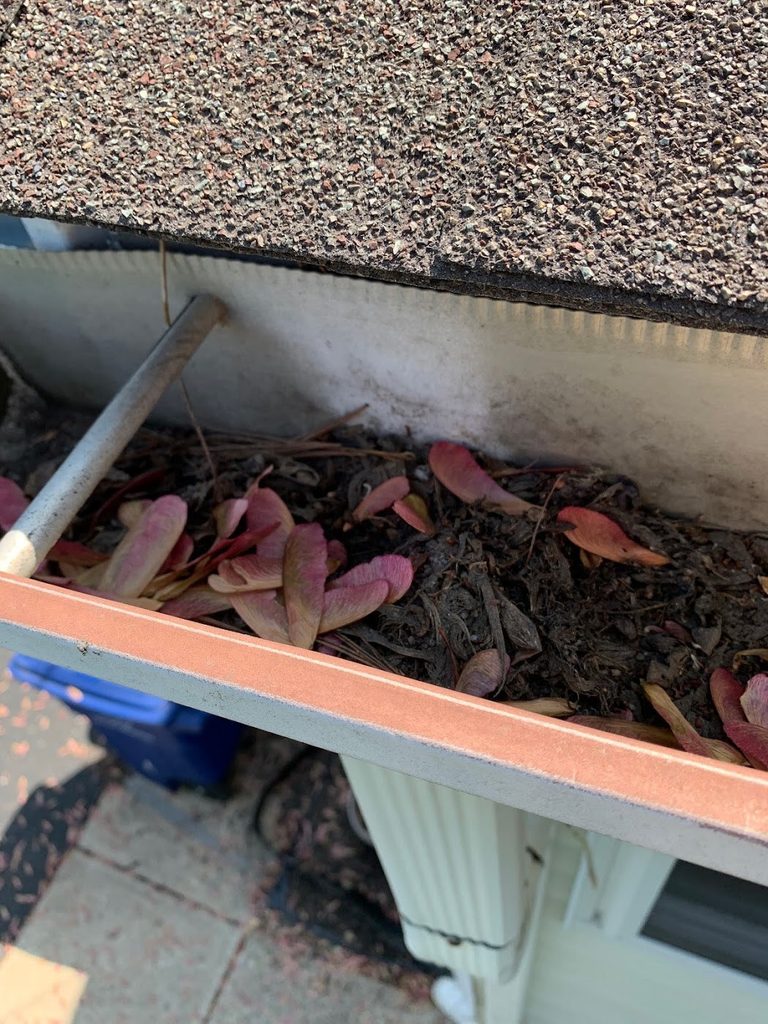
Anything the mesh blocks has to sit on top of it for a while. Dry leaves blow off, but wet seed pods, pollen, and fine grit can stick to the weave and form a thin layer. Oregon State Extension says leaf screens must be regularly cleaned to be effective, and that screens left unmaintained can become clogged and keep rainwater from flowing through (OSU Extension EM 9101). When that happens, rain runs across the top of the screen and over the front edge instead of into the gutter.
Roof grit is the type of debris most homeowners don’t expect to find in their mesh. The Colorado Roofing Association explains that a small amount of granule shedding into the gutters is normal after a new asphalt roof goes on, and that it usually tapers off over several months (Colorado Roofing Association). A roof replaced this year means that extra grit will find it’s way onto any screen during this first season.
Micro mesh vs a hooded gutter system
A hooded system takes a different approach. Instead of filtering water through holes, a curved hood guides rain around its edge and into the gutter, while leaves slide off the front. Here’s how these two types of gutter guards compare on the points that matter most for a Central Ohio house.
| What to compare | Micro mesh over existing gutters | Hooded system (K-Guard) |
|---|---|---|
| What gets installed | A fine screen on top of the gutter you already have (K-Guard Difference) | New gutter, hood, hangers and downspouts as one system (Our Products) |
| How water gets in | Drips through the mesh openings | Follows the curve of the hood into the gutter (How It Works) |
| Where debris goes | Sits on the mesh until wind or rain clears it (OSU Extension) | Slides off the hood edge (How It Works) |
| Gutter capacity | Same as your current gutter | Full-size gutter with 3×4-inch downspouts (Our Products) |
| What holds it up | Your existing hangers | Polymer hangers every 24 inches into the fascia and rafter tails (Justin’s video) |
| Upkeep to expect | Brushing or rinsing the mesh surface when a film builds up | A look from the ground after big storms and in spring |
Both types still require some upkeep, but the difference is where the work happens. With micro mesh gutters, you’re keeping a screen clear. With a hood, you’re checking the front edge and the downspouts. You’ll find more on the full range of styles in our comparison of screens, micro-mesh, and hooded guards.
How mesh is installed, and why your roof edge matters
Mesh panels attach in a few different ways. Some clip to the front lip of the gutter and rest on the back edge, while others tuck under the first row of shingles. Atlas Roofing’s technical bulletin says most gutter covers installed to good roofing practice don’t affect its shingle warranty, and also warns against covers whose instructions require fasteners through the shingles, removing or trimming shingles, or removing the drip edge (Atlas Roofing bulletin). Our post on whether gutter guards damage your roof goes through the roof-edge details.
Water volume is the other thing to check. A mesh panel doesn’t add any capacity to the gutter below it, and during a downpour every drop has to pass through the weave first. NOAA Atlas 14 puts a 100-year, 60-minute storm in Columbus at 2.82 inches per hour (NOAA Atlas 14). Under the Ohio Plumbing Code’s sizing formula, a 5-inch gutter rated at 74 gallons per minute can drain about 2,525 square feet of roof at that rate (Ohio Plumbing Code, Chapter 11). Long runs and widely spaced downspouts are a gutter problem, and a screen on top won’t change that. Our 5-inch vs 6-inch gutter guide shows how to check.
How to check any gutter guard from the ground
You don’t need a ladder to tell whether or not your gutter protection is working. A few good habits will helpt to catch most of the problems early.
- Watch the downspouts during a steady rain. Strong flow from each outlet means water is getting into the gutter.
- Look for water sheeting off the front edge of the gutter. On mesh, that usually points to a coated screen. On a hood, it can point to leaves stacked on the front edge or a gutter that’s lost its slope.
- After leaf drop, look for dark patches or matted seeds sitting on top of a screen.
- Check for dips along each run, since a gutter that sags between hangers holds standing water.
- If you had a roof replaced in the last year, expect extra granules and check the screen surface more often that first season.
These checks take a few minutes of looking up from the yard, and can tell you whether it’s time to brush off a screen or time to have someone look at the gutter itself.
How the K-Guard hood handles leaves and seeds
At K-Guard of Central Ohio, we install a hooded system rather than a screen. In this video, Justin explains that the hood works on reverse curve technology. He compares it to holding a bottle under a kitchen faucet, where the water follows the curve of the bottle. He also points out that water has two places to enter the gutter, one in the front and one in the back, and that the hood is removable, so a damaged hood can be replaced without replacing the whole gutter.
Our how it works page describes the curved hood using surface tension to guide rainwater into the gutter while leaves, pine needles, and debris slide off the edge. The system uses .032-gauge aluminum (The K-Guard Difference), and it replaces your old gutters, so the trough, hangers, hood and downspouts are fitted to each other from the start. You can see where we work on our Columbus gutter guard page.
Frequently asked questions
Do micro mesh gutter guards stop pine needles?
Fine mesh keeps more pine needles out of the trough than a coarse 1/4-inch screen does. The needles can still collect on top of the screen, so expect to clear the surface after heavy needle drop in fall.
Do mesh gutter guards need cleaning?
Yes. Oregon State University Extension says leaf screens must be regularly cleaned to be effective. Wet seed pods, pollen and roof grit can coat the mesh and keep water from passing through.
Can you put micro mesh on old gutters?
Most mesh products are made to go on existing gutters. That works if the gutters are sound and properly sloped. If they sag, leak or pull away from the fascia, a screen won’t fix those problems.
Will a mesh gutter guard affect my shingle warranty?
It depends on how it’s installed. Atlas Roofing says covers installed to good roofing practice usually don’t affect its warranty, but it warns against products that require removing, trimming, or fastening through shingles.
Is micro mesh or a hooded system better for heavy rain?
Both depend on the gutter and downspouts underneath. Mesh can’t drain more than the existing gutter can carry, and a coated screen sends water over the edge. A hooded system that includes a full-size gutter and 3×4-inch downspouts replaces that capacity along with the cover.
If you’re weighing micro mesh gutter guards against a hooded system, the most useful next step is a look at your roofline, your trees, and the gutters you have now. Get in touch to schedule an estimate, and we’ll walk you through which setup fits your home.