
5 Inch vs 6 Inch Gutters: Does Bigger Actually Stop Overflow?
Almost every estimate we run in Central Ohio includes some version of the same question: should the new gutters be 5 inch or 6 inch? It usually comes up because water poured over the front edge during a summer storm and the gutter looked too small to keep up. Sometimes it really is too small, but most of the time the width of the trough isn’t the part holding water back.
You don’t have to guess at this one. Plumbing code publishes the flow capacity of gutters and downspouts, NOAA publishes how hard it actually rains in Columbus, and those two numbers together can answer the question for a specific roof in about a minute.
What a Central Ohio roof actually sends to the gutter
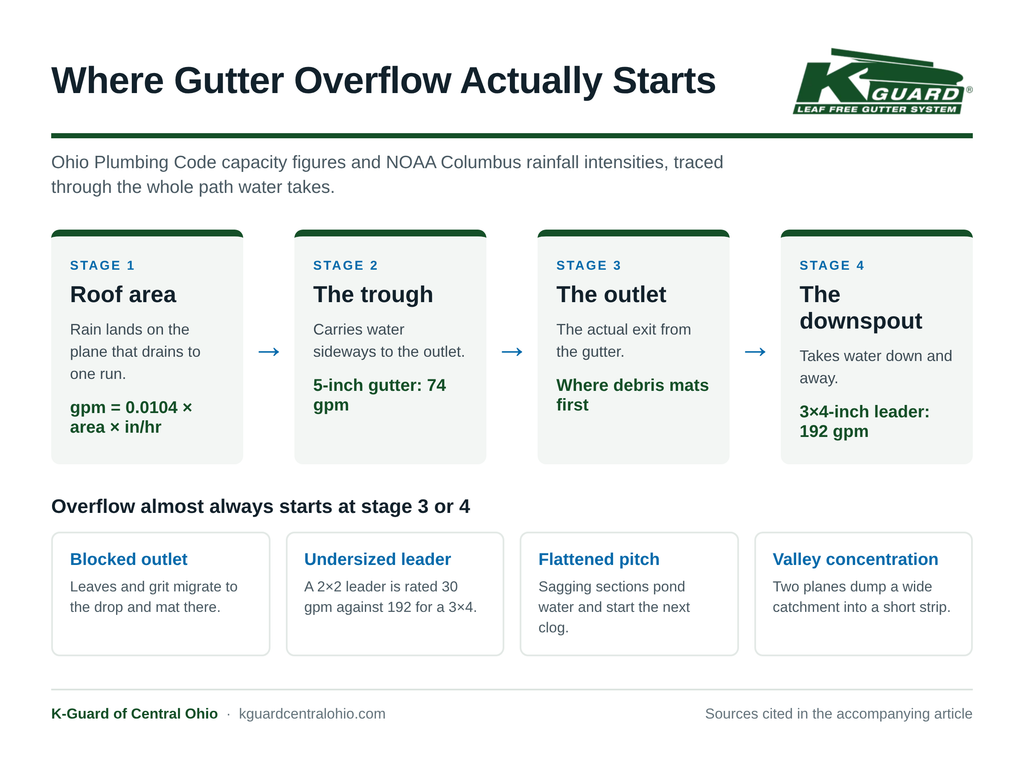
Ohio’s plumbing code sizes storm drainage from the 100-year hourly rainfall rate, and it gives you a conversion for turning rainfall into gallons per minute: 0.0104 multiplied by the roof area in square feet, multiplied by the rainfall intensity in inches per hour. That’s Equation 11-1 in Section 1106 of the Ohio Plumbing Code.
For intensity, NOAA Atlas 14 gives point estimates for downtown Columbus. At a one-hour duration, the 2-year storm is 1.32 inches per hour, the 10-year is 1.91, and the 100-year is 2.82 (NOAA Atlas 14 point precipitation frequency estimates). Those are hourly rates rather than daily totals, which is why a fifteen-minute cloudburst can overwhelm a system that handles a full day of steady rain without any trouble.
Here’s what that math produces for a single gutter run, next to the code’s published capacity for half-round gutters sloped at 1/8 inch per foot.
| Roof area draining to the run | Flow at 2-yr storm (1.32 in/hr) | Flow at 10-yr storm (1.91 in/hr) | Flow at 100-yr storm (2.82 in/hr) | 5-inch gutter capacity | 6-inch gutter capacity |
|---|---|---|---|---|---|
| 600 sq ft | 8.2 gpm | 11.9 gpm | 17.6 gpm | 74 gpm | 110 gpm |
| 1,000 sq ft | 13.7 gpm | 19.9 gpm | 29.3 gpm | 74 gpm | 110 gpm |
| 1,500 sq ft | 20.6 gpm | 29.8 gpm | 44.0 gpm | 74 gpm | 110 gpm |
| 2,000 sq ft | 27.5 gpm | 39.7 gpm | 58.6 gpm | 74 gpm | 110 gpm |
Flow figures calculated with Equation 11-1 using NOAA Atlas 14 intensities for Columbus. Capacities from Table 1106.6, Ohio Plumbing Code, which lists 74 gpm for a 5-inch gutter and 110 gpm for a 6-inch gutter at that slope.
Compare the right-hand columns to the numbers on the left and the gap is wide. Even at the 100-year intensity, a 2,000-square-foot roof section sends about 59 gpm to a trough rated for 74. A well-installed 5-inch system carries close to four times what a typical Columbus storm delivers, so on most homes around here the trough isn’t what’s limiting you.
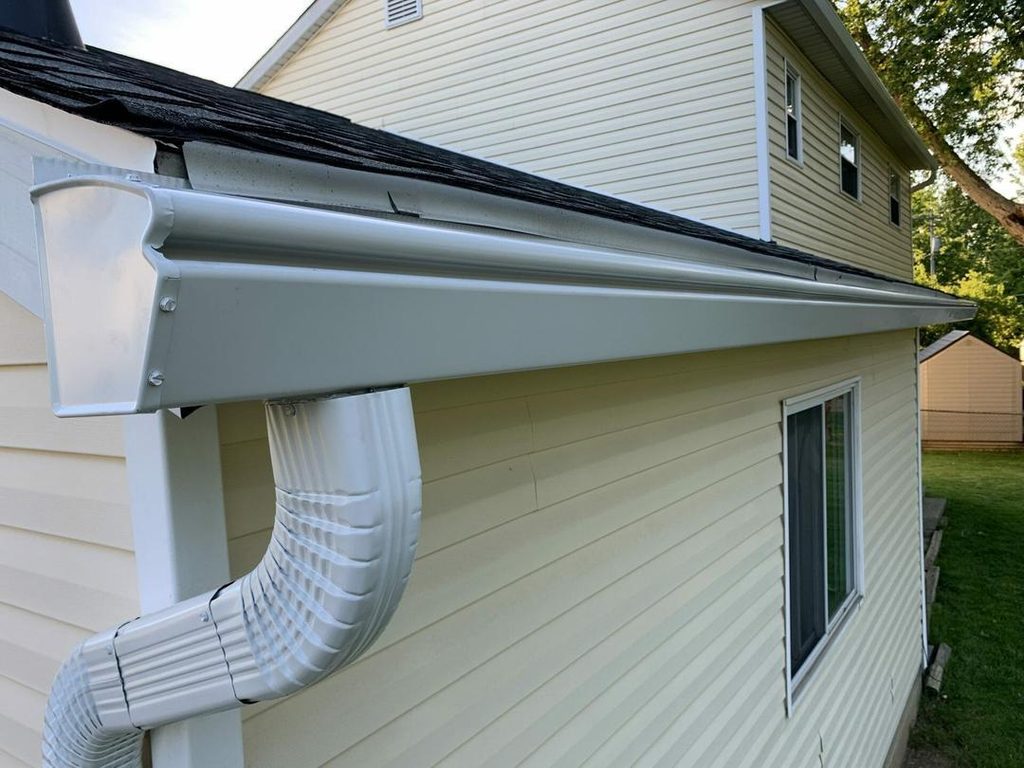
So where does the water actually back up?
Four places, in roughly this order of frequency.
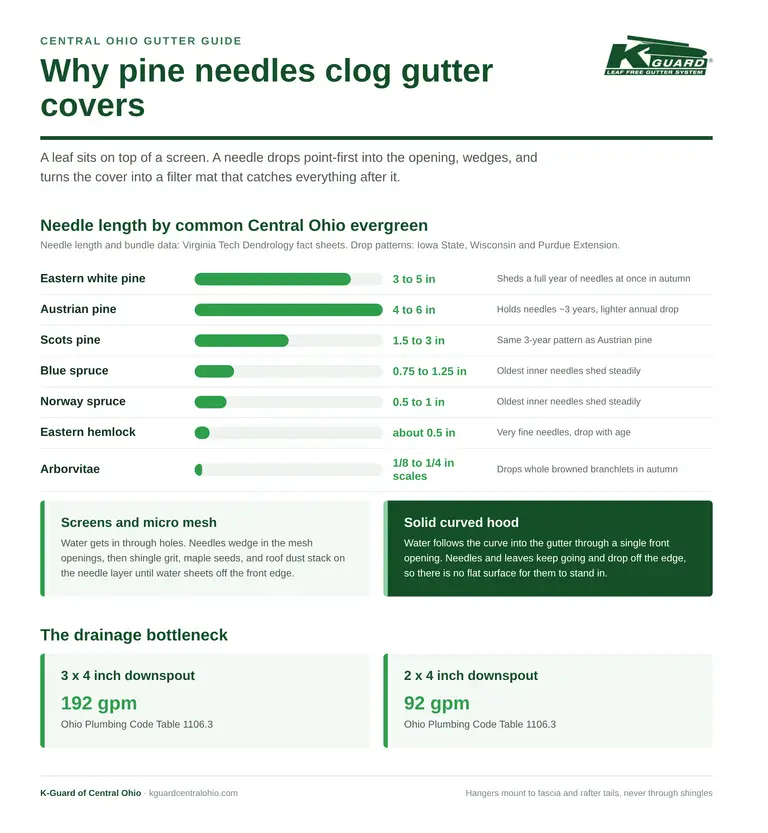
The outlet and downspout. Code sizes leaders separately in Table 1106.3, and the difference between sizes is large. A 3×4-inch leader is rated at 192 gallons per minute. The table doesn’t list the common 2×3-inch residential size, but it brackets it, with a 2×2 leader rated at 30 gpm and a 2×4 at 92 gpm. Two undersized outlets on a long run will overwhelm a gutter of any width.
Debris at the outlet. An open gutter doesn’t clog evenly. Leaves, shingle grit and maple seeds all migrate toward the drop and mat there, so the trough can be nine-tenths empty while water sheets over the front lip.
Pitch. The code table quotes its capacity at a stated slope, so a run that has flattened out or sagged between hangers carries less than the rating suggests. Those low spots hold water between storms, and that’s where debris settles and starts a clog.
Roof geometry. Two planes meeting in a valley send a wide catchment into a narrow strip of gutter, so the average across the run looks fine while one spot floods in heavy rain. Adding width rarely fixes a concentration problem like that, though adding an outlet near the valley usually does.
When 6-inch gutters genuinely make sense
There are real cases for the larger trough, and an honest estimator will name them:
- Long, uninterrupted runs where extra downspouts aren’t practical.
- Steep roof pitches, which deliver water to the eave faster than a shallow roof does.
- Large single planes, especially over 1,500 square feet feeding one run.
- Valleys that concentrate a wide catchment into a short section of gutter.
- Commercial or barn-style rooflines with limited downspout locations.
Outside those cases, the decisions that change how the system performs are usually outlet size, outlet count and hood design rather than an extra inch of width.
How this plays out on a K-Guard system
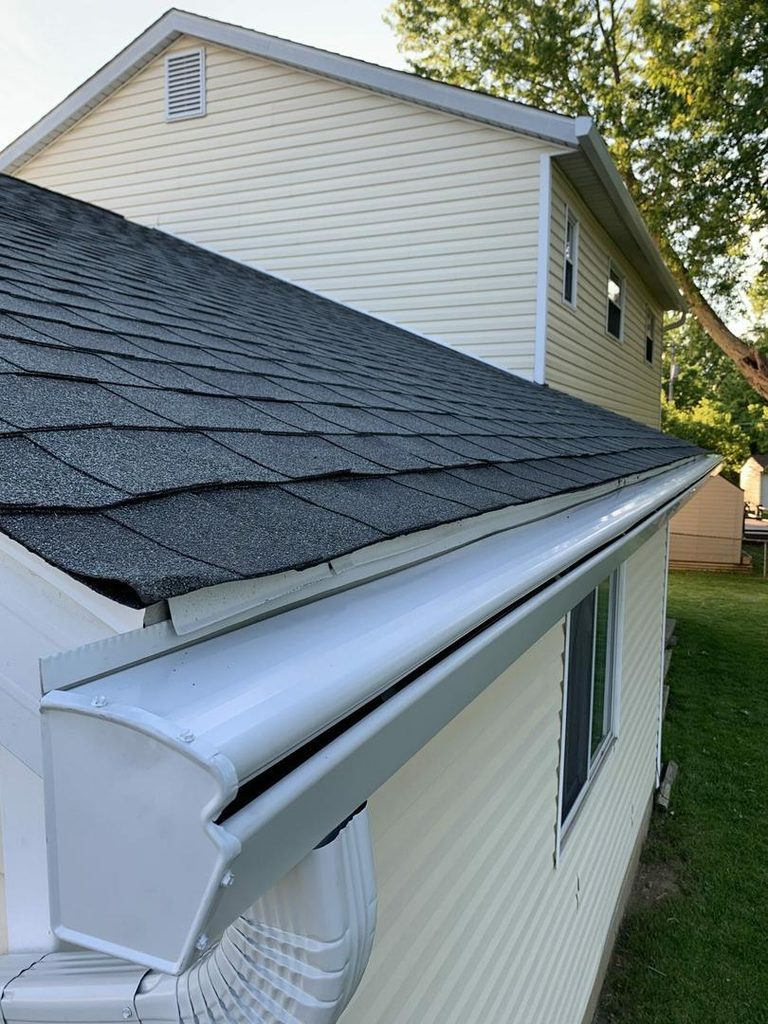
The K-Guard Leaf-Free Gutter System approaches the problem from the exit side. K-Guard’s own product description specifies a full 5-inch trench-style gutter combined with 3×4-inch downspouts that are wider than the conventional residential size (K-Guard corporate). Using the code table, that pairs a 74 gpm trough with a 192 gpm exit, so the outlet stops being the restriction.
The hood affects water flow too. A curved hood uses surface tension to admit water while shedding leaves and pine needles off the edge, so the material that normally mats at the drop never gets into the trough (how the system works). The hood, gutter, hangers and downspouts also go on as one assembly instead of being layered onto an aging trough, which means pitch gets set fresh across the whole run rather than inherited from the last installer (the K-Guard difference).
Questions worth asking before you sign anything
An estimator who can answer these has done the arithmetic on your house:
- How much roof area drains to each proposed run?
- How many downspouts, and what size are they?
- What slope are you setting, and how are you holding it?
- Where do the valleys land, and is there an outlet near each one?
If the only answer you get is that they’ll put up bigger gutters, you’re buying width and hoping it covers a drainage problem.
FAQ
Are 6-inch gutters better than 5-inch gutters?
Not automatically. Ohio Plumbing Code Table 1106.6 rates a 5-inch gutter at 74 gpm and a 6-inch gutter at 110 gpm at 1/8 inch per foot of slope. A 2,000-square-foot roof section in a 100-year Columbus storm produces about 59 gpm, which is inside the 5-inch rating. The larger trough earns its keep on long runs, steep pitches and valley-heavy rooflines.
How do I calculate what size gutter my house needs?
Multiply the roof area draining to that run by the rainfall intensity, then multiply by 0.0104, per Equation 11-1 of the Ohio Plumbing Code. Compare the result with the capacity tables in Section 1106. For Columbus, NOAA Atlas 14 gives 1.91 inches per hour for a 10-year, one-hour storm.
Why do my gutters overflow when they are not full of water?
Because the restriction is usually downstream. A blocked or undersized outlet, a sagging section that holds standing water, or a valley sending a lot of roof into a short stretch of gutter will all push water over the front lip while most of the trough looks empty.
Does a bigger downspout matter more than a bigger gutter?
Frequently, yes. Table 1106.3 rates a 3×4-inch leader at 192 gpm, while a 2×2 leader is rated at 30 gpm. Adding outlet capacity often solves an overflow that widening the gutter wouldn’t.
What size gutters does K-Guard install in Central Ohio?
K-Guard installs a full 5-inch trench-style gutter with a built-in hood and 3×4-inch downspouts, installed as one integrated system rather than a cover added to existing gutters.
Will gutter guards make overflow worse?
It depends on the design. Covers that reduce the opening into an already undersized or poorly pitched gutter can. A hooded system that replaces the gutter, sets fresh pitch and enlarges the downspout addresses the parts that actually restrict flow.
Get the numbers for your own roof
Correctly sized gutters protect the fascia, the siding and the ground around your foundation, and they do it without putting you on a ladder. If water spills over the front edge during heavy rain, contact K-Guard of Central Ohio to schedule an on-site estimate and ask for the roof area, outlet count and downspout size figured for your home.



One Response