
Gutter Guard Types Compared: Screens, Micro-Mesh, and Hooded Systems
Shopping for gutter protection in Central Ohio gets confusing fast. Three very different products get sold under the same phrase. The gutter guard types on the market run from a thin mesh screen you push into an existing gutter to a full replacement gutter with an engineered hood on top.
These are not variations of one idea. Each handles debris, water volume, and upkeep in a different way. The gap shows up most in a climate with dense fall leaf drop and a real winter.
This guide sorts the different types into three honest groups. It explains the physics of each, then gives you a decision table to take into a sales appointment.

The Three Gutter Guard Types, Defined
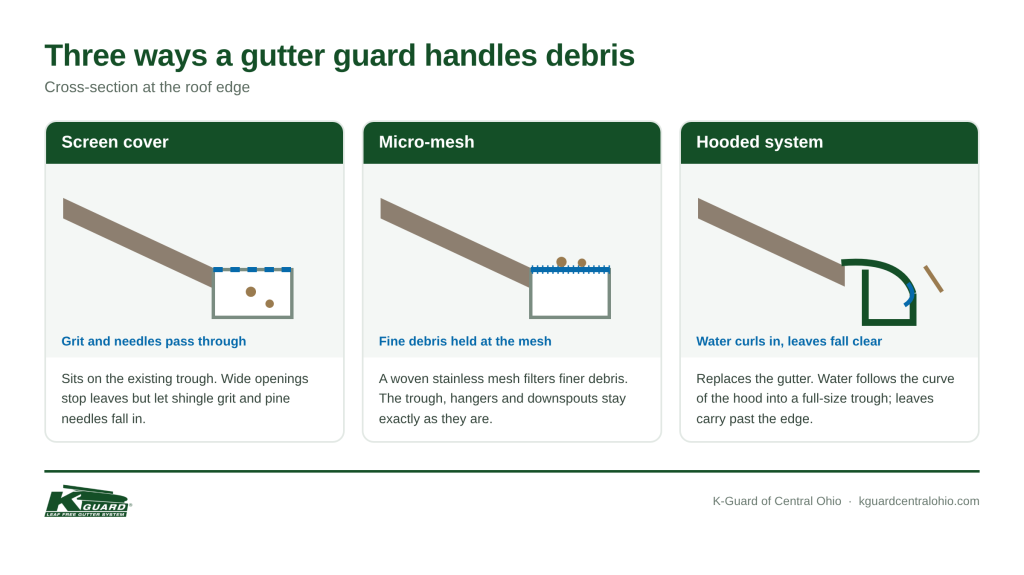
Screens and perforated covers are single-layer products. They come in aluminum, steel, vinyl, or plastic. They sit on top of the gutter you already have.
Amerimax describes one retail version as a hinged convex guard that clips to the front lip of the gutter with a push of a finger. It ships in three-foot sections sized to fit standard K-style gutters (Amerimax installation sheet). The openings in gutter screens stop a maple leaf. They do not stop a shingle granule or a pine needle.
Micro-mesh guards trade the wide screen for a fine woven mesh, usually stainless steel. Gutterglove calls its patented V-Bend product a stainless mesh with an engineered aperture, made since 2004 (Gutterglove). The company states the hole size in that stainless mesh is 540 microns (Gutterglove FAQ). A tighter weave excludes smaller debris. It also creates more surface area that can film over with grit.
Hooded, integrated systems are not covers. They replace the gutter itself. The K-Guard® system is built as one unit. Water sticks to the curve of the hood and flows into the trough while leaves are shielded from entering. The trough is a full-size five-inch gutter, and the downspouts are oversized 3×4-inch (K-Guard). Hangers are patented high-impact polymer, screwed into the fascia board and rafter tails (K-Guard). The K-Guard of Central Ohio product page lists those same four parts: hood, high-capacity gutter, 3×4-inch downspouts, and polymer hangers.
That structural split matters for one reason the manufacturer states plainly. A topper on a gutter that already leaks, rots, or pulls away leaves those problems in place. The topper only addresses debris (K-Guard).
How Each Style Handles Debris and Water
| Feature | Screens / perforated covers | Micro-mesh | Hooded integrated system |
|---|---|---|---|
| What is installed | Cover over the existing gutter (Amerimax) | Framed fine mesh over the existing gutter | New gutter, hood, downspouts, and hangers as one unit (K-Guard) |
| Debris excluded | Leaves and large twigs; openings pass grit and needles | Fine debris down to the aperture — 540 microns in one stainless product (Gutterglove) | Leaves, pine needles, and debris slide off the hood edge (K-Guard) |
| How water enters | Falls through the openings | Passes through the mesh | Surface tension around the hood curve (K-Guard) |
| Gutter capacity changed? | No — existing trough | No — existing trough | Yes — full-size 5-inch trough, 3×4-inch downspouts (K-Guard of Central Ohio) |
| Attachment | Clips to the front gutter lip (Amerimax) | Frame on the gutter, often under the first shingle course | Polymer hangers into fascia and rafter tails (K-Guard) |
| Fixes a failing gutter? | No | No | The trough is replaced as part of the system |
The third column is the one homeowners find odd at first. A reverse-curve hood does not filter water. It uses adhesion. Water clings to the curve, wraps around the lip, and drops into the trough. A leaf cannot follow that curve, so it carries past the edge and falls to the ground. K-Guard describes this mechanism directly (K-Guard).
Foam and brush inserts round out the shopping list. Both sit inside the trough rather than over it. Foam gutter guards are sold as polyether foam inserts shaped to the gutter profile (GutterFoam). A foam or brush insert leaves your existing trough, capacity, and hangers exactly as they are.
Why Central Ohio Makes This Choice Harder
Two local realities put pressure on any gutter guard.
The first is water volume. Columbus averages 2.90 inches of precipitation in October, 3.13 inches in December, and 3.85 inches in April under the 1991–2020 climate normals (National Weather Service). Monthly totals hide the real problem. Capacity is decided by single hard storms.
That is why trough and downspout size belong in the conversation, not just the cover on top. The plumbing code works the same way. Horizontal gutters must be sized on the flow rate coming off the roof surface, and capacity in gallons per minute rises with both size and slope (UpCodes, Section 1106.6).
The second reality is debris type. Local maple, oak, and ornamental pine mean you are not filtering one particle size. Oak tassels arrive in spring. Maple seeds follow in early summer. Dense leaf fall lands in October, and pine needles drop year-round.
Each defeats a different product. Screens pass needles and grit. Mesh stops them but collects them on its face, where they need brushing off. A hood sheds them over the edge.
The Maintenance Question Nobody Asks Directly
Every guard changes maintenance rather than ending it. Honest manufacturers say so. K-Guard’s national FAQ states that no protection system delivers zero maintenance, while noting that high-performance leaf guards cut buildup sharply and that inspection after severe storms is still advised (K-Guard).
The reason this matters is safety, not convenience. NIOSH researchers summarize a 16-year U.S. study of ladder falls treated in emergency departments. It estimates about 136,000 such falls per year, with frequency rising more than 50% between 1990 and 2005 (NIOSH paper hosted by the CDC). Fewer trips up a ladder is a real argument.
Debris left in a trough carries two quieter costs. The CDC lists clogged gutters among the container habitats mosquitoes use to lay eggs (CDC). And the wood behind a gutter that overflows stays wet. USDA Forest Service researchers state that wood will decay above 30% moisture content and will not decay below 20% (USDA Forest Service).
Choosing Between Gutter Guard Types: A Decision Table
| If your situation is… | The style that usually fits | Why |
|---|---|---|
| Gutters are sound, debris is large leaves only, budget is tight | Gutter screens | Lowest-cost step; grit and needles still enter |
| Gutters are sound, heavy pine needle or shingle-grit load | Fine mesh | Excludes fine debris; expect surface cleaning |
| You want the simplest retail fix and accept frequent checks | Foam or brush insert | Sits in the trough; changes nothing structural (GutterFoam) |
| Gutters leak, sag, or pull away | Hooded integrated system | Trough, hangers, and downspouts are replaced (K-Guard) |
| Long roof runs feeding few downspouts | Hooded integrated system | 3×4-inch downspouts flush water and small debris (K-Guard of Central Ohio) |
| You are on a ladder more than twice a year | Fine mesh or hooded | Cuts ladder exposure (NIOSH, CDC-hosted) |
Apply one more filter. Ask how the product attaches. K-Guard’s comparison material flags that guards fastened under roof shingles can raise roof warranty questions. It presents hangers screwed into the fascia board and rafter tails as the stronger approach (K-Guard). Whatever you buy, get the attachment method in writing. Then check it against your roof paperwork.
Where to Go Next
Want the mechanics of the hooded approach in more depth? Read how the K-Guard system works. For part-level specs on the hood, gutter, downspouts, and hangers, see our products. For a wider walkthrough of guard options, the earlier guide to comparing gutter protection options covers the shopping process itself.

Frequently Asked Questions
What are the main types of gutter guards? Three groups cover most of the market. Screens and perforated covers sit on an existing gutter. Mesh panels filter fine debris through woven stainless cloth. Hooded integrated systems replace the gutter with a hood, trough, downspouts, and hangers as one assembly (K-Guard).
Do gutter guards stop pine needles? Screen-style covers usually do not, because their openings are wider than a needle. Fine mesh excludes them at the aperture. Hood systems are designed so needles slide off the front edge instead of entering the trough (K-Guard).
Will a gutter guard fix a gutter that leaks or sags? No. A cover on a gutter that already leaks, rots, or pulls away leaves those defects in place. The maker of the integrated system says this directly, which is why that approach replaces the trough (K-Guard).
Are gutter guards truly maintenance-free? No system delivers zero maintenance. K-Guard’s own materials say so, while noting that high-performance leaf guards cut maintenance sharply (K-Guard).
Does gutter size matter as much as the guard? Yes. The plumbing code sizes horizontal gutters on the flow rate off the roof surface, not on the cover installed over them (UpCodes, Section 1106.6). A guard on an undersized trough can still overflow.
Do gutter guards work with 5-inch and 6-inch gutters? Retail screens and mesh are sold for both sizes. The K-Guard system is different. It supplies its own full-size five-inch trough as part of the assembly (K-Guard).
Picking the right style protects your fascia, your foundation, and the look of the house you already invested in. Contact K-Guard of Central Ohio to schedule a free inspection and estimate.



One Response