Gutter Hangers and Fascia: What Actually Holds Gutters to Your House
When we come out to look at a gutter run, homeowners usually point at what they can see from the driveway, the color, the seams, whether the front line looks straight. We’re looking at the hardware inside the trough, spaced out along the fascia, since that’s what we see give out years before the gutter itself wears out.
A gutter carrying rain and wet leaves gets heavy, and all of that weight lands on one board at the roof edge through a small number of fasteners. What those fasteners bite into, and what shape that board is in, is what keeps the run where it was installed.
Gutter hangers, spikes and straps: three gutter hanging systems
Older Central Ohio homes usually show one of three systems at the eave.
Spikes and ferrules. This is a long nail driven through the front lip, through a tube, and into the fascia. It’s simple and cheap, and it fails in a predictable way, because seasonal expansion works the spike back out until the front lip drops, water ponds, and the added weight speeds the whole thing up. Spike heads standing proud of the front lip are the sign you’ll notice first.
Strap hangers. Rain gutter strap hangers run up over the roof deck and fasten under the shingles, which makes them strong. Because they fasten to the roof covering, you’ll want to check your shingle manufacturer’s instructions before anyone adds or replaces them.
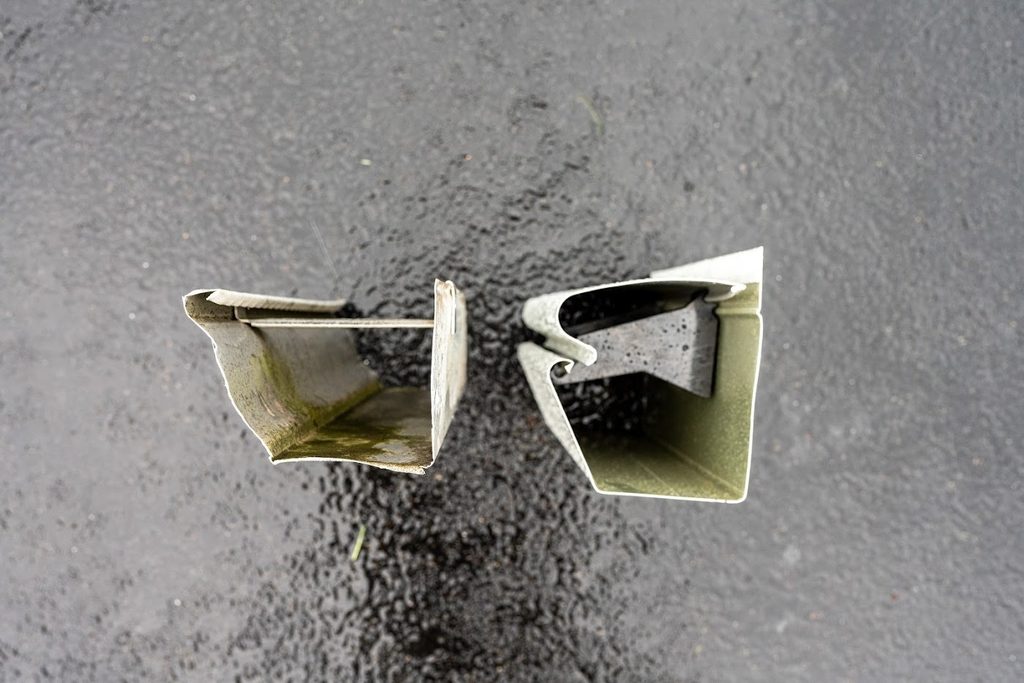
Hidden hangers. Hidden gutter hangers are clips inside the trough that screw into the fascia, and they’re the current standard for K-style aluminum gutters because a screw holds where a nail gradually relaxes.
We take a fourth approach, where the bracket is part of the gutter design rather than an accessory added to it. Our patented high-impact polymer hangers fasten the system to the fascia board and rafter tails, so it never attaches to the roof covering at all.
How far apart hangers should sit
Hanger manufacturers and the structural standard for gutters land on close to the same spacing, so this is one number you can hold an installer to.
| Source | Spacing guidance | Context |
|---|---|---|
| Amerimax hidden hanger installation guide | One hanger every 24 inches, tightening to 18 inches in heavy ice and snow load areas | Residential aluminum gutter runs |
| ANSI/SPRI GD-1 structural design standard | Fastener rows securing the nailer at no more than 24 inches on center | Gutter systems on low-slope roofs |
| Our K-Guard system | Bracket-based hangers fastened to fascia and rafter tails as part of the system design | Integrated hooded gutter |
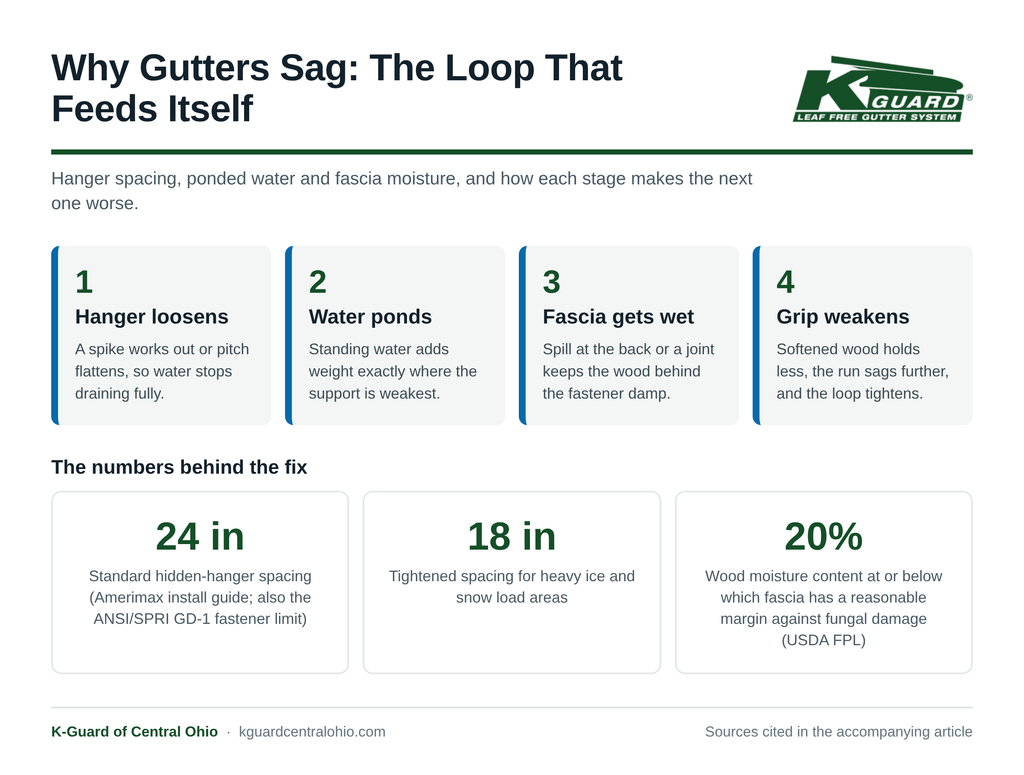
The Amerimax guide for hidden hangers calls for one every 24 inches, tightening to 18 inches where ice and snow load are heavy, and it also recommends increasing downspout size or count in heavy-downpour conditions (Amerimax aluminum gutter hidden hanger installation guide). On the commercial side, the ANSI/SPRI GD-1 standard limits fastener spacing securing the nailer to 24 inches on center per row (ANSI/SPRI GD-1).
Central Ohio is one of the places where the tighter 18-inch spacing earns its money, since ice loading here is a normal part of most winters and a run that carries ice in February gets tested harder than the guidance assumes.
The wood underneath is half the job
Every hanger screws into fascia, the board running along the roof edge behind the gutter, and it takes more weather than any other exposed wood on the house. When that board stays damp, screws that were tight on install day start working loose in it.
The USDA Forest Products Laboratory’s Wood Handbook is precise about the threshold. Serious decay occurs only when wood moisture content is above the fiber saturation point, which averages about 30 percent, and fully air-dried wood at 20 percent moisture content or less has a reasonable margin of safety against fungal damage (Wood Handbook, Chapter 14: Biodeterioration of Wood). A fascia that stays dry lasts for decades, while one taking a steady drip from an overflowing gutter doesn’t get anywhere close.
This loop is worth understanding, because it explains why sagging gutters get worse instead of holding steady:
- A hanger loosens or the pitch flattens, so water ponds.
- Ponded water spills at the back or the joint and wets the fascia.
- Wet fascia softens, so the screw’s grip weakens.
- The run sags further, ponds more, and the cycle repeats faster.
Soft fascia does not hold new hardware any better than it held the old hardware. We check the board when we come out to measure, and if any of it needs replacing, that goes in the estimate before we hang anything on it.

What you can check from the ground
None of this requires a ladder, and we’d rather you didn’t get on one to find out. From the driveway, in good light:
- Sight down the run and check whether it reads as a straight line or dips in the middle.
- Look for spike heads standing proud of the front lip.
- Check the gap between the back of the gutter and the fascia for daylight.
- After rain, look for a drip line in the soil or mulch directly below the run.
- Look at the fascia paint, since peeling and staining below a joint points to wet wood.
- Note any section that’s been re-attached with a different bracket than its neighbors.
Two or more of those on the same run generally means the attachment is the problem rather than the gutter itself.
How this shapes a replacement conversation
If the fascia is sound, your practical choices are hanger type and spacing. If the fascia isn’t sound, the wood gets addressed first, whatever product goes on afterward.
That’s also why we sell a system instead of an accessory. Because the hood, trough, hangers and downspouts are built together and go on at once, we set spacing and pitch fresh across the whole run rather than inheriting them from the last install (the K-Guard difference). You can see how we handle that in our installation process, from what comes off the house to what condition the wood underneath is in.
FAQ
How far apart should gutter hangers be?
Amerimax’s installation guide for hidden hangers calls for one every 24 inches, tightening to every 18 inches in heavy ice and snow load areas. The ANSI/SPRI GD-1 standard for low-slope roof gutter systems caps fastener spacing securing the nailer at 24 inches on center.
Why is my gutter pulling away from the house?
Usually the fastener has lost its grip, either because a spike has worked out of the fascia or because the wood behind it has stayed wet long enough to soften. Ponding water at a low spot speeds up both.
Are hidden hangers better than spikes?
Hidden hangers use screws rather than nails, which resist the seasonal working that backs spikes out of the fascia, and that’s why they’re the current residential standard.
Does the fascia need to be replaced before new gutters?
If it’s soft or decayed, yes. New hardware fastened into compromised wood repeats the failure. Wood kept below about 20 percent moisture content has a reasonable margin of safety against fungal damage, per the USDA Forest Products Laboratory.
Can gutter hangers be added to an existing gutter?
Sometimes, as a repair. It won’t correct pitch that has already flattened or seams that have opened, so treat it as a short-term measure on an aging run.
What holds a K-Guard system to the house?
Our patented high-impact polymer hangers, fastened to the fascia board and rafter tails, with the hood, gutter and downspouts installed as one integrated system.
Have the roofline looked at before it sags further
Sound hangers and dry fascia are what keep a gutter straight, protect the trim and siding below it, and keep you off a ladder. If a run on your house is sagging or pulling away, get in touch for an on-site estimate and ask what condition the fascia is in before any new gutter goes up.