The Complete Guide to Gutter Downspouts
Why Gutter Downspouts Are the Most Overlooked Part of Your Home’s Water Defense
Gutter downspouts are the vertical pipes that carry rainwater from your gutters down the side of your home and safely away from your foundation. They are the final — and most critical — link in your roof drainage system.
Quick answer: What you need to know about gutter downspouts
| Topic | Key Facts |
|---|---|
| What they do | Move water from roof gutters to ground level, away from your foundation |
| Common sizes | 2×3 in. (standard) and 3×4 in. (high-capacity) rectangular; 3–6 in. round |
| Best material | Rust-free aluminum is the industry standard |
| Spacing rule | One downspout per 20–40 linear feet of gutter |
| Discharge distance | Minimum 4–6 feet from the foundation wall |
| Bracket spacing | Secure to the wall at least every 4–6 feet |
| Common problems | Clogs, leaks, separation, ice buildup, foundation erosion |
Most homeowners spend a lot of time thinking about gutters — but very little time thinking about downspouts. That’s a mistake.
A clogged or undersized downspout can back up an entire gutter run, sending water cascading over the edge and straight down toward your foundation. Over time, that leads to basement flooding, soil erosion, and costly structural repairs.
The downspout may actually be the most underappreciated part of the entire gutter system — and getting it right matters far more than most people realize.
This guide covers everything: types, materials, sizing, installation, maintenance, extensions, and how to choose the right system for your home.
I’m Rich Mannino, General Manager of K-Guard Leaf Free Gutters, and I’ve spent nearly two decades helping homeowners across Central Ohio solve the exact problems that poorly designed gutter downspouts create. In that time, I’ve seen how the right downspout size, material, and placement can be the difference between a dry basement and an expensive water damage claim.
Materials and Profiles of High-Performance Downspouts
When it comes to gutter downspouts, the material and shape (profile) you choose will dictate how long the system lasts and how much water it can handle. In residential drainage, not all materials are created equal.
| Material | Pros | Cons |
|---|---|---|
| Heavy-Duty Aluminum | Rust-proof, lightweight, durable, available in many colors | Very few; the industry gold standard |
| Vinyl/Plastic | Cheap, DIY-friendly | Cracks in Ohio winters, fades in sun, lacks durability |
| Galvanized Steel | Strong | Prone to corrosion and rust over time |
| Copper | Beautiful aesthetic, extremely long-lasting | Very expensive, develops a patina (green) over time |
At K Guard, we utilize high-grade, heavy-duty aluminum because it provides the perfect balance of strength and weather resistance. Unlike vinyl, which becomes brittle and cracks during our freezing Central Ohio winters, aluminum maintains its structural integrity. It also outperforms thin-gauge steel, which eventually succumbs to rust after years of exposure to moisture.
Choosing the right look is also important. Your downspouts shouldn’t just be functional; they should complement your home’s exterior. You can explore Gutter Color Combinations from Roof to Rain: Make It Pop to see how different shades can enhance your curb appeal.
The K Guard Advantage: Oversized Profiles
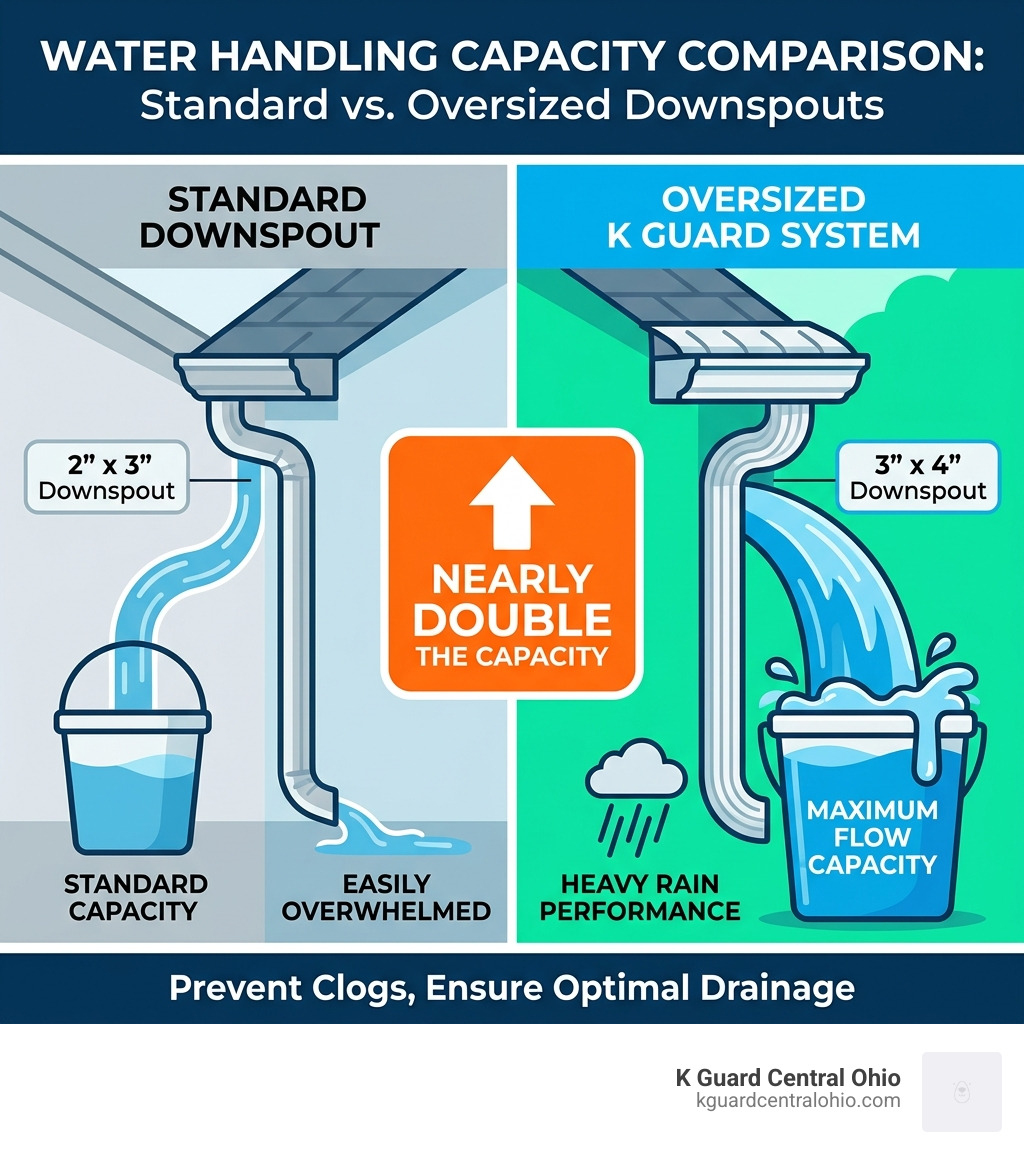
The most common residential gutter downspouts in the United States are 2×3-inch rectangular pipes. While these might suffice for a light drizzle, they often fail during the heavy downpours we see in April 2026.
We exclusively use 3×4-inch rectangular downspouts. This “oversized” profile is the secret to a high-performance system. A 3×4 downspout has a significantly larger cross-section than a 2×3, allowing it to move much more water and, more importantly, flush through any small debris that might enter the system. When paired with our K Guard hooded gutter system, these downspouts provide a seamless, high-capacity drainage solution that handles even the most intense Ohio storms without overflowing.
Material Durability and Finish
Our downspouts are manufactured from rust-free, high-grade aluminum that features a baked-on polymer finish. This isn’t just a coat of paint; it’s a durable finish designed to resist chipping, peeling, and fading. While many retailers like Home Depot or Lowe’s offer standard white or brown options, we provide a wide variety of Color Options to ensure your downspouts blend perfectly with your siding or trim. By avoiding materials like vinyl or thin-gauge steel, we ensure your system looks new and functions perfectly for decades.
Sizing and Placement Standards for Maximum Drainage

Properly sizing and placing your gutter downspouts is a science. If you have too few downspouts, your gutters will overflow. If they are placed incorrectly, water will pool against your foundation.
To determine the right setup, we look at your roof’s square footage and the “rainfall intensity” of Central Ohio. A large, steep roof collects water much faster than a small, flat one. Understanding Don’t Get Drained: Unpacking the True Cost of New Gutters and Downspouts helps put into perspective why investing in the right size from the start saves money on foundation repairs later.
Calculating Capacity for Heavy Rainfall
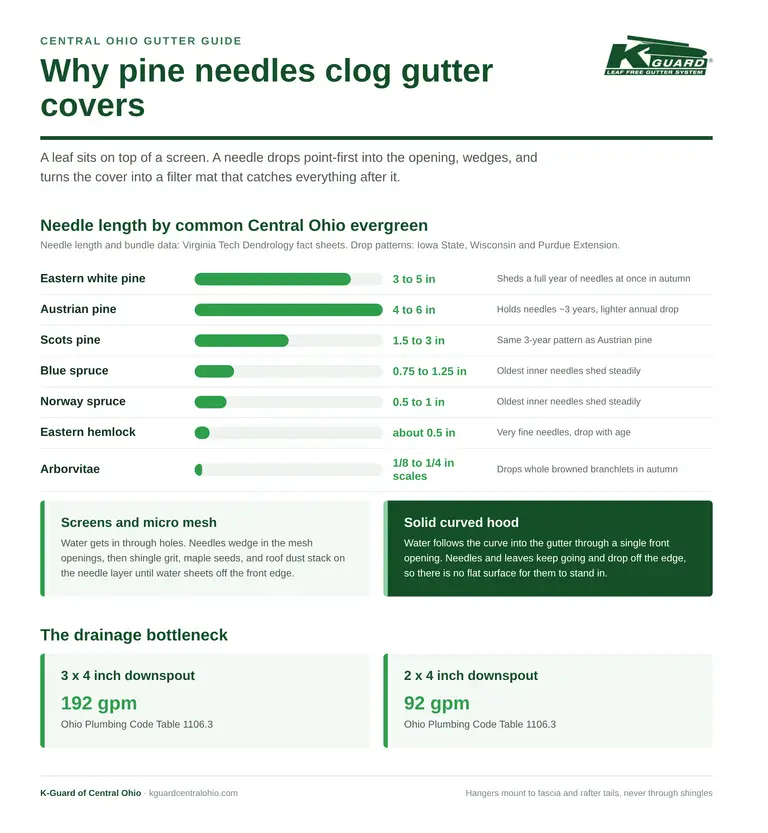
A standard 3×4-inch aluminum downspout has a drainage capacity of approximately 464 gallons per minute (GPM). This is a massive amount of water! In contrast, smaller 2×3 systems can struggle to keep up when a heavy storm hits a large roof area.
When we design a leaf-free system, we ensure the downspouts are sized to match the “wide-mouth” outlets of the K Guard system. This ensures there is no “bottleneck” where the gutter meets the downspout. If you have complex roof features, you might wonder To Gutter or Not to Gutter: A Dormer Dilemma; generally, if there is a roof surface, it needs a dedicated path for water to reach a downspout.
Professional Installation Standards
Building codes, such as IRC Section R903, provide guidelines for how gutter downspouts should be installed. At K Guard, we go beyond the minimum requirements.
- Mechanical Attachment: We secure downspouts to the dwelling using heavy-duty straps or bands.
- Spacing: Standards suggest attaching the downspout to the wall at intervals not exceeding 6 feet (though we often secure them every 4 feet for maximum stability against Ohio’s high winds).
- Structural Integrity: We ensure every connection is mechanically fastened with screws, not just tucked together, so they don’t separate during heavy rain or ice events.
Professional Installation and Maintenance-Free Living
Installing gutter downspouts might seem like a simple DIY weekend project, but getting the angles and seals right is difficult. Improperly installed elbows can lead to leaks that rot your fascia boards or siding. When Hiring a Gutter Contractor: What You Need to Know Before You Install, ensure they understand the importance of secure, leak-proof transitions.
Essential Components of a K Guard System
A complete downspout assembly is more than just a straight pipe. It includes:
- Front and Side Elbows: These allow the downspout to wrap around the eave of your roof and follow the contour of your home’s wall.
- Heavy-Duty Downspout Bands: These secure the pipe to your siding so it doesn’t rattle or blow away.
- Outlets: The transition point where the gutter feeds into the downspout.
- Sealants: High-grade, leak-proof sealants used at the joints to prevent “dripping” seams.
You can see our full process in action on our Installation page.
The End of Gutter Cleaning
The biggest advantage of the K Guard system is that it is designed to be clog-free. Traditional gutters and gutter downspouts require constant maintenance. Leaves and twigs fall into the gutter, wash into the downspout, and create a “plug” that stops all water flow.
With our hooded system, debris is deflected away while water is pulled into the gutter via liquid adhesion. This means you can finally say goodbye to the ladder. While other companies might suggest a Gutter Maintenance Schedule That Works Wonders, our goal is to eliminate that chore entirely. Our system also helps prevent ice buildup; by ensuring water flows freely through the oversized 3×4 downspouts, there is less standing water to freeze and cause damage during the winter.
Advanced Drainage Solutions and Foundation Protection
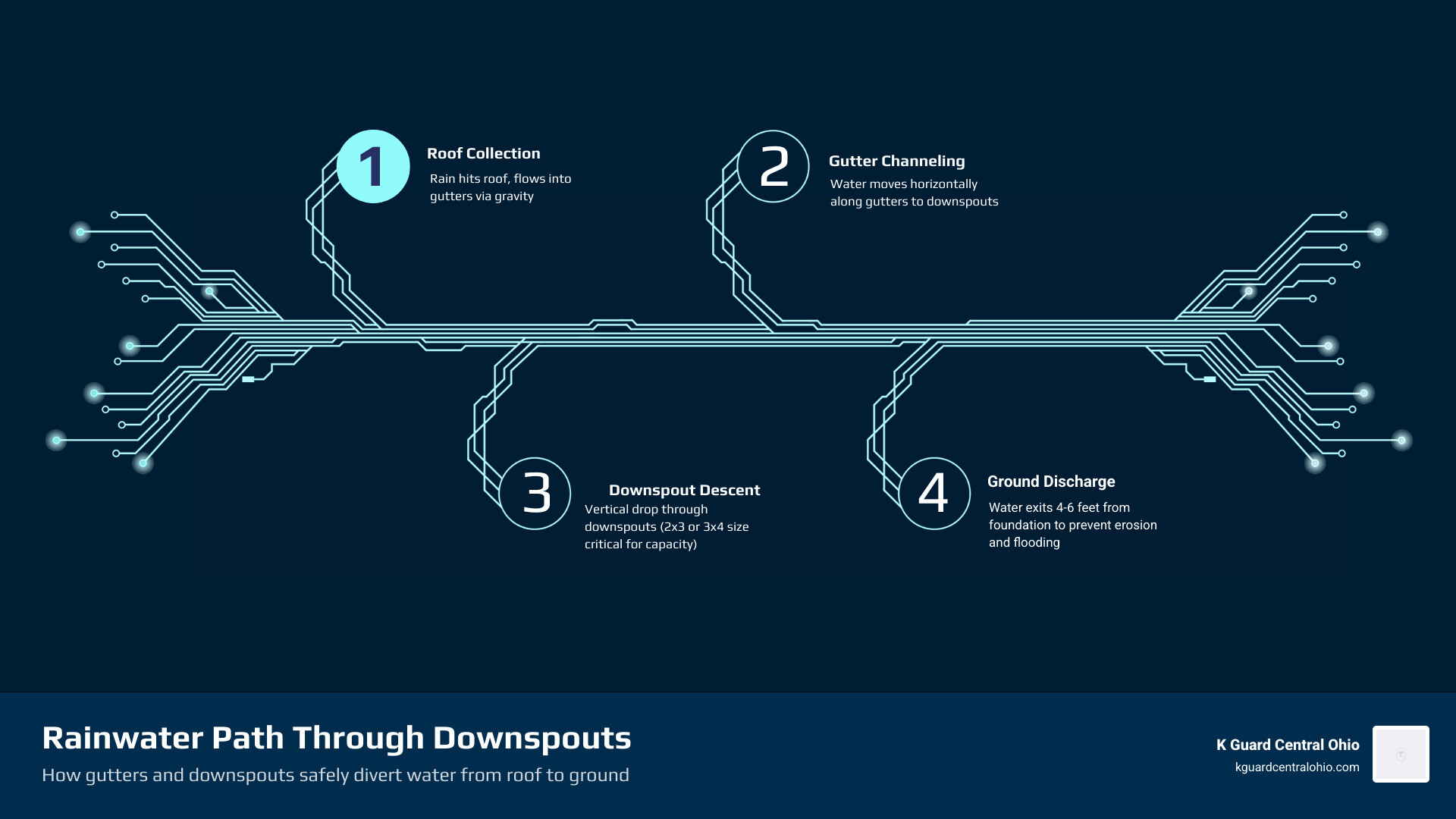
Getting the water down the wall is only half the battle. The most important job of gutter downspouts is to move that water away from your home. If the water just dumps at the base of your wall, it will eventually seep into your basement or crawlspace.
Underground Downspout Integration
For the ultimate clean look and maximum protection, many Central Ohio homeowners choose underground drainage. This involves connecting the downspout to a buried pipe that carries water far out into the yard.
- Debris Filtration: Even with a hooded system, a debris filter at the base of the downspout can act as a secondary fail-safe.
- Bubbler Pots and Pop-Up Emitters: These allow water to escape the underground pipe once it reaches a certain distance from the house.
- Mow-Over Lids: High-quality emitters feature green lids that sit flush with the grass, allowing you to mow right over them without damage.
- Freeze Protection: Professional underground systems are designed to handle the freeze-thaw cycles of Ohio, ensuring pipes don’t burst when the temperature drops.
Foundation Protection and Discharge Best Practices
A standard splash block (the little plastic or concrete tray at the bottom of a downspout) is often insufficient for heavy rain. We recommend that gutter downspouts discharge water at least 6 feet away from the foundation.
Proper discharge prevents:
- Foundation Erosion: Constant water flow can wash away the soil supporting your home.
- Basement Flooding: Hydrostatic pressure from saturated soil is the #1 cause of basement leaks.
- Landscaping Damage: High-velocity water can ruin flower beds and wash away mulch.
By using professional-grade extensions or underground kits, you ensure your home remains structurally sound. You can learn more about why these details matter on our Why KGuard page.
Frequently Asked Questions about Downspouts
Why does K Guard use 3×4 downspouts instead of the standard 2×3?
Standard 2×3 downspouts are easily overwhelmed by heavy rain and are much more prone to clogging. Our 3×4 downspouts offer nearly double the capacity, ensuring that even during extreme weather, your gutters won’t back up. This oversized design is essential for a truly maintenance-free system.
How do oversized downspouts protect my home’s foundation?
Oversized downspouts ensure that water is moved off the roof and into the drainage system as quickly as possible. By preventing overflows, they stop water from “sheeting” off the gutters and pooling at the base of your foundation, which is the primary cause of basement moisture and structural settling.
What is the average cost for a full K Guard system installation?
While every home is different based on its size and complexity, the average house installation for a complete K Guard system — including our leaf-free gutters and oversized gutter downspouts — is approximately $5,000. This investment provides a permanent solution and a lifetime guarantee.
Conclusion
Gutter downspouts are the unsung heroes of your home’s exterior. While they might not be the most glamorous part of your house, they are the primary defense against water damage, erosion, and foundation failure.
At K Guard Central Ohio, we provide the permanent solution that homeowners have been looking for. Our system combines heavy-duty aluminum construction, oversized 3×4 downspouts, and a patented hooded design that totally eliminates annual gutter cleaning.
With an average installation cost of $5,000, you aren’t just buying gutters; you’re buying peace of mind and a lifetime guarantee that you’ll never have to climb a shaky ladder to clear a clog again.
Ready to see how the K Guard system can protect your home? Learn How It Works or browse Our Products to find the perfect fit for your Central Ohio home.