Calculate Your Gutter Guard Costs Without Losing Your Mind
What Does a Gutter Guard Cost Calculator Actually Tell You?
A gutter guard cost calculator gives you a fast, practical estimate of what you’ll spend to protect your gutters — before you ever call a contractor. Here’s a quick breakdown of what to expect:
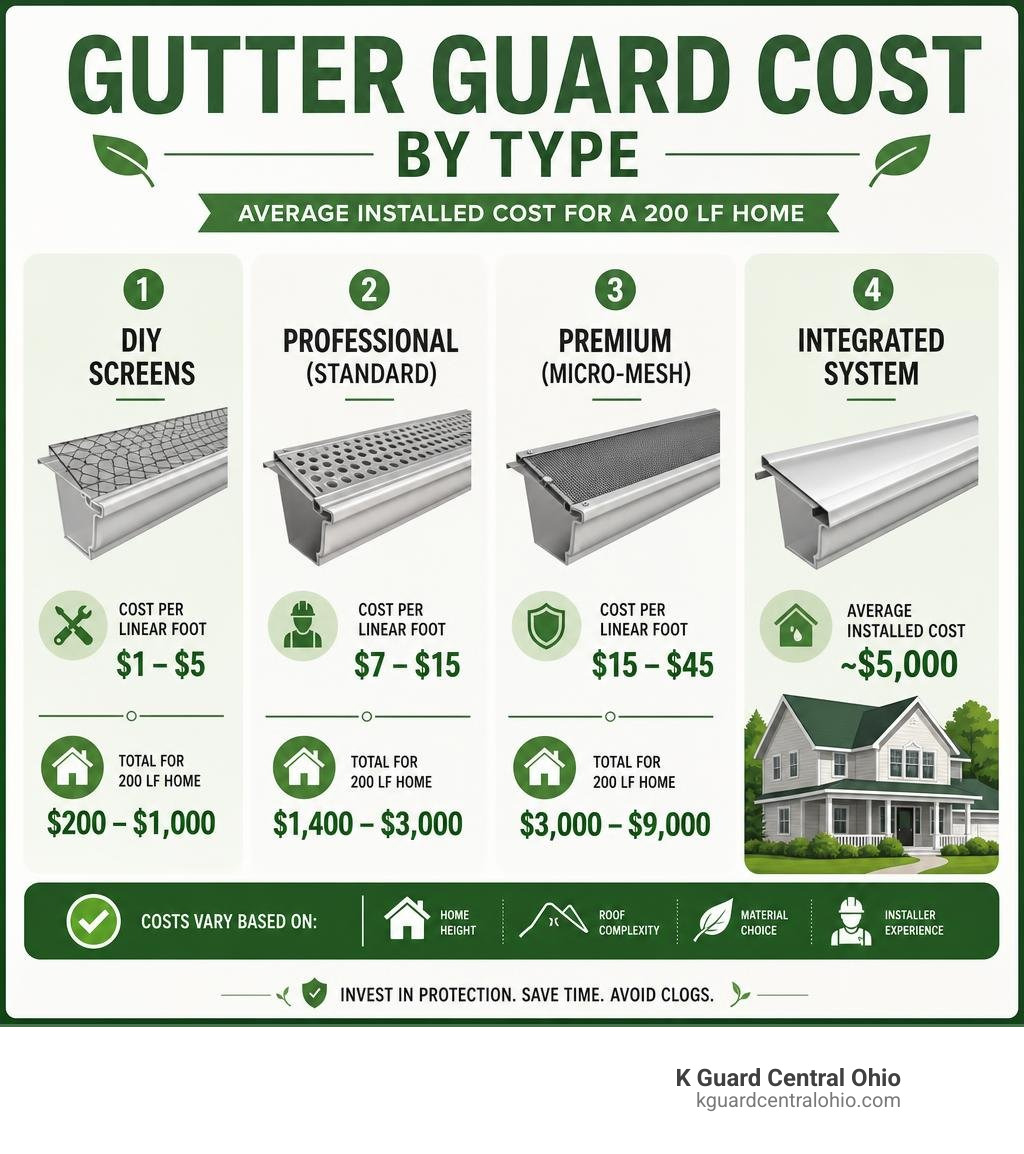
| Installation Type | Cost Per Linear Foot | Typical Total (200 LF Home) |
|---|---|---|
| DIY materials only | $1 – $5 | $200 – $1,000 |
| Professional (standard) | $7 – $15 | $1,400 – $3,000 |
| Professional (premium/micro-mesh) | $15 – $45 | $3,000 – $9,000 |
| K-Guard integrated system | Average installed cost | ~$5,000 |
The national average for professional gutter guard installation is around $1,000 for basic systems, but most homeowners with a full 200-linear-foot home pay $3,000–$9,000 depending on material and brand. For a premium, fully integrated system like K-Guard, the average installation cost is approximately $5,000, which includes a lifetime guarantee and the complete elimination of annual gutter cleaning.
Cost swings this wide can feel overwhelming. The type of guard, your home’s height, roof complexity, and the installer you choose all pull the number in different directions — sometimes by thousands of dollars.
I’m Rich Mannino, General Manager of K-Guard Leaf Free Gutters, and I’ve spent nearly two decades helping homeowners cut through the noise on gutter guard pricing and find solutions that actually hold up. My experience with the gutter guard cost calculator question comes from real-world installs, not just spec sheets. In the sections below, I’ll walk you through exactly how to estimate your costs and what to watch out for.
Important gutter guard cost calculator terms:
How to Use a Gutter Guard Cost Calculator for Your Home
When you start looking at a Gutter Guard Cost Calculator, the very first number it will ask you for is your home’s total gutter linear footage. If you don’t happen to have the original architectural blueprints of your home handy, don’t panic. You can get a highly accurate estimate right from the ground.
Using a calculator helps you visualize the project scope before you invite a single estimator to your property. Understanding how these measurements translate to dollars is the first step in realizing Why Your Home Needs Gutter Guards Right Now. It keeps you in the driver’s seat, ensuring you aren’t caught off guard by standard industry pricing.
Estimating Linear Footage for Your Gutter Guard Cost Calculator
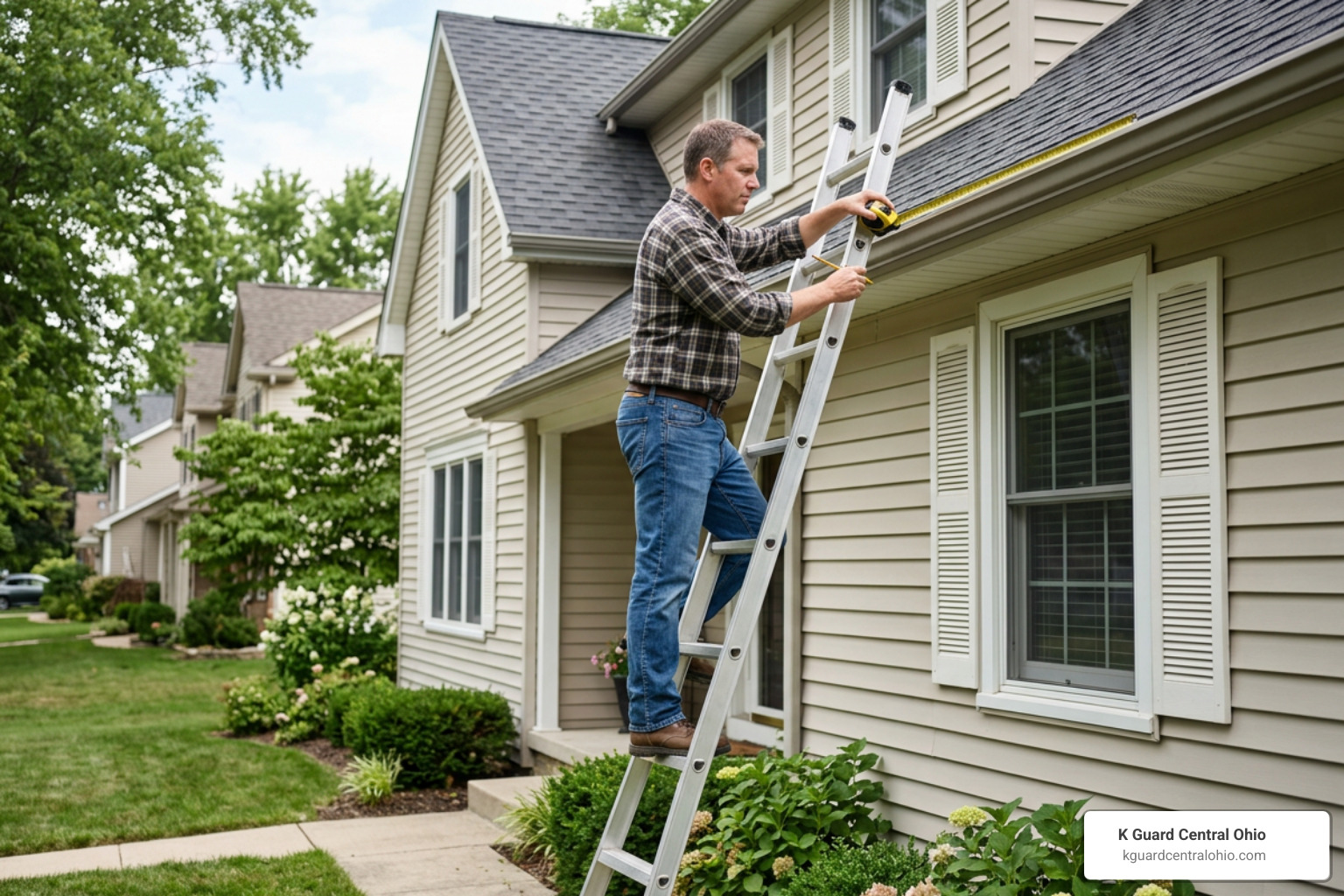
To get a reliable number for your gutter guard cost calculator, you don’t need to climb up a shaky ladder with a metal tape measure. Instead, you can estimate your linear footage using your home’s ground-level footprint.
Here is the easiest way to do it:
- The Footprint Method: Measure the length and width of your home at the foundation level. If your home is a simple rectangle measuring 50 feet by 40 feet, the total perimeter is 180 feet (50 + 50 + 40 + 40).
- Identify Gutter Runs: Standard gable roofs only have gutters on the two sloped sides, not the flat ends. In our 50×40 example, you would only have gutters along the two 50-foot sides, totaling 100 linear feet of gutters.
- Account for Roof Pitch and Complexity: If you have a hip roof (where the roof slopes down on all four sides), you will have gutters wrapping entirely around the perimeter. In that case, you would need the full 180 linear feet.
- Add a Waste Factor: Always add a 10% to 15% waste factor to your total calculation. This accounts for cutting, corner miters, and matching up the guards to your unique roofline angles. For a 100-foot run, budget for 110 to 115 feet of material.
Why a Gutter Guard Cost Calculator Saves You Money Long-Term
Taking the time to run these calculations isn’t just about budgeting for next week; it’s about planning for the next decade. Homeowners in Central Ohio often find themselves trapped in a cycle of paying $150 to $300 per gutter cleaning visit, multiple times a year.
If you clean your gutters twice a year, that is an ongoing cost of $300 to $600 annually. Over ten years, you will easily spend $3,000 to $6,000 on temporary cleaning services alone. And that’s assuming labor rates don’t rise by June 2026!
When you look at the math through a long-term lens, investing in a permanent solution stops looking like an expense and starts looking like a smart financial move. Beyond the direct cleaning bills, clogged gutters lead to pooled water, rotting fascia boards, ruined landscaping, and cracked foundations. A single foundation repair bill can easily exceed $10,000. By investing in a reliable system, you protect your home’s equity and completely eliminate those recurring maintenance costs. For a deeper dive into this financial breakdown, check out our guide on Gutter Guard Costs and Whether They Are Actually Worth It.
Key Factors That Drive Gutter Guard Installation Costs
A gutter guard cost calculator provides a great baseline, but real-world pricing is shaped by the physical realities of your home. No two properties in Columbus or the surrounding Central Ohio areas are exactly alike, and several key variables will influence your final installation estimate.
First and foremost is accessibility. If you have a single-story ranch home with a flat, easily accessible yard, the labor required to install your system is straightforward. However, if you own a multi-story colonial or a home built on a steep slope, the installers must use specialized safety rigging and taller ladders. This added complexity introduces a height surcharge, which typically increases professional labor rates by 20% to 40% for two-story homes, and up to 100% for three stories.
The physical condition of your existing gutters also plays a major role. If your current gutters are sagging, pulling away from the fascia, or rusted through, installing guards over them is a recipe for disaster. Any reputable professional will require that your gutters be cleaned, sealed, and structurally repaired before guards can be mounted. If your gutters are past their prime, it is often far more cost-effective to replace the entire setup with an integrated system like K-Guard, which replaces both the gutters and the guards simultaneously.
To understand how high-performing gutter systems handle the unique weather patterns we experience in Ohio, read about Heavy Rain Gutter Guards Defending Your Home from the Ultimate Deluge.
Why Cheap Add-On Guards Cost More Over Time
Many homeowners are tempted to buy cheap, retail add-on inserts from big-box stores to save money upfront. However, these systems are temporary band-aids that fail quickly under real-world conditions.
| Guard Type | Average Material Cost (Per LF) | Expected Lifespan | Typical Maintenance Required | Major Weakness |
|---|---|---|---|---|
| Plastic Screens | $0.50 – $1.00 | 3 – 5 Years | Annual manual cleaning | Warps in summer heat, cracks in winter |
| Foam Inserts | $1.50 – $3.50 | 2 – 3 Years | Frequent washing, replacement | Traps shingle grit, grows moss and weeds |
| Brush Guards | $2.00 – $4.00 | 10 – 20 Years | Pulling out and shaking clean | Pine needles and seeds get stuck in bristles |
| Standard Metal Screens | $1.50 – $5.00 | 5 – 10 Years | Brushing off the top | Small debris slips through; rusts over time |
| K-Guard Integrated System | Included in full system | Lifetime | Zero | Requires professional initial installation |
These cheap DIY inserts fail because they do not address the root cause of gutter clogs. They simply sit inside your existing gutters, acting as a shelf that catches leaves, seeds, and shingle grit. Eventually, the weight of the wet debris collapses the guards into the gutter trough, creating a worse clog than you had before.
Structural and Environmental Variables
Beyond the physical structure of your home, the environment surrounding your property dictates the type of gutter protection you need.
- Tree Canopy and Debris Type: The trees in your yard are the single biggest factor in choosing a system. If you have large oak or maple trees, standard screens might block the heavy leaves but will quickly clog with helicopter seeds and tassels. If you have pine trees, the needles will easily slip through standard mesh openings and clog your system from the inside.
- Roof Pitch: A steep roof pitch sends water cascading down at an incredible velocity. If your gutter guards cannot handle high flow rates, the water will simply overshoot the gutter entirely, pooling around your foundation.
- Local Climate: Here in Central Ohio, our gutters must withstand heavy spring downpours, humid summers, freezing winter snow, and ice dams. Cheap plastic guards will quickly warp under our hot summer sun and crack during our freezing winters.
DIY vs. Professional Gutter Guard Installation
When homeowners run the numbers on a gutter guard cost calculator, they often wonder if they can save money by taking the DIY route. While the lower upfront material cost of DIY retail products is appealing, it is crucial to understand the hidden costs, safety risks, and performance trade-offs involved.
Climbing ladders and working at roof height is inherently dangerous. According to national safety statistics, ladder falls are one of the leading causes of severe household injuries. Professional installers are fully licensed, bonded, insured, and trained in proper fall-protection techniques. When you hire a professional, you aren’t just paying for materials; you are paying for peace of mind, physical safety, and a guaranteed result.
For a detailed look at why staying on the ground is the smartest choice you can make, read our guide on how to Stop Climbing Ladders with the Best Gutter Guard Systems.
The True Cost of DIY Gutter Protection
At first glance, spending $500 on DIY materials at a local home improvement store looks like a massive savings compared to a professional installation. However, the true cost of DIY goes far beyond the retail price of the inserts.
To complete a proper DIY installation, you will need to purchase or rent specialized tools, including heavy-duty extension ladders, stabilizer bars, safety harnesses, and professional-grade cutting shears. These tool costs can quickly add hundreds of dollars to your budget.
Furthermore, DIY installations offer no workmanship warranty. If you make a mistake during the installation — such as damaging your roof shingles or altering the slope of your gutters — you could easily void your home’s roof warranty. Because cheap retail inserts degrade quickly under UV exposure and heavy winter ice, you will likely find yourself back on the ladder replacing them every few years.
The Value of Professional Gutter Protection Services
Choosing a professional gutter protection service means investing in a permanent, engineered solution for your home. Professional systems are designed to integrate seamlessly with your existing roofline without disrupting your shingles or voiding your warranties.
The real value of a professional system lies in the warranty and the quality of the materials. When you choose a premium, fully integrated system like K-Guard, you receive a lifetime warranty that guarantees your gutters will never clog. If there is ever an issue, a professional team will handle it, ensuring you never have to climb a ladder again.
To learn more about the long-term value of professional installation, read Professional Gutter Protection Services Are They Worth the Investment.
Frequently Asked Questions About Gutter Protection
Do gutter guards completely eliminate the need for cleaning?
While many retail products claim to be “virtually maintenance-free,” the reality is that most standard add-on screens, micro-meshes, and inserts still require periodic manual cleaning. Debris will inevitably pile up on top of flat screens, and pine needles or seeds can get stuck in the mesh pores, requiring you to climb up and sweep them off.
The K-Guard system is entirely different. Because it is a fully integrated, seamless system utilizing advanced physical principles, it is backed by a lifetime no-clog guarantee. It completely eliminates the need for annual gutter cleaning, keeping you safely on the ground forever.
How long does it take for gutter guards to pay for themselves?
For most homeowners, a high-quality professional gutter guard system will pay for itself within 5 to 10 years. If you currently spend $500 annually on professional gutter cleaning services, a $5,000 investment in a permanent, lifetime system will reach a full return on investment in exactly 10 years. Beyond that point, every year of protection is pure savings, not to mention the invaluable peace of mind and the prevention of costly home water damage.
Do gutter guards overflow during heavy rainstorms?
Many standard flat screen and reverse-curve add-on guards struggle to handle heavy downpours, causing water to overshoot the gutter and cascade onto your landscaping. The K-Guard system is engineered to handle even the most severe Midwestern deluges. By utilizing surface tension, K-Guard coaxes rainwater smoothly into the gutter trough while shedding leaves and debris over the edge, ensuring your home remains protected during heavy rainstorms.
Conclusion
When you look at a gutter guard cost calculator, it is easy to get lost in the sea of different materials, installation methods, and price points. However, the smartest approach to home maintenance is to invest in a solution that solves the problem permanently.
At K Guard Central Ohio, we provide a fully integrated, seamless leaf-free gutter system that is engineered to last for the lifetime of your home. We don’t offer temporary, flimsy add-ons that will warp, clog, or fail in a few seasons. Our system replaces your old, worn-out gutters with a beautiful, high-capacity, fully protected system that looks great and performs flawlessly under any weather conditions.
With an average installation cost of approximately $5,000 for a typical home, K-Guard delivers unmatched value, a lifetime no-clog guarantee, and the complete elimination of dangerous annual gutter cleaning.
If you are ready to stop worrying about your gutters and protect your Central Ohio home for good, explore Our Products today and schedule your free, no-obligation estimate!