
How to Start Gutter Maintenance in 5 Simple Steps
Why Gutter Maintenance Tips Every Homeowner Should Know
Following the right gutter maintenance tips can save you thousands of dollars in preventable home repairs. Here’s a quick overview of what you need to do:
- Clear debris from gutters at least twice a year — spring and fall
- Flush gutters and downspouts with a garden hose to confirm proper water flow
- Inspect for damage — look for sagging, rust, leaks, or separated seams
- Check the slope — gutters should drop about 1/4 inch per 10 feet toward the downspout
- Consider gutter guards to reduce how often you need to clean
Neglecting your gutters isn’t just inconvenient — it’s expensive. Overflowing gutters can cause an average of $8,000 in combined foundation and fascia damage. And 68% of fascia rot cases trace directly back to gutters that haven’t been cleaned or re-sloped in the past two years.
The good news? A simple, consistent routine keeps most of these problems from ever starting.
I’m Rich Mannino, General Manager of K-Guard Leaf Free Gutters, and I’ve spent nearly two decades helping homeowners across Central Ohio solve the exact gutter problems these gutter maintenance tips are designed to prevent. I’ll walk you through a practical, five-step routine — and show you where a permanent solution might make more sense than ongoing upkeep.
The Ultimate Guide to Gutter Maintenance Tips
When we think about home improvement, gutters rarely take center stage. They sit quietly at the edge of our roofs, doing their job without much fanfare—until they stop working.
Your gutter system is your home’s primary defense against water damage. When rain falls on your roof, your gutters collect those thousands of gallons of water and safely channel them away from your property. However, when leaves, twigs, pine needles, and shingle granules clog the system, that water has nowhere to go. It overflows, spilling directly down your siding, soaking into your fascia boards, and pooling at your foundation.

The consequences of this overflow compound quickly. If you want to understand the true value of preventative care, read our guide on Is Gutter Cleaning Worth It? Discover the Essential Benefits for Your Home. Uncontrolled water runoff can cause:
- Fascia Rot: The wood behind your gutters is highly vulnerable to moisture. Constant water exposure causes the wood to rot, weaken, and eventually fail, costing anywhere from $500 to $4,000 to repair.
- Foundation Damage: Water pooling at the base of your home saturates the soil, putting immense hydrostatic pressure on your foundation walls. This can lead to cracks, basement flooding, and structural shifting. Foundation repairs regularly run from $4,000 to over $10,000.
- Soil Erosion: Heavy sheets of overflowing water will wash away your landscaping, drown your plants, and carve deep trenches into your lawn.
- Mold and Mildew Growth: When water seeps behind your siding or into your crawlspace, it creates a damp environment where mold thrives, threatening both your home’s structural integrity and your family’s health.
To keep your home protected year-round, you need a solid framework. For a deeper dive into managing these seasonal demands, check out Gutter Maintenance: Year-Round Care & Cleaning 2026.
5 Simple Steps to Establish a Gutter Care Routine
If you have traditional sectional or open gutters, establishing a reliable maintenance routine is essential. While it may seem like a chore you can push off, taking a proactive approach protects your home’s architectural integrity.
Before we jump into the steps, let’s talk about safety. Working on a ladder is inherently risky. The Consumer Product Safety Commission reports over 160,000 ladder-related injuries annually. Never work on wet, windy, or icy days. Always have a partner nearby to spot you and stabilize the ladder.
If you are comfortable with heights and want to tackle this yourself, you can follow the instructions in this comprehensive DIY Gutter Cleaning and Repair Guide | Do It Yourself Authority to ensure you have the basics down.
Step 1: Clear Debris and Clogs Safely
The first step in any physical maintenance routine is removing the accumulated organic matter.
To do this safely and efficiently, you will need:
- A sturdy extension ladder (never lean it directly against your gutters, as this can bend the metal)
- A ladder stabilizer (stand-off) to keep the ladder secure against your home’s siding
- Heavy-duty work gloves to protect your hands from sharp metal edges and animal droppings
- Safety glasses to keep flying debris out of your eyes
- A plastic gutter scoop or trowel (avoid metal tools, which can scratch the protective coating of your gutters and invite rust)
- A bucket attached to your ladder with a S-hook to collect the debris
Start clearing debris near the downspout and work your way outward. This prevents you from accidentally pushing more clogs down into the downspout opening. Scoop out the leaves, twigs, and muck, dumping them into your bucket rather than throwing them onto your lawn or landscaping below. For a complete walkthrough on how to handle this process, check out our guide on Unclogging Your Gutters: A Step-by-Step Guide from the Ground Up.
Step 2: Flush the Troughs and Check Downspouts
Once the bulk of the debris is out of the gutter troughs, it’s time to flush the system. Grab your garden hose, equip it with a high-pressure spray nozzle, and bring it up the ladder.
Start at the far end of the gutter run (opposite the downspout) and wash the remaining fine dirt, pine needles, and shingle granules toward the downspout. As you flush the system, watch the water flow. Does it move quickly and cleanly toward the downspout? Or does it pool in certain areas?
Next, pay close attention to the downspouts themselves. Water should exit the bottom of the downspout freely. If water backs up and overflows at the top of the downspout elbow, you have a clog. You can clear minor downspout clogs by inserting the hose directly into the downspout and spraying at full pressure. For stubborn clogs, use a handheld plumber’s snake or auger to break up the debris from the bottom up, as 80% of downspout clogs occur at the elbow joints.
Finally, ensure your downspout extensions are properly positioned. Water must be discharged at least 4 to 6 feet away from your foundation (5 to 10 feet is even better) using splash blocks or flexible downspout extensions to prevent water from cycling back into your crawlspace or basement.
Step 3: Inspect the Slope and Alignment
Clean gutters are useless if they aren’t pitched correctly. Gravity is what makes your gutter system work.
A properly aligned gutter system should have a slope of approximately 1/4 inch of drop for every 10 feet of run toward the downspout. If the slope is too flat, water will pool in the middle of the gutter, accelerating rust, attracting mosquitoes, and adding unnecessary weight that pulls the gutters away from the fascia. If the slope is too steep, water will rush too quickly, overflowing the downspout during heavy Central Ohio rainstorms.
You can verify your gutter pitch by watching how the water drains during your flush test. If water sits in a section for more than 24 hours after flushing, your pitch is off.
Inspect your gutter hangers and fasteners. Traditional systems use spikes driven through metal tubes (ferrules) directly into the fascia. Over time, freeze-thaw cycles in Central Ohio cause these spikes to back out, leading to sagging gutters. Ensure your hangers are spaced every 24 to 36 inches (or every 24 inches in areas prone to heavy snow and ice) to provide adequate structural support.
Step 4: Seal Leaks and Replace Damaged Hardware
While your gutters are dry, walk around your home and inspect them closely for leaks, cracks, and physical damage. Pay special attention to the joints, mitered corners, and end caps, as these are the most common failure points.
If you find minor leaks or separated seams:
- Use a wire brush to clean the area thoroughly, removing any old sealant, rust, or dirt.
- Ensure the metal is completely dry.
- Apply a high-quality, water-resistant butyl rubber caulk or specialized gutter sealant to the joint. (Standard hardware store silicone often fails to bond long-term; in fact, roughly 95% of DIY sealant applications fail within the first 12 months).
- Allow the sealant to cure for at least 24 hours before exposing it to rain.
If you have old, loose gutter spikes, replace them with modern, heavy-duty screw-style ferrule brackets. These brackets screw directly into your fascia board, providing a much stronger hold that won’t back out when the winter weather hits. If you see widespread rust, multiple cracks, or sections that have pulled more than three inches away from the fascia, minor repairs won’t suffice—it’s time to look at replacement options.
Step 5: Upgrade to a Maintenance-Free System
If you are tired of climbing ladders, scooping out decomposing leaves, and worrying about whether your gutters will survive the next major storm, it is time to consider an upgrade.
Many homeowners look into DIY gutter guards, such as plastic screens, foam inserts, or micro-mesh covers. While these covers can reduce your cleaning workload by 80% to 90%, they are not a permanent solution. Fine organic material, pollen, and shingle granules still pass through micro-mesh, settling in the gutter and creating a sludge that eventually clogs the system. Foam inserts are even worse—they trap organic matter and quickly become breeding grounds for moss, weeds, and insects.
The only way to truly eliminate gutter cleaning is with a fully integrated, seamless system like the K-Guard Leaf Free Gutter System.
Unlike add-on covers, K-Guard is a complete, engineered system. It features a patented, high-strength hood that utilizes liquid adhesion to draw rainwater into the gutter trough while deflecting leaves, twigs, and debris over the edge. It is constructed from heavy-duty aluminum that will never rust, sag, or pull away from your home. Best of all, it comes with a lifetime clog-free guarantee. To learn more about how this upgrade protects your home, read Why Your Home Needs Gutter Guards Right Now.
The Financial Reality: DIY Maintenance vs. Permanent Protection
Many homeowners hesitate to upgrade their gutters because they view DIY cleaning as a “free” chore. However, when you calculate the long-term costs of tools, professional cleaning services, and the high price of neglect, the financial reality looks very different.
Let’s look at the numbers. On average, professional gutter cleaning in Central Ohio costs between $119 and $234 for a single-story home, and $150 to $400 for a multi-level home. If you have mature trees on your property, you will need this service performed at least twice a year—meaning you are spending $300 to $800 annually just on basic upkeep. If your gutters are severely neglected, contractors may charge an additional 10% to 50% to clear heavy clogs.
Now, consider the cost of repairs if your gutters fail. Fascia rot repair ranges from $500 to $4,000. Basement flooding cleanup averages $4,500, and structural foundation repairs can easily top $8,000 to $10,000.
Below is a comparison of what you can expect to spend over a 10-year period:
| Expense Category | 10-Year DIY / Traditional Gutter Cost | 10-Year K-Guard System Cost |
|---|---|---|
| Initial Installation | $1,500 – $2,500 (Standard Seamless) | ~$5,000 (Average K-Guard System) |
| Annual Cleaning Costs | $3,000 – $8,000 (2x/year professional cleaning) | $0 (Guaranteed maintenance-free) |
| Minor Repairs & Sealants | $300 – $1,000 (Replacing spikes, sealing leaks) | $0 (Lifetime warranty) |
| Potential Damage Costs | $500 – $8,000+ (Fascia rot, foundation erosion) | $0 (Full protection) |
| Total 10-Year Investment | $4,800 – $11,500+ | ~$5,000 |
As you can see, investing in a permanent, leaf-free system is actually the more cost-effective choice over time. If you are looking for ways to manage your home maintenance budget, read our article on 5 Surprising Ways to Cut Gutter Cleaning Costs.
To understand how to keep your home protected and make the most of your investment, you can also review the Keep Your Gutters Clean: The Essential Maintenance Guide for Homeowners in 2026 – Cottagewillow to see how industry standards are shifting toward permanent protection.
Frequently Asked Questions
What are the most important seasonal gutter maintenance tips?
In Central Ohio, our weather is highly seasonal, which means your gutter maintenance needs to adapt to the time of year.
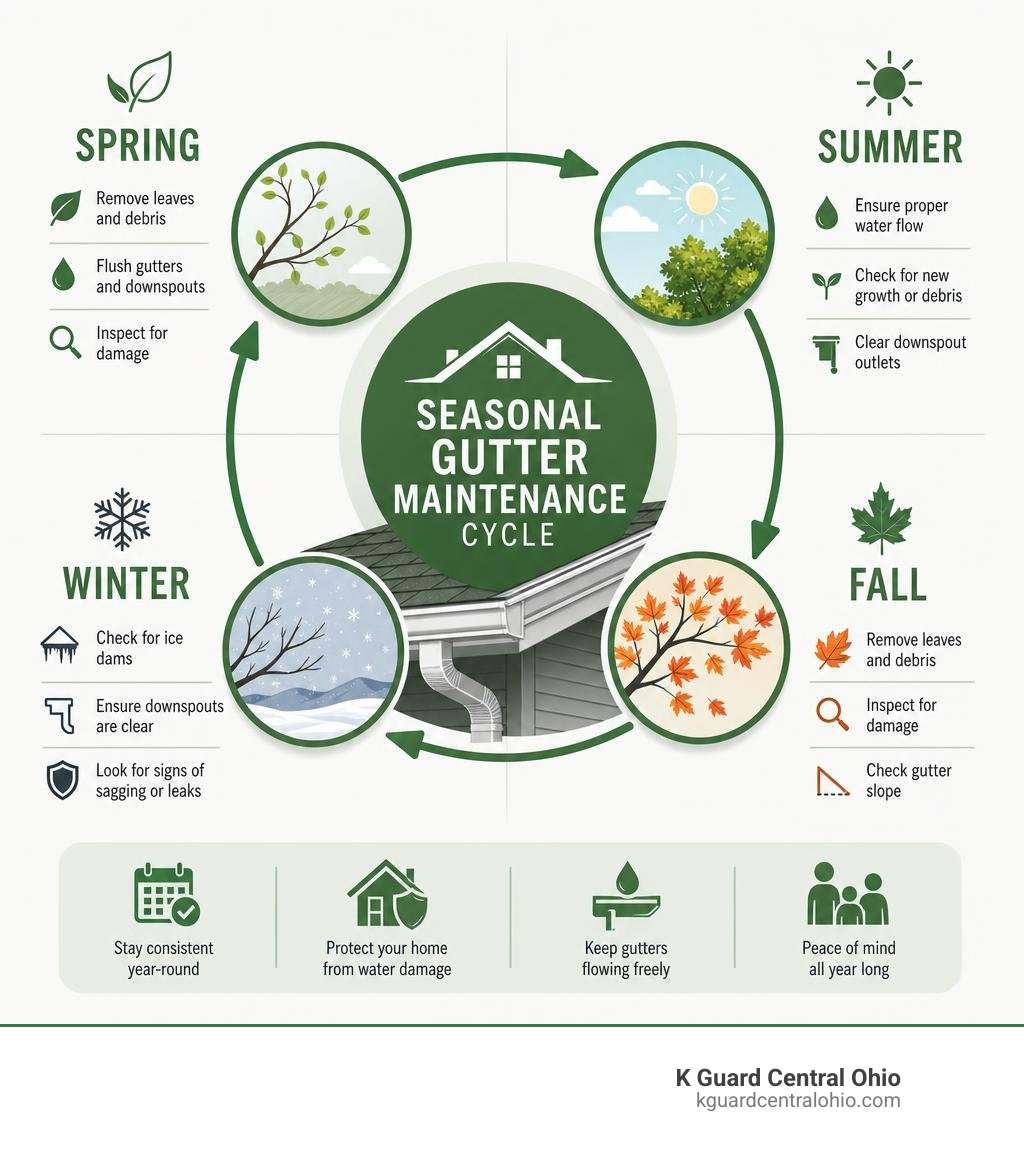
- Spring Care (April to May): This is when trees release their seeds, buds, and heavy pollen. These small organic pieces quickly turn into a thick paste inside your gutters, blocking downspouts just as spring rainstorms arrive.
- Late Summer Check (August): Check your system after heavy summer thunderstorms to make sure no branches have fallen and that your gutters aren’t sagging from high-volume downpours.
- Autumn Protocol (October to November): This is the most critical time of the year. Wait until about 95% of the leaves have fallen from the trees before performing your final cleanout. If you clean too early, the remaining leaves will clog your system before winter. For a complete seasonal breakdown, read our guide Don’t Get Drained: A Gutter Maintenance Schedule That Works Wonders.
- Winter Monitoring (December to February): Snow and ice present major challenges. Clogged gutters trap water, which freezes and expands, forcing ice under your shingles and causing roof leaks. Never use a hammer or shovel to chip ice out of your gutters, as this will damage the metal. Instead, monitor your roofline for ice dams and ensure your downspouts remain clear.
How do I safely execute DIY gutter maintenance tips?
If you choose to clean your gutters yourself, safety must be your top priority. Always follow these rules:
- Maintain Three Points of Contact: Keep either two hands and one foot, or two feet and one hand, on the ladder at all times. Never overreach; instead, climb down and move the ladder.
- Use a Ladder Stabilizer: A stabilizer prevents the ladder from sliding side-to-side and keeps it from crushing your aluminum gutters.
- Work with a Partner: Never clean your gutters alone. Always have a spotter on the ground to stabilize the ladder base and assist you if needed.
- Wear Protective Gear: Use thick suede or leather work gloves to protect against sharp metal edges, screws, and animal waste. Wear safety glasses to protect your eyes from splashing mud and debris.
How much does professional gutter cleaning cost?
The cost of professional gutter cleaning varies based on your home’s size, height, and the condition of your gutters:
- Single-Story Homes: Typically ranges from $119 to $234, depending on the total linear footage.
- Multi-Level Homes (Two or Three Stories): Typically ranges from $150 to $400, reflecting the increased risk and specialized equipment required.
- Heavy Clogs and Neglect: If your gutters have not been cleaned in years and are packed with compacted mud and growing plants, expect to pay an additional 10% to 50% on top of the standard rate.
While these cleaning rates may seem manageable in the short term, they quickly add up year after year, making a permanent solution like K-Guard a much smarter financial decision.
Conclusion
At the end of the day, your home is your most significant investment. Protecting it from water damage shouldn’t require risking your safety on a ladder multiple times a year, nor should it mean spending hundreds of dollars annually on temporary cleaning services.
With K Guard Central Ohio, you can put an end to the endless cycle of gutter cleaning. Our K-Guard Leaf Free Gutter System provides complete, permanent protection for your home. With a $5,000 average installation cost, our system offers a lifetime guarantee and the complete elimination of annual gutter cleaning, ensuring you never have to climb a dangerous ladder to clean your gutters again.
If you are ready to protect your home’s foundation, fascia, and landscaping with a maintenance-free gutter system, contact us today to schedule your free estimate.