
When It Rains, It Pours: The Top Causes of Overflowing Gutters
Why Your Gutters Are Overflowing (And What It’s Costing You)
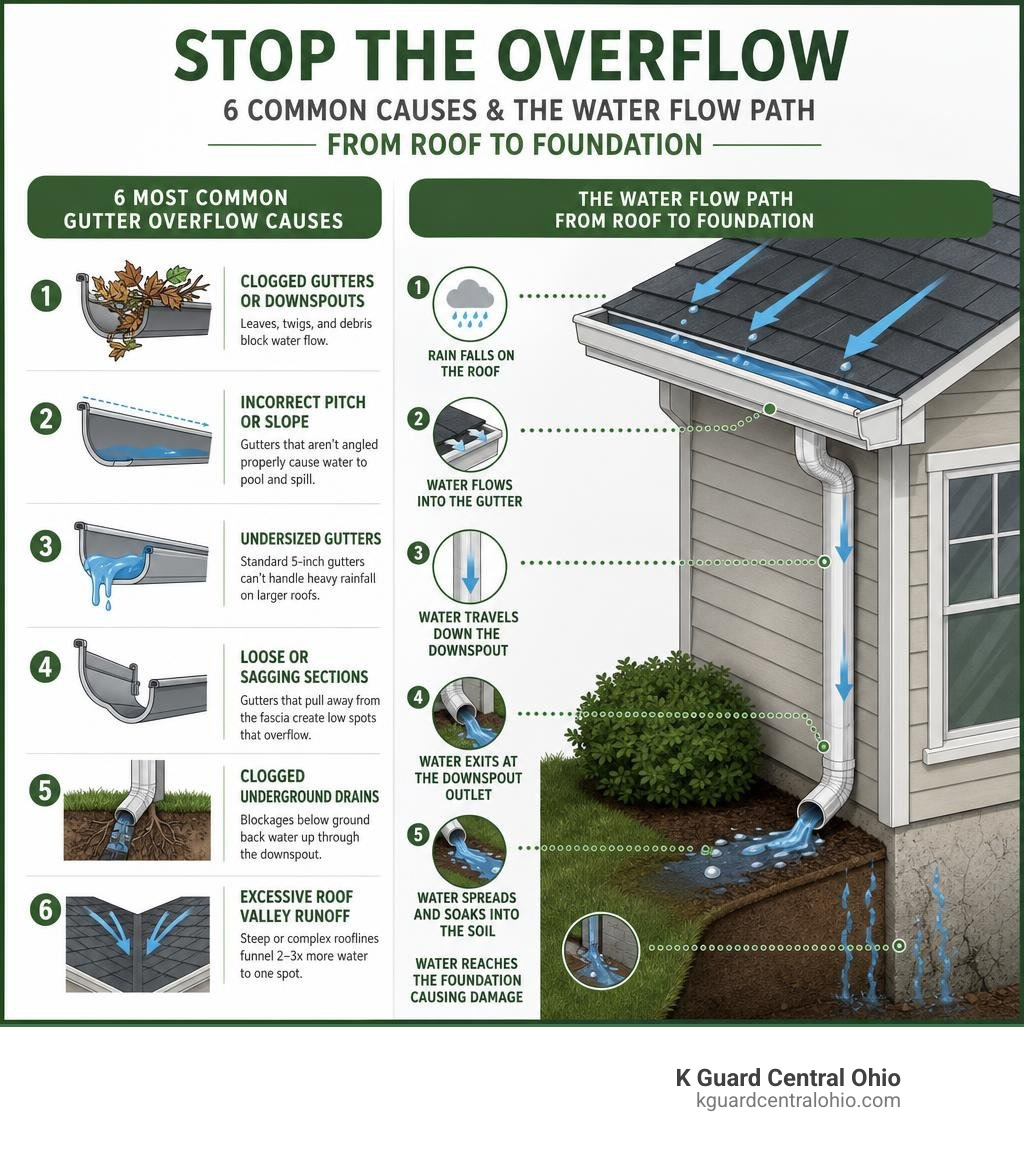
Gutter overflow causes more damage to homes than most people realize — and it happens faster than you’d expect. Here are the most common reasons gutters overflow:
- Clogged gutters or downspouts — leaves, twigs, and debris block water flow
- Incorrect pitch or slope — gutters that aren’t angled properly cause water to pool and spill
- Undersized gutters — standard 5-inch gutters can’t handle heavy rainfall on larger roofs
- Loose or sagging sections — gutters that pull away from the fascia create low spots that overflow
- Clogged underground drains — blockages below ground back water up through the downspout
- Excessive roof valley runoff — steep or complex rooflines funnel 2–3x more water to one spot
One inch of rain on a 2,000 sq ft roof produces roughly 1,000 gallons of water. Your gutter system has to handle all of it — fast. When it can’t, that water doesn’t just disappear. It runs down your foundation, soaks into your soil, and sets off a chain of damage that can cost $10,000 to $52,000+ to fix.
The frustrating part? Gutters often overflow even after a recent cleaning. A clogged downspout, a slight sag, or a gutter that was simply never sized right for your roof can all cause the same problem — water pouring where it shouldn’t.
I’m Rich Mannino, General Manager of K-Guard Leaf Free Gutters, and I’ve spent nearly two decades helping homeowners in Central Ohio solve persistent gutter overflow causes — from simple clogs to full system replacements. In this guide, I’ll walk you through exactly how to diagnose what’s going wrong and what to do about it.
Gutter overflow causes further reading:
The Cost of Neglect: Why Overflowing Gutters Are a Serious Threat
When storms roll through Central Ohio, they do not hold back. Many homeowners treat overflowing gutters as a minor nuisance—something to deal with “next weekend.” But ignoring that cascading water is a high-stakes gamble. Water is a force of nature, and when it escapes its designated path, it will find its way into your home’s most vulnerable structures.
Foundation Damage and Soil Erosion
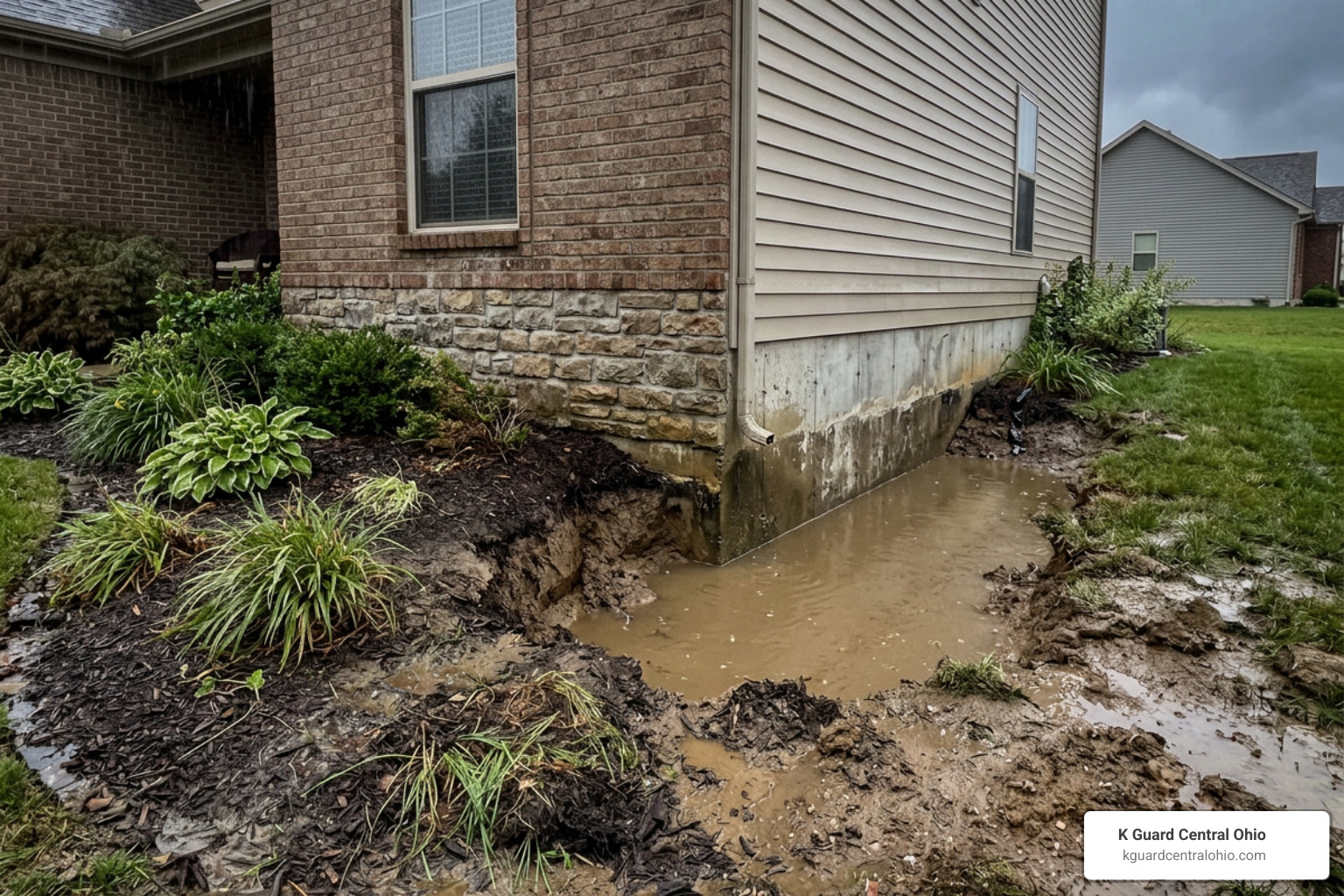
The primary job of a gutter system is to direct water far away from your home’s foundation. When gutters overflow, thousands of gallons of water dump directly at the base of your home. This leads to severe soil erosion, washing away the supportive earth around your foundation. Over time, the saturated soil expands and contracts, putting immense hydrostatic pressure on your foundation walls. This chronic stress can cause bowing, cracking, and structural shifting. Repairing this level of structural failure is a nightmare, often costing between $10,000 and $52,000+ within just two years of ignored overflow.
Roof, Fascia, and Siding Destruction
Water overflowing from the rear of the gutter doesn’t just fall straight down; it backs up under your shingles and saturates your fascia boards. The wood begins to rot, weakening the physical structure holding your gutters in place. This moisture also creeps behind your siding, leading to peeling paint, warped boards, and exterior wall staining.
Basement Flooding and Mold Growth
Once the soil around your foundation is completely saturated, that water will find any microscopic crack to seep into your basement or crawl space. Basement flooding ruins drywall, flooring, and personal belongings. Even worse, the persistent dampness creates a perfect breeding ground for mold and mildew, compromising your family’s respiratory health. If you are experiencing these issues, understanding Gutters Overflowing in Heavy Rain: Causes and What to Check | EskiTips is a crucial first step in halting the cycle of destruction.
Investigating Gutter Overflow Causes: How to Diagnose Your System
To fix the problem, you have to find the root cause. You don’t necessarily have to climb a ladder to start your investigation; in fact, the best time to diagnose gutter overflow causes is safely from the ground while it is actually raining.

Step 1: Observe the Overflow Pattern
Grab an umbrella and walk around your home during a heavy downpour. Where exactly is the water spilling over?
- Overflowing at one specific corner: This usually indicates either a localized clog right above the downspout or an incorrect pitch angle directing too much water to a dead end.
- Spilling over the entire front edge: The system is likely completely choked with debris, or the gutters are simply too small to handle the volume of roof runoff.
- Water dripping behind the gutter: This points to a failed or missing drip edge, or loose hangers that have allowed the gutter to pull away from the fascia board.
Step 2: Perform a Hose Test
On a dry day, you can simulate a rainstorm. Take a garden hose up to the furthest point of a gutter run and turn it on. Watch how the water travels. Does it flow smoothly and quickly to the downspout, or does it pool in the middle? If water pools, you have a pitch or sagging issue. If water backs up and rises in the gutter, your downspout is clogged.
Step 3: Check the Pitch with a Level
A properly functioning gutter cannot be perfectly flat. It must slope downward toward the downspouts at a rate of 1/4 inch for every 10 feet of run. You can verify this by placing a level along the bottom of the gutter or looking for a visible downward angle toward the downspout. For more details on maintaining your system safely, check out our guide on How to Start Gutter Maintenance in 5 Simple Steps.
Debris Accumulation: The Most Common Gutter Overflow Causes
When we talk about gutter overflow causes, debris is the undisputed heavyweight champion. Despite how simple it is to understand, only 25% of homeowners clean their gutters the recommended twice annually.
In Central Ohio, our beautiful oak, maple, and pine trees drop an incredible amount of organic material. Over the seasons, leaves, pine needles, twigs, and helicopters accumulate in the gutter trough. As this organic matter decomposes, it forms a thick, heavy muck. Add in a layer of rough shingle grit washing off your roof, and you get a dense barrier that completely blocks water from reaching the downspout outlets.
When a heavy rainstorm hits, this debris acts like a dam. The water has nowhere to go but over the sides, dragging wet leaves and dirt with it, which stains your siding. To prevent this, homeowners must learn the art of keeping their gutters clear; you can read more about this in our article on how to Say Goodbye to Gutter Gunk: Simple Strategies for Debris-Free Gutters. For those in Columbus who prefer to outsource this dirty and dangerous chore, professional gutter cleaning services are highly recommended to keep your system running smoothly.
Structural and Design Flaws: Hidden Gutter Overflow Causes
Sometimes, your gutters are completely free of leaves and dirt, yet water still pours over the edges like a waterfall. This is incredibly frustrating, but it points directly to structural and design flaws within the system.
Improper Pitch and Sagging Sections
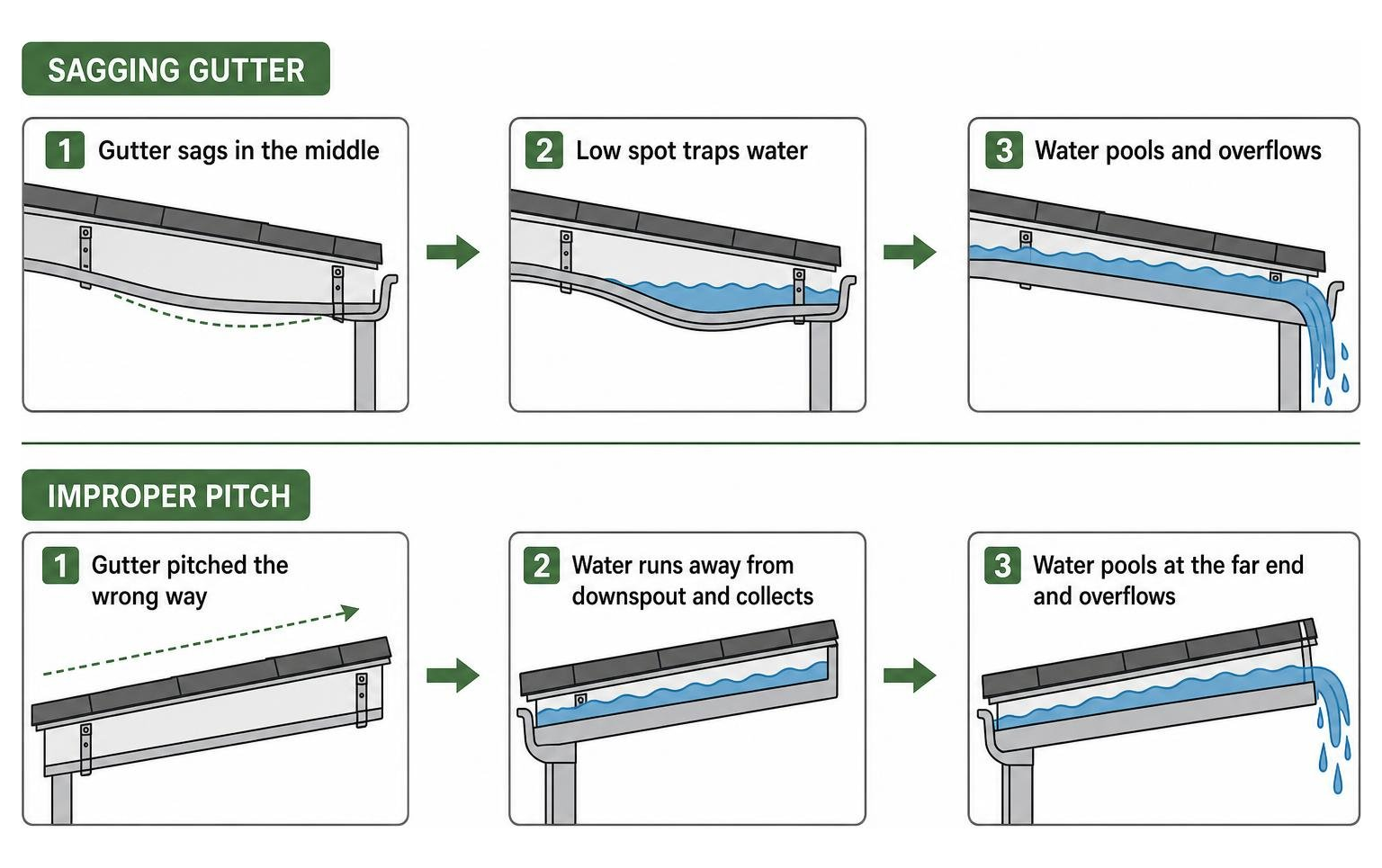
Gutters rely entirely on gravity. If the system was installed poorly, or if the hangers have loosened over time, the pitch can easily get thrown off. If the gutter slopes away from the downspout, water will pool at the opposite end until it overflows.
Furthermore, wet debris is heavy — weighing anywhere from 20 to 50 pounds per cubic foot. This chronic weight pulls on the gutter hangers, causing the aluminum to sag and warp. Once a section sags, it creates a permanent low point where water pools, accelerates rust, and spills over.
Undersized Gutters
Many older homes in Central Ohio were built with standard 5-inch K-style gutters. While these are fine for mild, steady drizzles, they are frequently overwhelmed by heavy Midwestern summer storms. A standard 5-inch gutter is rated to handle about 2,500 square feet of roof area at 1 inch of rain per hour. However, local storms can easily dump 2 to 4 inches of rain per hour, instantly surcharging the system. Upgrading to high-capacity 6-inch gutters increases water capacity by roughly 40%, but it comes with an average professional upgrade cost of $1,180 (ranging from $628 to $1,733).
Additionally, aluminum gutters last about 20 to 30 years nationally, but in Central Ohio, that lifespan is cut short by about 25% (lasting only 15 to 20 years). This is due to our brutal climate, which features 25 to 40 freeze-thaw cycles per year that constantly twist, stress, and degrade gutter metal and sealants. If your system is aging, it is critical to address these structural issues before they lead to costly water damage to your home’s foundation and exterior.
Downspout and Drainage System Bottlenecks
You can have pristine, perfectly pitched, oversized gutters, but if the exit path is blocked, the entire system will fail. The downspout is the bottleneck of your home’s drainage.
Downspout Capacity and Elbow Blockages
Most standard gutter installations utilize small 2×3 inch downspouts. These narrow channels easily choke on small twigs, leaves, and shingle grit. The blockages almost always occur at the sharp bends or elbows where the downspout curves to hug your home’s exterior. Upgrading to larger 3×4 inch downspouts is a highly effective solution, as they have twice the physical capacity of standard downspouts and allow small debris to pass through without catching. If you want to understand how downspouts function as a complete system, read The Complete Guide to Gutter Downspouts.
Underground Drain Line Backups
Many homes in Central Ohio feature downspouts that connect directly into underground drain lines to carry water out to the street or a dry well. Over time, these underground pipes can become clogged with leaves, dirt, or invasive tree roots. When an underground pipe is blocked, the water has nowhere to go. It backs up through the downspout, filling the entire vertical column with heavy water until the gutter itself overflows. If you are experiencing water pooling at the base of your downspouts, you should inspect your fittings and connections; learn more in The Ultimate Guide to Gutter to Downspout Connection and Fittings.
Short-Term Fixes vs. Long-Term Solutions
When dealing with overflowing gutters, homeowners have to choose between band-aid fixes and permanent solutions.
| Solution Type | Method | Pros | Cons |
|---|---|---|---|
| Short-Term (DIY) | Manual Cleaning | Low upfront cost ($0-$50 for tools) | Must be repeated 2-4 times a year; high fall risk |
| Short-Term (DIY) | Splash Guards | Directs heavy valley water into the trough | Only addresses localized corner overflow; doesn’t fix clogs |
| Mid-Term (Pro) | Re-pitching & Repair | Corrects structural sagging and improper slope | Costs $75-$900+; doesn’t prevent future debris clogs |
| Long-Term (Pro) | K-Guard Gutter Guards | Eliminates cleaning permanently; lifetime guarantee | Higher initial investment (average installation ~$5,000) |
While DIY cleaning is a necessary maintenance task for standard open gutters, it is a temporary fix. You will find yourself back on the ladder in a few months. If you are determined to tackle a clog yourself right now, read our step-by-step guide on Unclogging Your Gutters: A Step-by-Step Guide from the Ground Up.
For those looking to break the cycle of seasonal gutter chores, establishing a strict schedule is key; check out Don’t Get Drained: A Gutter Maintenance Schedule That Works Wonders. However, even the most diligent cleaning routine cannot overcome design flaws or severe weather events that standard open gutter systems simply aren’t built to handle.
When to Call a Professional for Gutter Repair or Replacement
It is easy to underestimate gutter work, but it is one of the most dangerous home maintenance tasks you can perform. Ladder-related injuries exceed 500,000 annually in the United States, with falls from ladders being a leading cause of home injury.
If your home is two stories or higher, if your roof pitch is steep, or if there are active power lines near your roofline, you should never attempt a DIY repair.
Furthermore, physical structural issues like sagging gutters, rotted fascia boards, or incorrect pitch are incredibly difficult to correct without professional tools. A professional gutter repair costs an average of $75 to $900+, with a typical repair landing around $385 to $395. A professional team uses laser levels to guarantee a perfect pitch and can safely inspect your fascia and rafter tails for hidden rot before mounting new hardware. If you are tired of dealing with temporary fixes, read Solving Your Gutter Woes: An Expert’s Take on Rain Gutter Solutions.
Frequently Asked Questions about Gutter Overflow
Why do my gutters overflow even after I just cleaned them?
If you recently scooped out all the leaves but water still overflows, the culprit is usually a hidden downspout clog, a blocked underground drain, or an improper pitch. Debris often gets lodged in the tight elbows of the downspout where you cannot see it. Additionally, if the gutter has sagged or was installed without the correct slope (1/4 inch per 10 feet), water will pool and overflow instead of draining, making professional inspection essential.
How do I know if my gutters are too small for heavy rain?
If your gutters overflow uniformly along the entire front edge during heavy rain, but drain perfectly during light showers, they are likely undersized. Standard 5-inch gutters are easily overwhelmed by intense Midwestern downpours. Upgrading to a 6-inch system or installing high-performance gutter guards designed for heavy rain is the most reliable way to protect your home. Learn more about protecting your home from intense storms in Heavy Rain Gutter Guards: Defending Your Home from the Ultimate Deluge.
Can overflowing gutters cause foundation damage?
Yes, absolutely. Overflowing gutters dump water directly at your home’s foundation, saturating the soil. This saturated soil exerts immense pressure on your basement walls, leading to cracks, leaks, and structural shifting. Foundation repairs are incredibly expensive, often costing between $10,000 and $52,000+ if the water issues are ignored for more than a couple of years.
Conclusion
At K Guard Central Ohio, we believe you shouldn’t have to risk your life on a ladder just to keep your home safe from water damage. Standard open gutters are a constant source of stress, requiring endless cleaning, repairs, and adjustments to prevent water from destroying your foundation.
Our specialized K-Guard leaf-free gutter guard system is a complete, high-capacity replacement that eliminates gutter overflow causes once and for all. Built with heavy-duty aluminum and featuring a patented, fully integrated hood design, K-Guard is engineered to handle even the most severe Central Ohio downpours.
Best of all, K-Guard comes with a lifetime clog-free guarantee, completely eliminating the need for annual gutter cleaning. You will never have to clean your gutters again — period. With an average home installation cost of approximately $5,000, K-Guard is an investment that pays for itself by preventing thousands of dollars in foundation repairs, fascia rot, and basement flooding.
Ready to protect your home permanently? Upgrade to K Guard’s Premium Gutter System today and schedule your free, no-obligation estimate.