Six Signs Your Gutters Need to Be Replaced (Before the Fascia Does)
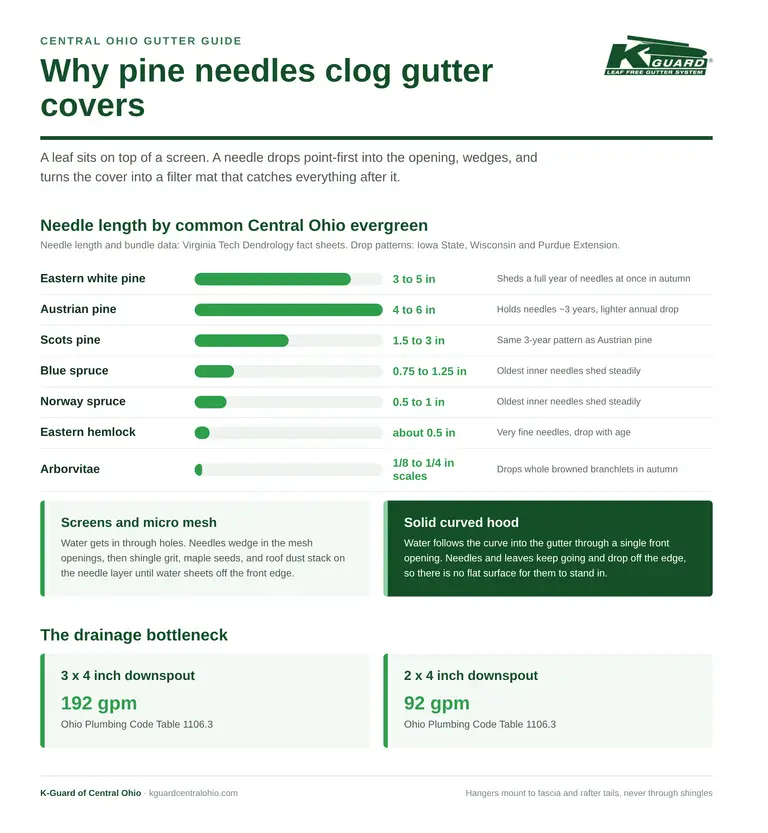
Gutters rarely fail all at once. They lose pitch, hold water, a seam weeps, and the wood behind them stays damp a little longer after each storm. By the time paint is peeling and a board feels soft, the repair is more than just a gutter repair.
Below are six key signs that matter most on Central Ohio homes, and what each one says about whether gutters can be repaired or need to be replaced. Each one is structural, not cosmetic, and has something you can check yourself before calling anyone.
Six Signs Your Gutters Need to Be Replaced
Each sign points to a different way gutters fail. One on its own is worth a closer look, two or more on the same run usually means that run is past repair.
1. Sagging Gutters and Visible Damage at the Fascia
A gutter that dips mid-run has a fastener problem. So does a gutter with a gap between its back edge and the fascia. Water now sits in the low spot and spills behind the trough instead of moving to the downspout.
Weight is why this accelerates. Trapped water pulls steadily on hangers built to carry moving water. One inch of rain on a 1,000-square-foot roof produces roughly 623 gallons of runoff (UADA Extension). Once a gutter sags, it holds more, then it sags further.
2. Continuous Standing Water After the Rain Stops
Look into the trough a day after a storm. It should be damp, not holding water. Water left in the trough means the pitch is gone or the outlet is blocked. Horizontal gutters must be sized on the flow rate coming off the roof surface so water keeps moving (UpCodes, Section 1106.6).
Trapped water also creates a pest problem. The CDC’s Aedes guidance lists clogged gutters among the container habitats mosquitoes use to lay eggs (CDC).
3. Gutters Peeling Paint, Water Marks, and Soft Wood
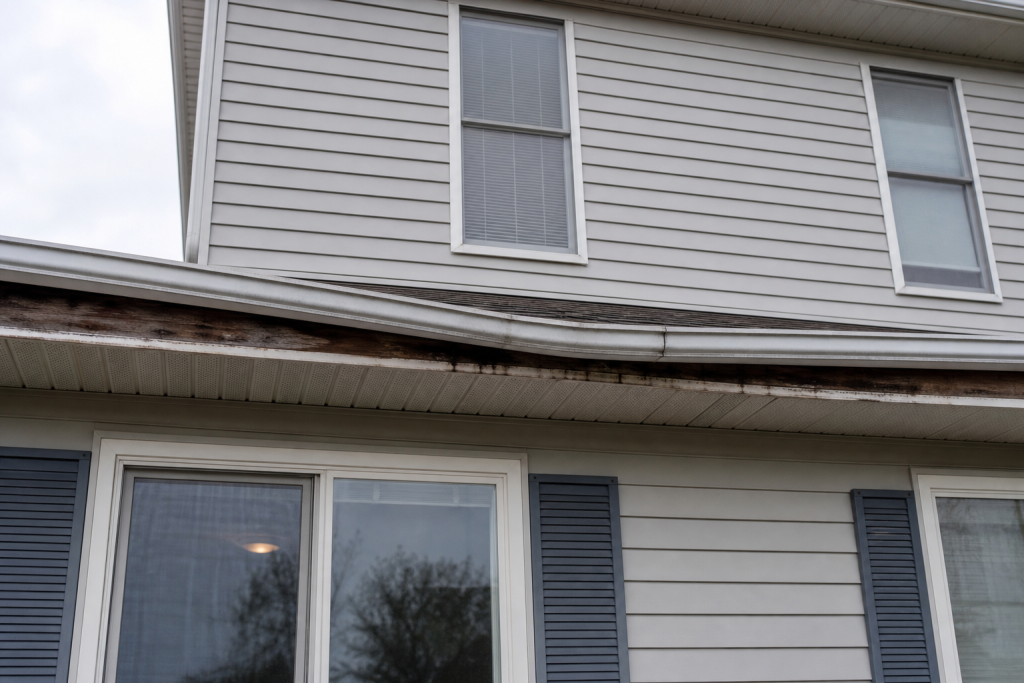
This sign decides whether you replace gutters alone, or gutters plus carpentry. Peeling paint and dark water marks on fascia or soffit mean one thing- the wood gets wet often and dries slowly.
USDA Forest Service researchers state that wood will decay above 30% moisture content and will not decay below 20% (USDA Forest Service). They call the range between the two a grey area. Fascia behind a leaking gutter spends long stretches in that grey area. Homeowners who wait often pay for board replacement they could have avoided.
4. Rust, Cracks, and Weeping Seams in the Gutter System
Sectional gutters fail at their joints first. Every joint is a sealed seam that expands and contracts all year. Watch for rust streaks below a joint, hairline cracks at a corner, or a steady drip at a seam. Rust and cracks together point to a gutter body at the end of its service life.
Material used matters here. Amerimax notes that galvanized steel is hardier than aluminum but may rust. Aluminum, in turn, tends to be hardier than vinyl (Amerimax). Rust usually means steel gutters and a corrosion timeline that repairs do not reverse.
5. Gutters Eroding Soil, Thinning Mulch, and Wetting the Basement
Look down, not up. Trenched soil, thinning mulch, or a splash pattern on siding below a joint all say the same thing. Water is going where it should not.
It helps to know how much water is actually involved. Multiply your roof’s square footage by 0.623 and you get the gallons it sheds per inch of rain (UADA Extension) – for a 1,500-square-foot roof, that’s about 930 gallons in a single inch. A worn-out gutter doesn’t shrink that number, it just dumps it next to your foundation instead of carrying it to the downspout. That’s why gutter manufacturers put foundation cracking and basement flooding at the top of the list when they explain what gutter protection is for.
6. Ice Damming and Winter Overflow at the Eave (a Cold-Weather Sign)
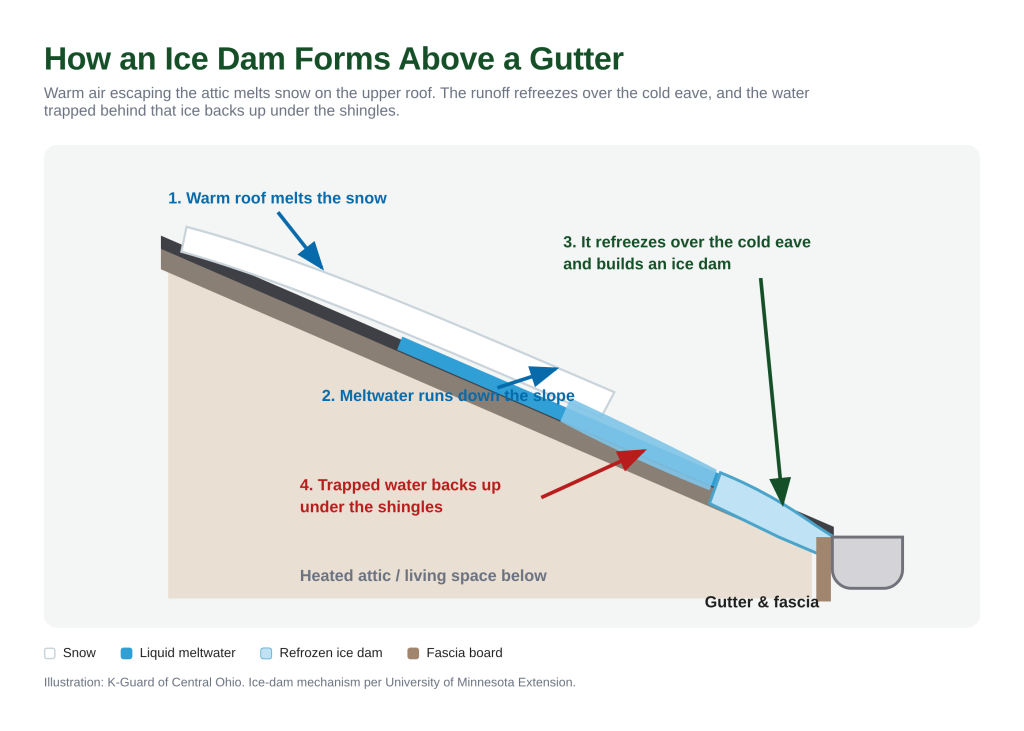
An ice dam is a ridge of ice at the roof edge that stops melting snow from draining. University of Minnesota Extension explains the mechanism. Snow on an above-freezing part of the roof melts. The water runs down to a section averaging below 32°F and refreezes. The dam then grows as more meltwater arrives, and the trapped water finds cracks in the roof covering (UMN Extension).
This isn’t a rare-event problem in Central Ohio. Columbus averages 9.5 inches of snow in January, 7.6 in February and 5.1 in December, and the rain never really lets up either — 3.85 inches in April, 4.67 in July (National Weather Service, 1991–2020 normals). Put those together and you get the pattern homeowners here run into every year: the leaves that pack a gutter in November are what’s holding ice in it come January.
What the Local Climate Puts Through Your Gutters
Monthly Columbus normals, 1991–2020, from the National Weather Service Wilmington, OH office:
| Month | Normal precipitation (in.) | Normal snowfall (in.) | What it stresses |
|---|---|---|---|
| January | 3.00 | 9.5 | Ice loading and dam formation at the eave |
| February | 2.41 | 7.6 | Freeze-thaw cycling on seams and hangers |
| March | 3.62 | 4.1 | Mixed melt and rain volume |
| April | 3.85 | 0.5 | Peak spring rain; capacity and pitch |
| May | 3.99 | 0.0 | Sustained volume plus tree debris |
| June | 4.33 | 0.0 | Downspout flow rate |
| July | 4.67 | 0.0 | Highest normal monthly rainfall |
| August | 3.74 | 0.0 | Intense short storms |
| September | 3.14 | 0.0 | Early leaf drop begins |
| October | 2.90 | 0.2 | Heaviest leaf load of the year |
| November | 2.79 | 1.2 | Debris plus first freezes |
| December | 3.13 | 5.1 | Snow load on weakened hangers |
Two things in that table are worth a second look. The wettest month is July, not April, which is why overflow and capacity problems tend to show up in the middle of summer rather than during spring rains. And the heaviest leaf drop comes in October, just weeks ahead of the first hard freezes.
Repair or Replace? A Triage Table
| What you see | Usually a repair | Usually a replacement | Why |
|---|---|---|---|
| One loose hanger, gutter otherwise straight | Yes | — | Refastening restores pitch |
| Sag across a full run | — | Yes | Fastening system and pitch are both compromised |
| Single weeping seam on a newer gutter | Yes | — | Joint can be resealed |
| Rust streaks at multiple joints | — | Yes | Corrosion is systemic, not local |
| Overflow only in heavy storms | Maybe | Maybe | Check downspout size and count before deciding |
| Peeling paint or soft fascia behind the trough | — | Yes | Wood is at or above the decay moisture threshold (USDA FS) |
| Water still in the trough a day after rain | — | Yes | Pitch or outlet capacity has failed |
Once the signs point to replacement, the question gets bigger than the gutter itself. Bolting a cover onto a trough that already leaks, sags or is pulling off the fascia doesn’t fix any of that, it just hides it, which is exactly the argument K-Guard makes against toppers, and the reason its system replaces the gutter instead of covering it (K-Guard). Four pieces do the work together: a curved hood that pulls water in by surface tension while leaves slide off the edge, a high-capacity trough, oversized 3×4-inch downspouts, and patented polymer hangers (K-Guard of Central Ohio).
What to Do This Week
Walk the perimeter after the next steady rain. Photograph any sagging gutters, any splash pattern on siding, and any dark staining on fascia or soffit. Check the trough again the following day for water that has not drained. Those three observations tell an estimator more than a phone description will. They also separate the signs that need a repair from the signs your gutters need to be replaced.
For the mechanics of how a hooded system handles water and debris, read how the K-Guard system works. For what a replacement day involves, see the installation overview. And for background on how long gutters last in the first place, our earlier post on the lifespan of your gutters is a good starting point.

Frequently Asked Questions
How do I know if my gutters need to be replaced or just repaired? Isolated problems are usually repairs: one loose hanger, one seam. System-wide symptoms mean replacement. Watch for sag across a full run, rust at multiple joints, standing water a day after rain, or soft wood on the fascia.
Does peeling paint on the fascia mean the wood is rotting? It means the wood is wetted repeatedly. Decay becomes possible above about 20% wood moisture content, and USDA Forest Service researchers describe decay above 30% as well established (USDA FS). Peeling paint is the stage before soft wood.
Why do my gutters overflow only during heavy rain? That is usually a capacity or outlet issue, not a clog. Gutters must be sized on the flow rate off the roof surface (UpCodes, Section 1106.6). One inch of rain on a 1,000-square-foot roof is about 623 gallons to move (UADA Extension).
Can standing water in gutters cause other problems? Yes. The CDC’s mosquito control guidance lists clogged gutters among the habitats mosquitoes use for egg laying (CDC).
Do ice dams mean my gutters failed? Not by themselves. Ice dams come from uneven roof surface temperatures and snow cover (UMN Extension). Debris-packed gutters make eave overflow worse.
Is fall a bad time to replace gutters in Central Ohio? Fall is often the practical time. October carries the heaviest leaf load and November brings the first freezes, based on Columbus climate normals (NWS). Work finished before that sequence avoids a winter of ice in a failing trough.
Catching these signs early protects your fascia, your foundation, and the curb appeal you already paid for. Contact K-Guard of Central Ohio to schedule a free inspection and estimate.