
Never Clean Your Gutters Again with the K-Guard Gutter System
Stop Searching for Gutter Cleaning — There’s a Better Answer
Gutter cleaning is one of those chores most homeowners dread — and keep paying for, year after year. But what if you never had to do it again?
Here’s the quick answer most people are looking for:
- Standard gutters need cleaning at least twice a year (spring and fall), more if you have heavy tree cover.
- Professional cleaning typically costs $150–$300 per visit — that adds up to thousands over the life of your home.
- DIY cleaning means ladder risks, wet debris, and clogged downspouts — every single season.
- The permanent fix is a leaf-free gutter system like K-Guard, which is engineered for the complete elimination of annual gutter cleaning, backed by a lifetime guarantee, with an average installation cost of around $5,000.
Most homeowners spend years cycling through the same routine: debris builds up, water backs up, damage follows. Clogged gutters don’t just look bad — they can cause foundation damage, fascia rot, basement flooding, and ice dams. The real question isn’t how to clean gutters more efficiently. It’s how to stop cleaning them for good.
The Hidden Costs and Dangers of Annual Gutter Cleaning
Every spring and autumn, homeowners across Central Ohio face the same tedious, frustrating dilemma. Do you drag a heavy, unstable ladder out of the garage to scoop out handfuls of freezing, smelly sludge? Or do you pick up the phone and pay hundreds of dollars to a professional service to do it for you?
At first glance, hiring a local service might seem like a simple way to cross a chore off your to-do list. However, when you look closely at the math, you realize that paying for annual cleaning is a continuous, exhausting financial drain.
If you are paying an average of $225 per visit for a standard single-story home, and you require at least two cleanings per year, you are spending $450 annually. Over a decade, that is $4,500 down the drain. If you own a larger two-story home, those rates can easily jump by 20% to 35%, pushing your ten-year cost well past $6,000. You can read more about whether this constant cycle is truly practical in our article: Is Gutter Cleaning Worth It? Discover the Essential Benefits for Your Home.
Beyond the sheer financial cost, the physical dangers of DIY cleaning are incredibly high. According to safety statistics from the Consumer Product Safety Commission, ladder falls are one of the leading causes of household injuries in the United States. One slip on a patch of wet grass or a momentary loss of balance while reaching for a stubborn clump of leaves can result in serious, life-altering injuries.
Even if you try to save money by finding budget shortcuts, as explored in our guide on 5 Surprising Ways to Cut Gutter Cleaning Costs, you are still left with a temporary fix. Traditional open gutters are fundamentally flawed. They are designed to catch water, but their open-top design means they also act as a giant net for leaves, twigs, pine needles, and nesting pests. The moment the cleaning crew leaves your driveway, the clogging process begins all over again.
How to Maintain and Clean Standard Gutters (If You Must)
If you still have traditional open gutters on your home, ignoring them is not an option. When open gutters clog, rainwater spills over the sides, running straight down your siding and pooling around your foundation. Over time, this causes soil erosion, cracked foundations, flooded crawlspaces, and rotten fascia boards.
To prevent these catastrophic structural issues, you are forced to adhere to a strict, rigorous schedule. For most homes, this means a thorough cleaning in the late spring (after trees drop their seeds and blossoms) and another in the late fall (after the final leaves drop). For homes surrounded by heavy oak, maple, or buckeye trees, a third cleaning is often required. You can map out this grueling schedule using our resource: Don’t Get Drained: A Gutter Maintenance Schedule That Works Wonders.
However, let’s be honest: manual DIY maintenance is a temporary, dirty, and dangerous chore. It is a band-aid solution to a design problem that can be permanently solved.
Essential Tools and Safety Tips for Manual Gutter Cleaning
If you are determined to clean your gutters by hand, you must prioritize safety and use the right tools. Here is what you will need:
- A sturdy extension ladder (never stand on the top three rungs, and always follow the “belt buckle rule” by keeping your body centered between the rails).
- Heavy-duty work gloves (wearing thin nitrile gloves underneath keeps your hands dry and protected from sharp metal edges and cold muck).
- A gutter scoop or garden trowel.
- A garden hose with a high-pressure spray nozzle.
- Safety glasses to protect your eyes from flying debris.
- A bucket with a wire hook to collect the debris (never drop debris directly onto your lawn or landscaping).
To start, position your ladder on stable, level ground. Begin cleaning near the downspout, scooping out large debris and placing it in your bucket. Once the major clogs are removed, use your garden hose to flush out the remaining fine dirt, spraying from the far end of the gutter toward the downspout.
If water backs up during the flush, you have a clogged downspout. To clear it, try spraying water at full pressure directly down the spout. If that doesn’t work, you will need to feed a hand auger (plumber’s snake) down the spout, spinning it to break up the compacted leaves and pulling the clog out from the bottom. For a detailed walkthrough of this process, check out Unclogging Your Gutters: A Step-by-Step Guide from the Ground Up and How to Start Gutter Maintenance in 5 Simple Steps.
Using a Leaf Blower for Gutter Cleaning
An alternative DIY method is using a leaf blower equipped with a specialized gutter-cleaning attachment. These attachments typically feature a long, curved U-bend tube that allows you to blow leaves out of the gutters while standing safely on the ground.
While this method eliminates the need to climb a ladder, it has major limitations:
- Dry Debris Only: This method only works if the leaves are completely dry and light. If it has rained recently, the leaf blower will simply splatter heavy, wet mud all over your face, siding, and windows.
- Messy Cleanup: Unlike hand-cleaning, where you place debris directly into a bucket, a leaf blower blasts leaves in every direction, leaving you with a massive yard cleanup project afterward.
- Safety Hazards: You must wear safety goggles and ear protection, as falling debris and dust will rain down on you during the process.
Identifying and Repairing Common Gutter Problems
Cleaning your gutters is only half the battle; traditional gutters are also prone to physical wear and tear. Over time, the weight of wet leaves, snow, and ice causes standard gutters to sag and pull away from the fascia board.
When maintaining your gutters, you must inspect them for the following issues:
- Incorrect Slope: For water to drain properly, gutters must have a slight downward pitch toward the downspouts. The ideal slope is a 1/4-inch to 1/2-inch decline for every 20 feet of gutter run. If the slope is off, water will pool in the middle, leading to rust and leaks.
- Loose Support Hangers: Traditional gutter spikes or hangers can back out over time. To prevent sagging, support hangers should be spaced every 2 feet along the gutter.
- Leaking Seams: Standard sectional gutters have seams that inevitably expand, contract, and leak. You must scrape away old, failing caulk, dry the area completely, and apply a high-quality gutter sealant to the inside seams and end caps.
This constant cycle of cleaning, patching leaks, and adjusting sagging brackets highlights why traditional gutter systems are a ticking clock of home maintenance headaches.
Why Gutter Guards Are the Ultimate Permanent Solution
If you are tired of the endless chore of gutter cleaning, you have likely looked into gutter guards. However, not all gutter guards are created equal.

Many homeowners turn to inexpensive DIY options like plastic screens, metal mesh, or foam inserts. While these products claim to keep debris out, they often create more problems than they solve.
- Screens and Grates: Leaves and pine needles lay flat on top of the screens, blocking rainwater from entering. Water simply sheets over the top, cascading down your siding just like a clogged gutter would.
- Micro-Mesh: While micro-mesh is better at keeping small debris out, pollen, pine sap, and dirt quickly coat the fine mesh, creating a slick surface that prevents water from entering the gutter. Additionally, seeds can sprout directly in the mesh, turning your gutters into a high-altitude garden.
- Foam Inserts: Foam acts like a giant sponge, trapping dirt and organic material inside the gutter, which leads to mold growth and heavy, sagging gutters.
To achieve true ladder-free living, you need an integrated, engineered system. To learn more about why generic covers fall short, read our in-depth comparisons:
- Gutter Guard Benefits: Why You Need to Stop Climbing That Ladder
- Stop Climbing Ladders with These Top Gutter Guards for Homes
- Stop Climbing Ladders with the Best Gutter Guard Systems
- Why Your Home Needs Gutter Guards Right Now
The K-Guard Difference: Never Clean Your Gutters Again
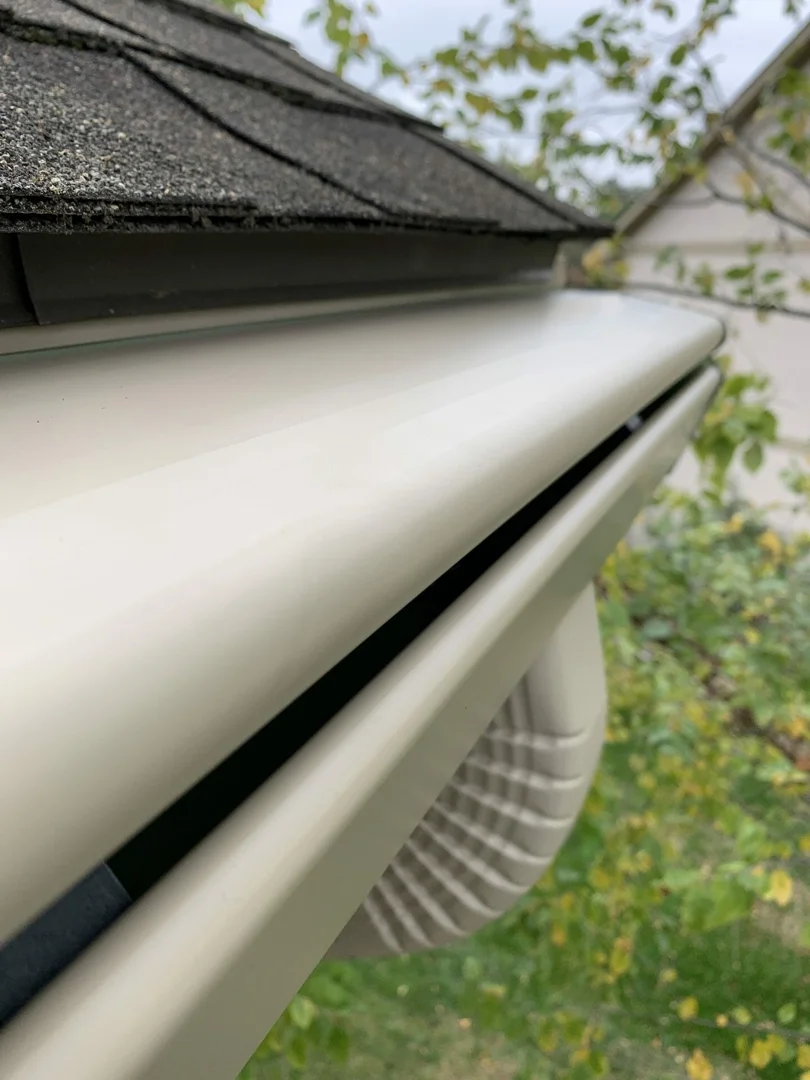
At K-Guard Central Ohio, we don’t just offer another gutter cover or add-on screen. We provide a complete, fully integrated, seamless leaf-free gutter system that replaces your old, failing gutters entirely.
The K-Guard system is engineered with a patented curved hood design that utilizes the scientific principle of liquid adhesion. Rainwater clings to the curved surface of the hood, wrapping around and flowing smoothly into the extra-wide gutter channel below. Meanwhile, leaves, twigs, buckeye seeds, and other debris slide harmlessly off the edge, falling to the ground.
Here is what sets K-Guard apart:
- Lifetime No-Clog Guarantee: If your K-Guard gutters ever clog, we will come out and clean them for free. It is that simple. You will never have to climb a ladder to clean your gutters again.
- Heavy Rain Defense: Built to withstand the intense, sudden downpours we experience here in Central Ohio, K-Guard can handle up to 22 inches of rain per hour without overflowing.
- Superior Strength: Our system is supported by patented, high-strength hangers made of all-weather polymers. These hangers are spaced every 24 inches inside the gutter, attaching directly to your rafter tails to prevent sagging or pulling away from your home.
- Aesthetic Appeal: K-Guard is seamless, custom-fit to your home, and available in a wide variety of colors to perfectly complement your trim and siding.
With an average house installation costing approximately $5,000, K-Guard is a one-time investment that protects your home’s foundation, landscaping, and roof for a lifetime.
To see the engineering behind our system, explore The K-Guard Difference, read about How It Works, and discover how we protect your home from severe storms in our article: Heavy Rain Gutter Guards: Defending Your Home from the Ultimate Deluge. You can also check out our guide on Gutter Guard Costs and Whether They Are Actually Worth It to see how the numbers stack up.
Frequently Asked Questions About Gutter Maintenance
How often do gutters need to be cleaned?
For standard open gutters, you must clean them at least twice a year. However, if your Central Ohio property has heavy tree canopy — especially mature oaks, maples, or evergreens — you will likely need to clean them three or four times a year to prevent severe clogs. When you install the K-Guard system, the cleaning frequency drops to zero. You will never have to clean them again.
What is the average cost of hiring a professional?
For standard gutters, professional cleaning services typically charge between $150 and $300 per visit, with the average single-story home running about $225. Factors like home height (two-story or three-story homes), steep roof pitches, and heavy debris buildup can increase those prices significantly.
It is important to note that K Guard Central Ohio does not offer gutter cleaning services. Instead, we provide a permanent, preventative solution. Rather than paying thousands of dollars in recurring cleaning fees to services like those described in Stop Living on the Edge with an Aluminum Gutter Cleaning Service and Gutter Glory: Everything You Need to Know About Residential Cleaning Services, a one-time investment in K-Guard eliminates those ongoing costs forever.
Are gutter guards worth the investment?
Absolutely, but only if you choose a complete, integrated system. While cheap DIY screens are rarely worth the frustration, a professional, lifetime-guaranteed system like K-Guard protects your home from thousands of dollars in water damage, preserves your foundation, and increases your home’s resale value. Most importantly, it gives you peace of mind and keeps you safely on the ground. Read more about the financial return on investment in Professional Gutter Protection Services: Are They Worth the Investment?.
Conclusion
At the end of the day, you have a choice. You can keep spending your weekends climbing dangerous ladders, or keep writing checks to gutter cleaning companies year after year. Or, you can choose a permanent solution that protects your home and your wallet.
At K Guard Central Ohio, we are dedicated to helping local homeowners end the cycle of gutter maintenance once and for all. Our seamless, leaf-free gutter system provides lifetime protection, unmatched durability, and absolute peace of mind.
Ready to say goodbye to gutter cleaning forever? Contact us today to schedule your Free Estimate and explore our complete line of home protection products at https://kguardcentralohio.com/our-products/.