
The Definitive Guide to K Style Gutters
What Are K-Style Gutters? (And Why Most Homes Are Getting Them Wrong)
K-style gutters are the most common residential gutter profile in the U.S. — and if your home has gutters, there’s a good chance you already have them. Here’s what you need to know at a glance:
| Feature | K-Style Gutters |
|---|---|
| Profile shape | Flat back, decorative ogee front (like crown molding) |
| Most common size | 5-inch (residential); 6-inch (steep or large roofs) |
| Water capacity | Higher than half-round gutters of the same width |
| Common materials | Aluminum, galvanized steel, copper, vinyl |
| Biggest weakness | Open top collects debris, leading to clogs and overflow |
| Average installation cost | ~$5,000 for a full home |
Most homeowners don’t think about their gutters until something goes wrong — a flooded basement, rotted fascia boards, or water stains running down the siding. By then, the damage is already done.
The problem isn’t always the gutter style. It’s that traditional open gutters, including standard K-style, require constant cleaning and maintenance to work properly. Leaves, twigs, and debris fill them up fast — especially in Central Ohio, where heavy rainfall and falling leaves are a seasonal reality.
This guide breaks down everything you need to know: how K-style gutters work, what materials and sizes to choose, when to repair vs. replace, and why an integrated leaf-free system is the smarter long-term investment for most homeowners.
Understanding K-Style Gutters: Design, Profile, and Features
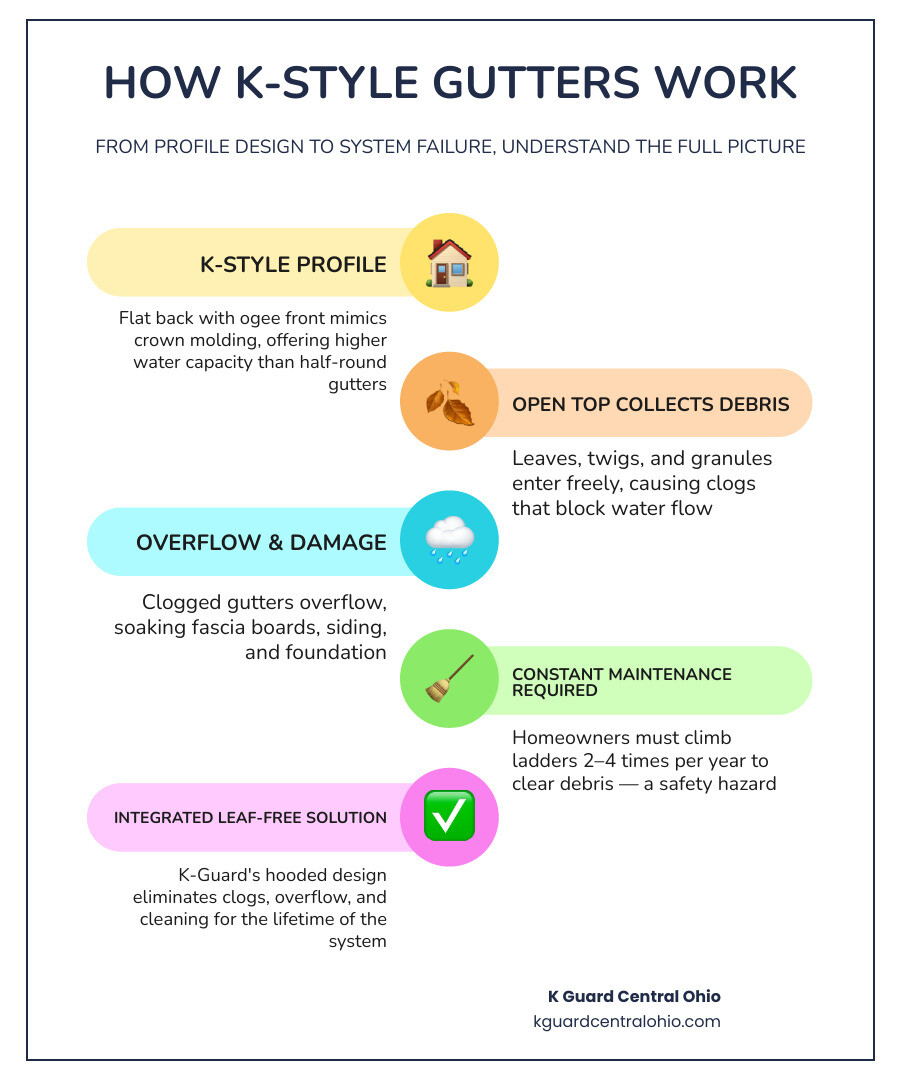
To understand why k style gutters dominate the market, you have to look at their unique shape. If you look at a cross-section of a K-style gutter, the outer profile resembles the letter “K” (albeit a very stylized, curvy one!). The front face features a double curve known as an ogee profile, which closely mimics the appearance of interior crown molding. This architectural detail is why many homeowners and builders prefer them; they blend seamlessly into the roofline, acting as a decorative trim rather than an eyesore.
For a deeper dive into how this shape became the industry standard, you can read the K-Style Gutter — Common Roof Drainage Profile Guide | Jaspector.
Beyond aesthetics, the “K” shape serves a critical structural purpose. The folds and bends in the metal act as built-in reinforcement. Even when constructed from lightweight materials like aluminum, k style gutters are exceptionally strong by design and are highly resistant to bending or deforming under external force. They also feature a flat back, allowing them to be mounted flush against the fascia board without the need for external brackets. This flush mount provides a secure connection that distributes the weight of the water evenly.
But how do they perform when the skies open up? You can explore their functional advantages in detail via K-Style Gutters | K-Style Gutter Installer In Gonzales. In short, their flat-bottomed, wide-top design allows them to hold significantly more water than a rounded shape of the same width.
Why the K-Style Profile Outperforms Half-Round Gutters (And Their Shared Limitations)
When comparing k style gutters to half-round gutters, the performance difference comes down to volume and physics. Because a half-round gutter is perfectly symmetrical and curved, its water capacity is mathematically lower than a flat-bottomed K-style gutter of the exact same width. K-style gutters hold more water volume, making them much better suited to handle the sudden, heavy downpours we experience here in Central Ohio.
Furthermore, half-round gutters require specialty brackets and hangers to suspend them from the roofline, which can be easily bent by heavy snow or ice loads. The flat back of the K-style profile offers superior structural strength, keeping the system stable during freezing winters.
However, both of these traditional open gutter styles share a massive, fatal flaw: they are completely open to the elements.
While the sharp angles and flat bottom of the K-style profile are great for water capacity, they create a perfect trap for leaves, pine needles, maple seeds, and silt. Debris easily gets wedged in the corners, blocking the flow of water to the downspouts. Once a clog forms, water pools, stands, and eventually spills over the sides. No matter how beautiful the crown molding profile looks, an open K-style gutter will eventually fail and clog without integrated protection.
Materials, Sizing, and Customization Options
Choosing the right material for your gutters is just as important as choosing the right shape. The material dictates how long your gutters will last, how much they will cost, and how much maintenance they will require. To understand all your choices, check out our guide on Everything You Need to Know About Gutter Materials.
Here is a quick breakdown of how common materials stack up:
- Heavy-Duty Aluminum: The undisputed industry standard. It is lightweight, completely rust-proof, highly durable, and can be easily painted or customized.
- Vinyl: While cheap and easy to find in retail home centers, vinyl is highly susceptible to the extreme temperature swings of Central Ohio. Freezing winters make vinyl brittle, leading to cracking, sagging, and rapid degradation within just a few years.
- Galvanized Steel: Strong and resistant to physical damage, but prone to rust once the protective zinc coating wears off or gets scratched.
- Copper: Beautiful and virtually indestructible, but incredibly expensive. Copper is typically reserved for high-end historic restorations.
Standard 5-Inch vs. 6-Inch Capacity: Choosing the Right Fit for Ohio Weather
Size matters when it comes to managing rainwater. The standard residential size for k style gutters is 5 inches. For most average-sized homes with standard roof pitches, a 5-inch gutter is perfectly adequate.
However, 6-inch gutters are often required for:
- Larger homes with expansive roof surfaces.
- Steeply pitched roofs that shed water at extreme speeds.
- Homes with complex rooflines that funnel massive amounts of water into single valleys.
To learn more about how sizing impacts your budget, see 5-Inch Seamless Gutters: What You Need to Know About Pricing.
But here is the catch: upgrading from a 5-inch to a 6-inch open gutter does not solve the clogging problem. A larger open gutter simply holds more leaves before it eventually overflows. If your gutters are choked with debris, a 6-inch open gutter will fail just as quickly as a 5-inch gutter.
Downspouts and Color Combinations
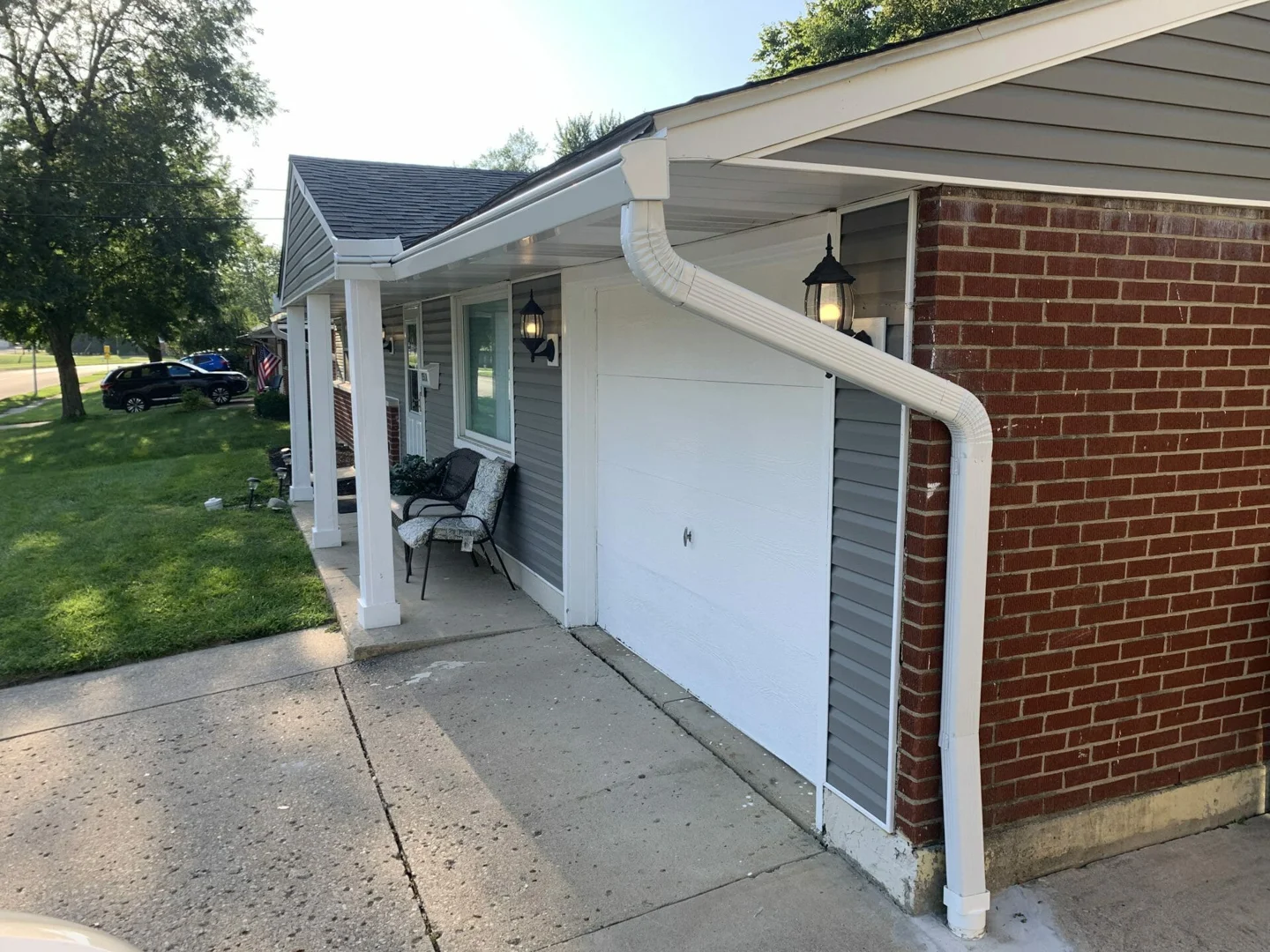
A gutter system is only as good as its downspouts. Downspouts are the vertical pipes that carry water from the gutters down to the ground and away from your foundation. To understand how they fit into the bigger picture, explore The Complete Guide to Gutter Downspouts.
Downspouts come in various shapes and sizes, including round and square profiles. You can learn about the pros and cons of each in our article on the Different Types of Downspouts: Round, Square, and Everything in Between. Choosing the right downspout ensures that water clears the gutter run quickly without backing up.
Aesthetics play a huge role in your home’s curb appeal, too. Modern gutter systems are available in a wide array of colors. Selecting a color like Musket Brown can subtly but powerfully transform the overall look of a house, allowing the gutters to blend into the roofline rather than standing out. For tips on choosing the perfect shade, read Gutter Color Combinations: From Roof to Rain, Make It Pop.
Lifespan, Maintenance, and Warning Signs of Failure
How long do k style gutters last? A standard aluminum gutter can last 20 to 30 years, but only if it is meticulously maintained. Because open gutters collect debris, they require cleaning at least twice a year—more if your Central Ohio property is surrounded by mature trees.
When maintenance is ignored, or when standard open gutters simply reach the end of their lifespan, they will begin to fail. Homeowners must watch for these critical warning signs of gutter failure:
- Fascia Rot: Water overflowing from the back of the gutter directly rots the wooden fascia board behind it.
- Loose Fasteners: Sagging gutters or pulling away from the roofline.
- Staining: Dark water stains on your home’s siding or foundation.
- Soil Erosion: Deep trenches in your landscaping directly beneath the gutters.
Why DIY Gutter Installation and Maintenance Are Dangerous Mistakes
It is incredibly tempting for a handy homeowner to try a DIY gutter installation or attempt to clean their own gutters. However, this is a recipe for disaster.
First, proper gutter installation requires precise calculations. If the slope (or pitch) of the gutter is off by even a fraction of an inch, water will pool in the middle of the run rather than flowing toward the downspouts. This standing water adds immense weight, leading to sagging, loose fasteners, and eventual system collapse. For a look at what the process takes, check out the DIY Guide to Installing Rain Gutters on a House and How to Install Gutters in 7 Easy Steps.
Second, climbing a ladder to clean or repair gutters is one of the most common causes of serious household injuries. Balancing on a ladder while scooping out wet, heavy, rotting leaves is inherently dangerous. When you factor in the cost of tools, safety gear, and the high risk of making a mistake, DIY gutter work simply isn’t worth it. You can read more about the hidden financial and physical risks in Don’t Get Drained: Unpacking the True Cost of New Gutters and Downspouts.
Why Repairing Traditional Gutters Fails (And Why Replacement is the Only Real Solution)
When homeowners notice a leak or a sag, their first instinct is to call a handyman for a quick repair. However, treating the visible symptom of gutter failure without addressing the root cause is a costly mistake.
If your fascia board is already rotted, patching a leak or slapping on a new bracket won’t fix the underlying structural damage. The wood will continue to decay, and the gutter will eventually fall off. Furthermore, a like-for-like swap of standard open gutters fails to solve the chronic issue of clogging. You will still find yourself climbing ladders or paying hundreds of dollars every year for professional cleanings. To understand why a complete system overhaul is often the only permanent fix, read our guide Install and Replace Rain Gutters Like a Pro: The Ultimate Homeowner’s Guide.
The Ultimate Solution: K-Guard Leaf-Free Gutter System
If you are tired of the endless cycle of cleaning, repairing, and worrying about your gutters, there is a better way. The K-Guard Leaf-Free Gutter System is a fully integrated, heavy-duty gutter system designed to eliminate clogging forever.
Unlike standard k style gutters with aftermarket mesh screens or plastic covers slapped on top, K-Guard is built as a single, cohesive unit. It features:
- An Integrated Hood: Utilizing liquid adhesion physics, rainwater flows smoothly over the curved hood and into the gutter, while leaves, twigs, and debris simply slide off the edge and fall to the ground.
- Heavy-Duty Construction: Made of high-strength, non-corrosive aluminum that will never sag or rust.
- A Lifetime Guarantee: We guarantee your gutters will never clog, or we will clean them for free.
- Total Peace of Mind: No more dangerous ladders, no more water damage, and the complete elimination of annual gutter cleaning.
With an average installation cost of approximately $5,000, K-Guard is an investment that pays for itself by protecting your home’s foundation, siding, and landscaping permanently. Discover how this system works by reading Seamlessly Superior: How to Get Heavy Duty Gutters You’ll Never Have to Touch.
Frequently Asked Questions About K-Style Gutters
Why are they called K-style gutters?
They are called “K-style” because their outer profile vaguely resembles the letter “K” when viewed from the side. The decorative, double-curved front face is also known as an ogee profile, designed to mimic the elegant look of interior crown molding along your home’s roofline.
Why are K-style gutter repairs a temporary fix compared to K-Guard?
Standard open gutters require constant maintenance. Small hardware, seals, covers, and basic repair parts for K-style gutters may cost under $10 to $50, but larger assemblies, structural connectors, or specialty parts can easily run from $50 to several hundred dollars. When you add the high cost of professional labor for setup, ladder work, and safety testing, recurring repairs quickly become a money pit. Upgrading to a permanent K-Guard system eliminates these ongoing costs entirely.
Why is upgrading to K-Guard better than buying standard replacement K-style gutters?
When buying standard replacement gutters, you have to carefully match the size, material, rating, and connection types to ensure they can handle local weather loads. Even then, you are still left with an open gutter that will clog. Upgrading to K-Guard gives you a fully engineered, integrated system with a lifetime clogs-free guarantee, making it a much smarter long-term investment for your home.
Conclusion
At K Guard Central Ohio, we believe your home deserves the absolute best protection possible. While standard k style gutters are a step up from older half-round profiles, their open-top design leaves your home vulnerable to water damage, fascia rot, and foundation issues.
Don’t wait for the next heavy Central Ohio storm to find out if your gutters are up to the task. Schedule a professional system evaluation with our team today. Upgrading to the K-Guard Leaf-Free Gutter System permanently protects your home’s foundation, preserves your fascia, and ensures you will never have to climb a dangerous ladder to clean gutters again.
Ready to make the switch? Learn more about why our system is the ultimate choice for Ohio homeowners by visiting Why K-Guard.